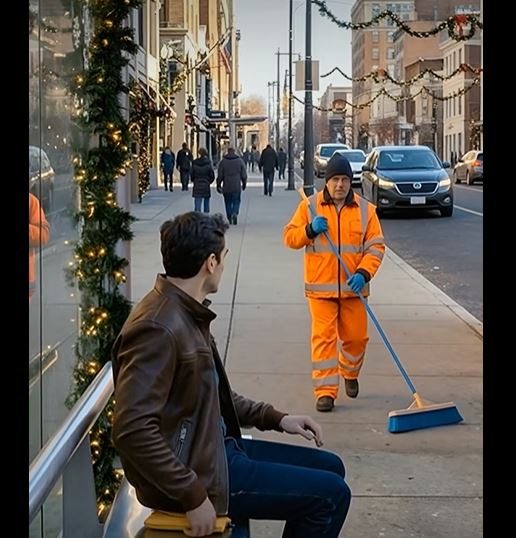
In a world increasingly defined by the speed of its motion and the indifference of its crowds, Elias stood out by standing still. He lived in the heart of a metropolis where “minding one’s own business” was the unwritten law of survival. To look too closely at a stranger was to invite trouble; to intervene was to shoulder a burden that wasn’t yours.
But Elias was built differently. He didn’t view the world as a series of obstacles to navigate, but as a community that was slowly fraying at the edges.
The Moment of Choice
It happened on a Tuesday, under the flickering fluorescent lights of the underground subway station. The air was thick with the scent of ozone and damp concrete. Hundreds of commuters moved in a synchronized, rhythmic blur, their eyes glued to glowing screens, their ears blocked by noise-canceling headphones.
In the center of the platform, an elderly man had collapsed. His groceries were scattered—red apples rolling toward the yellow safety line, a carton of milk leaking across the tile.
People swerved around him like water around a stone in a stream. Some glanced down with a fleeting look of pity before checking their watches; others didn’t even see him at all. They were running for the 5:15 express, and in their minds, a stranger’s crisis was merely a delay.
Elias was also running late. He had a final-round job interview ten blocks away—the kind of opportunity that could pull him out of his cramped studio apartment and change his life. He saw the man. He saw the crowd. And for a split second, he felt the pull of the stream.
Then, he stopped.
The Weight of a Decision
He dropped his briefcase and knelt in the spill of milk.
“Sir? Can you hear me?” Elias asked, placing a steady hand on the man’s shoulder.
The man’s eyes were open but glassy, his breathing shallow. While the rest of the world continued its frantic pace, Elias became an island of calm. He didn’t just call for help; he stayed. He directed a passerby to find a transit officer, used his own coat to prop up the man’s head, and spoke in a low, soothing voice to keep him conscious.
As minutes ticked by, Elias knew his interview was slipping away. He could almost hear the door closing on his future. Yet, as he looked at the man’s weathered face, he realized that “the right thing” isn’t a calculation of profit and loss. It is a fundamental acknowledgment of another person’s humanity.
The Ripple Effect
Something strange happened as Elias sat there. A young woman, seeing him help, stopped to gather the scattered apples. A teenager pulled out a pack of tissues to help clean the milk. The “stream” of indifferent commuters began to break. The sight of one person doing the right thing acted as a permission slip for others to be kind.
By the time the paramedics arrived, four strangers were standing in a circle, guarding the space.
Elias eventually made it to his interview, thirty minutes late and with a milk-stained sleeve. He explained what happened, expecting a cold dismissal. Instead, the hiring manager looked at him with a newfound respect.
“We can teach skills,” the manager said. “We can’t teach character. Most people would have walked past. You chose to stay.”
Why It Matters
The world doesn’t change through massive, cinematic events. It changes through the quiet, inconvenient choices made by individuals who refuse to be indifferent. Doing the right thing often costs something—time, money, or a “perfect” reputation—but it earns something far more valuable: a world that is a little less cold for the rest of us.