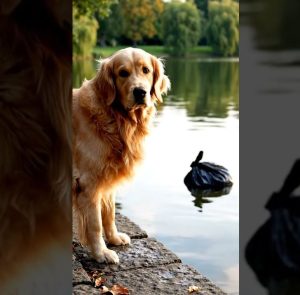
In a world often overwhelmed by news of environmental degradation and rising pollution levels, an unlikely hero has emerged from the suburban streets of a quiet coastal town. He doesn’t wear a cape, and he doesn’t have a badge. Instead, he has a wagging tail, a golden coat that shimmers in the morning sun, and a mouth that seems permanently fixed on a discarded plastic bottle. Meet Barnaby, the four-year-old Golden Retriever who has become a local sensation and a global inspiration for his relentless crusade against litter.
The Spark of an Unlikely Passion
Barnaby’s journey into environmentalism didn’t begin with a training program or a deliberate command. Like most Golden Retrievers, his mouth is his primary tool for interacting with the world. Goldens are “soft-mouthed” by nature, bred originally to retrieve waterfowl for hunters without damaging the birds. However, Barnaby’s owner, Sarah Jenkins, noticed that during their daily walks through the local park, Barnaby wasn’t interested in tennis balls or sticks. He was interested in what humans had left behind.
From that day on, the “game” evolved. Barnaby began to scan the horizon not for squirrels, but for the glint of plastic, the crinkle of snack wrappers, and the discarded remnants of takeaway meals. What started as a quirky habit soon transformed into a full-scale community service project.
The Environmental Impact of a Four-Legged Cleaner
While a dog picking up a piece of trash might seem like a small gesture, the cumulative impact of Barnaby’s work is staggering. On an average three-mile walk, Barnaby retrieves between 15 and 20 items of litter. Over the course of a year, that adds up to over 5,000 pieces of debris removed from the local ecosystem.
Environmental scientists note that the types of litter Barnaby focuses on—plastic bottles and aluminum cans—are among the most harmful to local wildlife. Plastic bottles can take up to 450 years to decompose in a landfill, and even longer in a natural environment where they break down into microplastics that contaminate soil and water. By intercepting these items before they enter storm drains or local waterways, Barnaby is preventing a chain reaction of pollution.
The Science of the “Golden” Drive
Why does Barnaby do it? To understand his motivation, one must look at the specific traits of the Golden Retriever breed. These dogs are famously “biddable,” meaning they have an intense desire to please their owners and complete tasks. They are also highly tactile. For a Golden, carrying something in their mouth provides a sense of purpose and comfort.
Animal behavioralists suggest that Barnaby has associated the act of “retrieving” litter with positive reinforcement. Every time he finds a bottle, he receives praise, a pat on the head, or perhaps a small treat. Over time, the environment itself has become his playground. He has learned to distinguish between “natural” items like sticks (which he usually ignores) and “man-made” items like plastic (which he targets).
A Day in the Life of a Litter Hunter
A typical day for Barnaby starts at 6:30 AM. He waits by the door, not just for his breakfast, but for his “work gear”—a specialized harness equipped with small side pouches where Sarah can store smaller pieces of trash he finds.
As they move through the neighborhood, Barnaby’s nose is constantly to the ground. He has developed an uncanny ability to find trash hidden deep within bushes or submerged in shallow ditches. He has been known to wade into the edges of the local creek to pull out discarded shopping bags.
The most impressive part of his routine? His discernment. Barnaby knows not to pick up anything dangerous, like broken glass or medical waste. Through a combination of instinct and Sarah’s careful supervision, he focuses on the “cleaner” recyclables. Once his “catch” is secured, he carries it with a gentle grip until they reach a public bin or return home to their own recycling station.