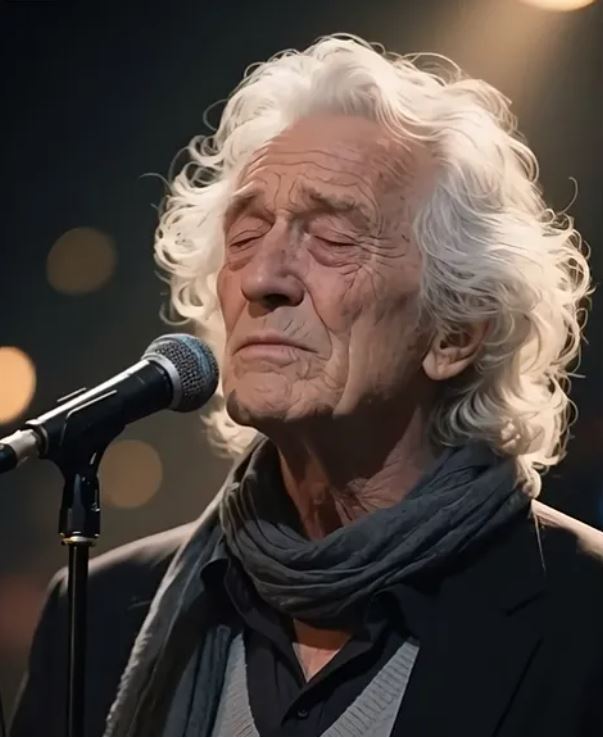
In the heart of the city’s busiest subway terminal, where the air is thick with the scent of ozone and the frantic energy of ten thousand commuters, there was a permanent fixture that most people had learned to treat as part of the architecture. He was known simply as “Old Silas.”

Silas sat on a tattered wool blanket near the entrance to the 4th Street line. He was a man of shadows and worn denim, his face a map of a hard life lived outdoors. For years, he was the invisible man. People stepped over his outstretched legs; they looked past his weathered plastic cup; they ignored his presence with the practiced apathy of the urban soul.
But one rainy Tuesday, the “invisible man” decided to speak. And when he did, the city stopped.
The First Note
It began when a young woman, overwhelmed by the crowd and dropped her groceries, burst into tears. The frantic pace of the station didn’t slow for her. People just swerved around her like water around a stone.
From his corner, Silas didn’t move toward her—he knew his approach might frighten her—but he opened his mouth. He didn’t shout; he didn’t beg. He began to hum. It was a low, resonant vibration that seemed to cut through the screeching of the train brakes and the clatter of high heels.
The hum turned into a song. Silas began to sing an old folk melody, a song about a river that always finds the sea.
The Warmth of a Hidden World
I’ve heard world-class baritones in the finest opera houses, but I have never heard a sound like Silas’s voice. It wasn’t just “good”; it was warm. It felt like a crackling fire in a cold room. It had a texture like worn leather and a depth that seemed to echo from the very center of the earth.
The woman who was crying stopped. She looked up, her eyes wide. A businessman in a three-piece suit, halfway through an angry phone call, lowered his device. A group of teenagers, mid-laugh, fell into a sudden, respectful silence.
As Silas sang, the terminal transformed. The harsh fluorescent lights seemed to soften. The strangers standing in the tunnels weren’t just commuters anymore—they were an audience. Silas sang about loss, about the “scary drives” of the soul, and about the “Golden” moments of grace that keep us alive. He sang as if he were the bus driver of the city’s spirit, navigating them all toward a home they had forgotten.
Why the People Cried
It wasn’t just the beauty of the voice that made people cry; it was the sheer responsibility of it. Here was a man who had every reason to be bitter, every reason to scream at the world that had discarded him. Instead, he was using the only thing he had left—his breath—to comfort the very people who had ignored him for years.
In that moment, the hierarchy of the city collapsed. The “homeless man” was the richest person in the room, and the “successful” commuters realized how spiritually bankrupt they had become in their hurry.
Justice was served in the form of a collective realization: We are only as strong as the people we pretend not to see.
The Unthinkable Response
As Silas finished the final verse, the silence in the terminal was absolute. It lasted for five, ten, fifteen seconds. Then, the unthinkable happened.
Usually, when people give to the homeless, they drop a coin and keep walking, avoiding eye contact. But after Silas sang, a line formed. People weren’t just giving money; they were waiting for their turn to look him in the eye.
A woman handed him her scarf. A young man went to the nearby kiosk, bought a hot meal, and sat down on the floor next to him to eat. The businessman who had been on his phone took off his own coat and draped it over Silas’s shoulders.
“Thank you,” the businessman whispered, his voice cracking. “I haven’t heard my father’s voice in twenty years, but for a second there, I felt like he was standing right next to me.”