
At first glance, it looked like a mess waiting to happen. Open paint jars sat on the floor of a small, sunlit studio, their glossy colors catching the afternoon light. Any cat owner would immediately brace for disaster—paw prints on the couch, splashes on the wall, perhaps even a ruined carpet. But this time, something entirely different unfolded. This cat didn’t knock over the paint. It stepped into it with intention, curiosity, and a strange kind of grace. What followed was not chaos, but creation.
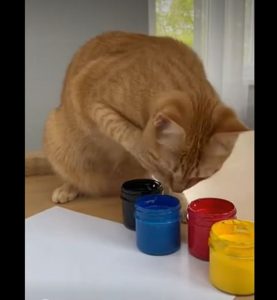
The cat’s name was Milo, a calm gray tabby with alert green eyes and a habit of watching everything as if the world itself were a puzzle to be solved. Milo belonged to a freelance illustrator who often worked from home, surrounded by canvases, brushes, and half-finished ideas. For months, Milo had watched quietly from windowsills and tabletops, observing the slow movements of hands, the dipping of brushes, the transformation of blank white surfaces into something meaningful. While others might have dismissed the cat’s gaze as idle curiosity, Milo was learning.
One afternoon, as the illustrator stepped away to answer a phone call, Milo jumped down from his usual perch. He approached the floor where a large canvas lay flat, surrounded by small trays of non-toxic paint. Blue, yellow, red, and white waited patiently, thick and inviting. Milo sniffed the air, tilted his head, and then did something unexpected. He placed one paw into the blue paint, lifted it, and carefully set it down on the canvas.
The first print was hesitant, almost shy. A single blue mark bloomed against the white background. Milo froze, as if surprised by what he had done. Then, slowly, he placed another paw forward—this time into yellow—and stepped again. Blue met yellow, creating a soft green hue. Without realizing it, Milo had begun to mix colors. The canvas was no longer empty, and the moment was no longer accidental.
What happened next felt less like a coincidence and more like a performance. Milo began to walk across the canvas in gentle arcs, occasionally stepping into different colors, sometimes dragging his tail lightly across the surface. The marks left behind were organic and rhythmic, like a visual echo of movement itself. There was no rush, no panic. Only a cat exploring texture, sensation, and space.
When the illustrator returned, she stopped in the doorway, stunned into silence. Her first instinct was to shout, to save the canvas, to intervene. But something held her back. What she saw was not destruction. It was expression. Milo was not ruining her work—he was creating his own. She quietly picked up her phone and recorded the moment, knowing instinctively that this was something rare.
The video later spread across the internet, captivating millions. Viewers were charmed not just by the novelty of a cat “painting,” but by the calm focus in Milo’s movements. Comments poured in from artists, animal lovers, and skeptics alike. Some called it instinct. Others joked about feline genius. A few debated whether animals could truly make art. But most agreed on one thing: watching Milo create felt oddly moving.
Art, after all, is not always about technique or intention in the human sense. Sometimes it is about presence. About the act of leaving a mark and responding to the world through movement and feeling. Milo did not plan a composition or study color theory, yet the final canvas carried balance, contrast, and flow. The randomness felt deliberate. The simplicity felt honest.
As days passed, the illustrator decided not to clean the canvas or repaint over it. Instead, she framed it. Then she laid out another blank canvas, once again surrounded by paint. This time, she sat nearby and watched. Milo approached more confidently now. He sniffed, stepped, turned, and even paused, as if considering his next move. Each session produced something different—sometimes chaotic, sometimes surprisingly minimal. No two pieces were alike.