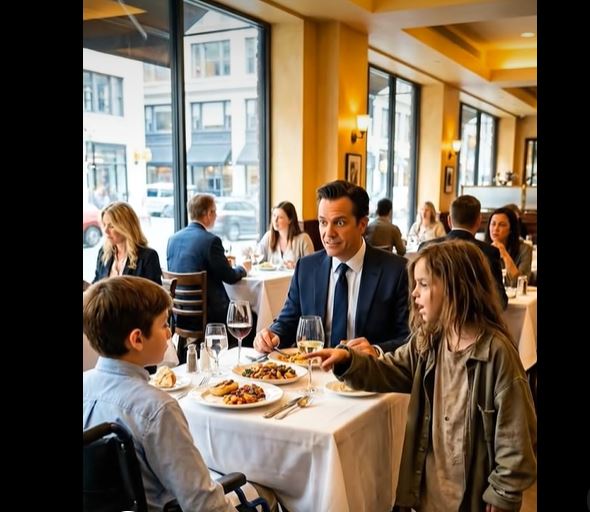
Feed me and I’ll heal your son,” she whispered. The man froze, staring at the strange woman who had appeared at his door just as the sun dipped behind the horizon. His young son lay inside, pale and feverish, his tiny body trembling with weakness. Doctors had tried everything, but the illness stubbornly persisted. Desperation had driven the father to places he would never have imagined, and now, before him, stood someone claiming she could save his child—but at a price so simple, yet so mysterious.
The woman’s eyes were deep and knowing, almost otherworldly. She didn’t demand gold or jewels, nor did she ask for anything material. All she wanted was food—a humble meal, prepared with care and offered without hesitation. The man hesitated. How could a stranger promise such a thing? And yet, as he looked at his son, whose shallow breaths and sunken eyes carved themselves into his heart, he realized that the decision was no longer about logic or reason—it was about hope.
With trembling hands, he brought her a plate. Bread, warm and fragrant, sat alongside a simple bowl of stew. She accepted it silently, her hands moving with deliberate grace as she ate.
There was something mesmerizing in the way she consumed the meal, as if each bite carried a quiet, hidden power. The father watched, equal parts awe and anxiety, feeling the tension in the air thicken with each passing second. He could hardly believe that a child’s fate might hinge on something so ordinary as a plate of food.
When the meal was finished, she rose and placed a hand gently on the boy’s forehead. The fevered skin, burning and unyielding moments before, seemed to soften under her touch.
A warmth spread from her hand, flowing through the boy as though a current of life itself had been restored. The father could hardly breathe as he watched color return to his son’s cheeks, his lips no longer cracked and pale. A faint sigh escaped the boy’s lips, then another, deeper and stronger, and finally, the tremors subsided. He opened his eyes, clear and alert, looking at his father with the confused curiosity of someone waking from a long, dark dream.
The father turned to the woman, words failing him. She simply smiled, a quiet, serene expression that held no boast, no expectation. “Sometimes,” she said softly, “healing is not about medicine alone, but about the care and trust we offer. The meal was a symbol, nothing more—but your belief made the difference.” And with that, she walked into the night, disappearing as quietly as she had appeared.
News of the miraculous recovery spread quickly. Neighbors whispered about the mysterious woman, about the strange, silent ritual that had brought life back to a boy on the brink of despair.
No one could explain it, and many dismissed it as coincidence—but for the father, the memory was etched deeply into his soul. That night, he held his son close, feeling the steady beat of his heart, marveling at the inexplicable power of compassion, trust, and the unexplainable magic that sometimes enters our lives when we least expect it.
In the days that followed, the father often thought of the woman and the simple meal that had changed everything. He realized that miracles often come in the humblest forms, hidden in gestures that seem ordinary, waiting for someone willing to believe. And though he would never see her again, her words stayed with him: sometimes the smallest acts—an offering of food, a hand held, a heart open to possibility—can bring about the most extraordinary outcomes.