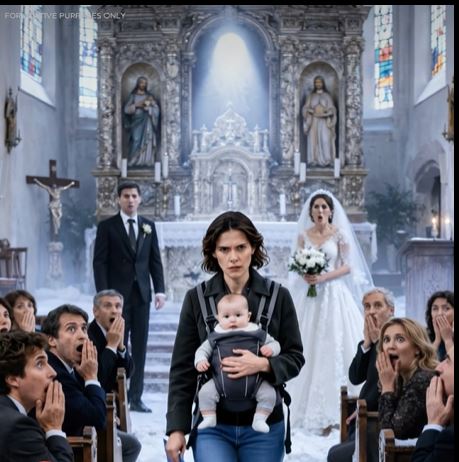
I still remember the day he walked out. It was a late autumn evening, and the wind cut through the apartment like a knife. I had been exhausted, juggling feedings, diaper changes, and the constant anxiety that comes with caring for a newborn. He didn’t even glance at me when he announced he was leaving. No explanation. No goodbye. Just the cold certainty of someone who had already made up his mind. Six weeks later, he was marrying someone else.

I had heard about the wedding through mutual friends, their voices hushed and careful when they relayed the news. I felt something I couldn’t name at first—anger, hurt, disbelief—but mostly a sense of disbelief that anyone could move on so quickly. Everyone said I shouldn’t go, that it would be humiliating or childish. But deep down, I knew I had to. Not to cause drama, not for revenge, but to remind him that I was still here, still strong, and still a force to be reckoned with.
The day of the wedding, I stood across the street from the venue for a moment, taking it all in. The church doors were polished, sunlight glinting off the stained glass, while guests in sleek attire arrived in clusters, chatting and laughing. I smoothed my dress, adjusted my hair, and took a deep breath. I wasn’t walking in as a woman scorned—I was walking in as a mother, a survivor, and a person who refused to be invisible.
As I entered, the soft murmur of the crowd changed subtly. People noticed me, of course—they always do when someone carries themselves with quiet confidence. My eyes locked on him immediately. He was standing at the altar, smiling nervously at the congregation. For a moment, he didn’t recognize me. And then he did.
I could see it in his eyes: confusion, panic, disbelief. The carefully constructed composure he had displayed for six weeks crumbled in seconds. The groom he had chosen to be with, the new life he thought he had moved on to, seemed suddenly fragile. He swallowed hard, looking as if he’d just been punched in the gut.
I walked down the aisle—not fast, not hurriedly, just steadily, every step deliberate. Guests whispered behind me, sensing the tension but unsure of what it meant. Some looked at me with admiration, some with surprise, and a few with judgment. But I didn’t care. All I cared about was the power in that moment: the realization that leaving me had not erased me, nor diminished my strength.
When I reached the front, I stopped a few feet away from him. His bride-to-be looked equally startled, unsure of who I was or why I was standing there. I didn’t speak immediately. I let the silence hang, letting him feel every second of the weight of what he had done. And then I spoke, softly, but firmly:
The ceremony went on, of course. I didn’t ruin it, didn’t scream or throw myself into melodrama. That wasn’t my goal. My presence alone was enough. I stayed to watch, not for him, but for myself. To prove that I could show up, remain composed, and walk away with dignity intact. I was no longer the overwhelmed new mother he had left behind—I was a person who could face heartbreak, rise above it, and demand acknowledgment without begging for it.
Afterwards, people came up to me. Some offered congratulations for my courage, some whispered admiration for my composure, and a few tried awkward small talk. But mostly, I felt a quiet satisfaction: the kind that doesn’t need applause or recognition. He had been forced to see the reality he had abandoned, and I had walked in as proof that leaving me did not erase my presence, my worth, or my future.