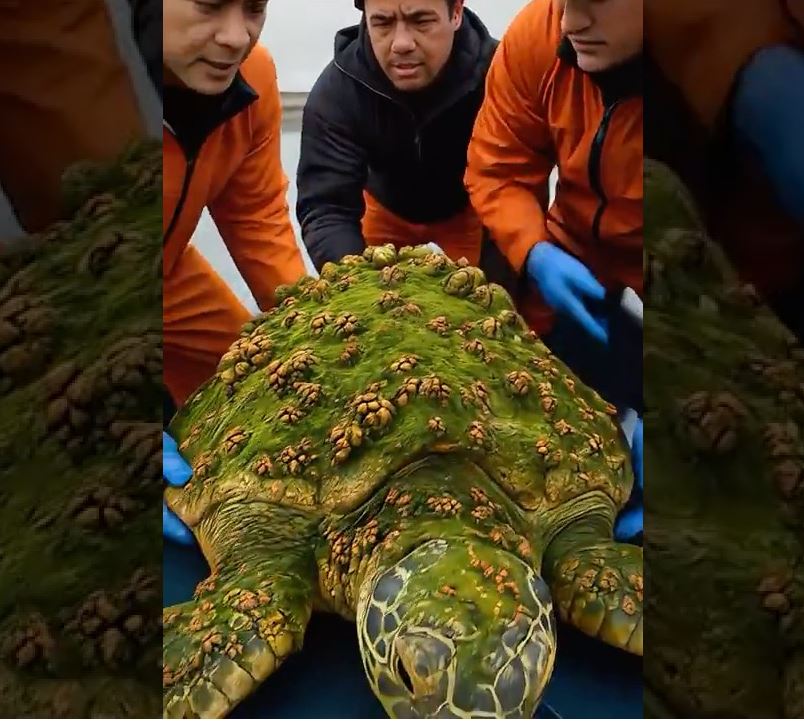
It began on a quiet stretch of beach, where the sun had just begun its slow descent toward the horizon. Waves lapped gently against the shore, and the sky was painted in shades of orange and pink. Volunteers from a local marine conservation group were performing a routine patrol, checking for stranded sea turtles and signs of danger along the coastline. Most days, their work involved gentle guidance—helping hatchlings reach the water or cleaning debris from nests—but today would be far more challenging.
The turtle appeared unexpectedly. Half-buried in sand, its flippers tangled in discarded fishing net, it struggled weakly, its shell scratched and marred from previous encounters with debris. Its breathing was shallow, each movement slow and deliberate, a silent plea for help. The volunteers rushed forward carefully, knowing that improper handling could injure the turtle further, but also aware that time was critical.
The first step was delicate extraction. Using specialized gloves and soft nets, the team worked together to free the turtle from the nylon trap. Its flippers were bound tight, its movements frantic yet sluggish from exhaustion. Every second counted. With a final tug, the turtle was freed, collapsing gently into the sand as if sensing that danger had passed—but the journey to safety was only beginning.
The volunteers transported it to a nearby rehabilitation center, a modest facility with tanks, medical equipment, and dedicated staff trained in marine rescue. Here, the turtle underwent examination. The veterinarians discovered bruised flippers, minor shell cracks, and signs of malnutrition. Over the next several weeks, the turtle—nicknamed Emerald—was treated with fluids, nutrients, and physical therapy for its injured limbs. The process was slow and painstaking, requiring patience from both staff and turtle.
But Emerald’s story did not end with rehabilitation. Release back into the wild posed its own set of challenges. The team carefully monitored tides, currents, and water temperatures to ensure a safe journey. On the morning of release, volunteers carried Emerald to the beach, flippers moving with newfound strength. The turtle paused briefly at the edge of the surf, almost as if acknowledging the humans who had saved it, before plunging into the waves.
The journey continued beyond the beach. Volunteers tracked Emerald using a small, non-invasive GPS tag attached during recovery. Her route was astonishing: strong ocean currents carried her hundreds of miles, past coral reefs, mangroves, and fishing zones. Each day’s data showed careful navigation—avoiding hazards, finding feeding grounds, and gradually regaining the stamina necessary for full independence. Every volunteer and researcher following her progress felt a mix of awe and relief, amazed by the resilience and intelligence of the creature they had saved.
Months later, Emerald’s tracking device confirmed she had reached open waters safely, thriving in her natural habitat. Her journey became a symbol for the local community and beyond—a reminder that even the smallest acts of care, like cutting a turtle free from netting, can set in motion an incredible story of survival. Schools, conservation groups, and online communities shared her story widely, inspiring others to look more closely at the impact humans have on wildlife and the importance of intervention.
From a tangled mess of discarded netting on a quiet beach to the vast, open ocean, Emerald’s journey was remarkable. It illustrated not just the resilience of wildlife but also the dedication and compassion of the humans who chose to act. Each flipper stroke carried her further from danger, but every step of the rescue and rehabilitation carried her closer to hope.
Rescuing a green turtle—watching Emerald navigate her perilous path from near tragedy to freedom—is a story that reminds us all of the profound connection between humans and nature, and the extraordinary outcomes that care, patience, and courage can create.