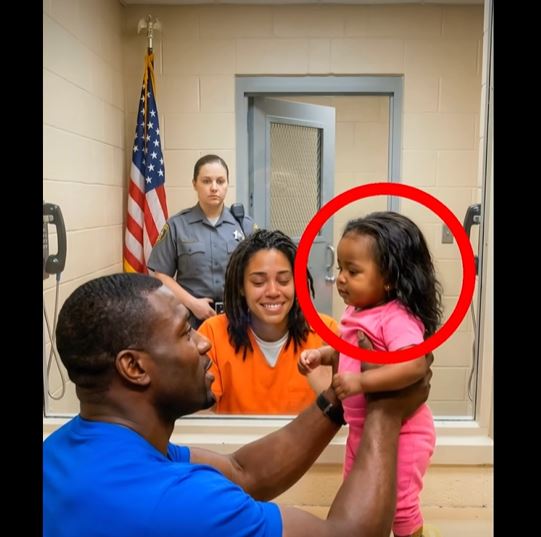
The visitation room was cold, sterile, and unforgiving, the kind of place designed to strip away comfort and enforce rules rather than encourage connection.

Metal chairs lined the walls, spaced precisely apart, and the glass partition that separated families from their loved ones was thick enough to make every word sound distant, distorted, and impersonal. A clock ticked relentlessly on the wall, each second a reminder of the rules that bound the space: time limits, monitored conversations, rigid schedules, and the silent threat of authority if those rules were broken.
It was a Thursday morning, and the air was heavy with tension. Families shuffled in, escorted by guards who barely looked at them, focused instead on ensuring that no one breached protocol. Conversations were whispered, smiles were cautious, and hugs were brief, fleeting, almost rehearsed, because any display that strayed too far from the rules could be stopped immediately.
She was a visitor that day, a mother who had been waiting months for this moment. Her daughter, ten years old, sat across from her, clutching a small stuffed animal and fidgeting nervously. It had been difficult for them both—months of separation had strained their bond, leaving them awkward in each other’s presence, aware of the boundaries imposed by the stark room and the watchful eyes of the guards.
The mother tried to speak, to comfort her daughter, but the conversation felt forced, stiff. “How was school?” she asked, her voice tentative. “Are you… eating okay?”
The daughter nodded, but her eyes were downcast. She wanted to open up, to express her worries and her loneliness, but the walls seemed to swallow words. She fidgeted with the hem of her sleeve, her small hands betraying the tension she tried to hide behind obedience.
Then it happened.
One of the guards, a man who had spent countless hours enforcing rules and correcting behavior, was stationed quietly nearby. He was a man of few words, precise and professional, with a reputation for rigidity. He had always approached his role with exacting adherence to protocol, rarely bending the rules, rarely offering kindness.
That day, he noticed something—the mother’s trembling hand, the daughter’s anxious glance, the silence that spoke volumes. In that brief moment, he chose to act differently. Not loudly, not dramatically, just quietly.
He leaned forward slightly and, in a voice low enough that only the mother and child could hear, said, “You have a minute more. Go ahead.”
It seemed small. In fact, by any official measure, it was nothing at all. But it shattered the invisible barrier of fear and formality that had hung in the room. The mother looked up, startled, meeting the guard’s eyes, and realized he had made a conscious choice to give them a few extra minutes—just enough to breathe, to connect, to feel human.
The mother reached across the table, her hands trembling, and gently took her daughter’s small fingers in hers. The child’s eyes widened in surprise, then softened, the tension melting away just slightly. They began to talk—not in whispers dictated by rules, but in real conversation, sharing stories, laughter, even tears. Words came more easily now, honesty replacing formality, connection replacing fear.
Other families noticed, too. The tension in the room softened slightly, eyes that had been wary met each other with a sense of shared understanding. Staff who had been mechanical in their approach began to see the impact of small acts of kindness, the possibility that rules need not entirely suppress empathy.
By the time the official end of visitation approached, the mother and daughter were holding hands across the table, laughing softly at a story from home, connected in a way that had seemed impossible at the start of the day. The mother leaned close and whispered something that made her daughter giggle, and for the first time in months, the room felt warm rather than cold.