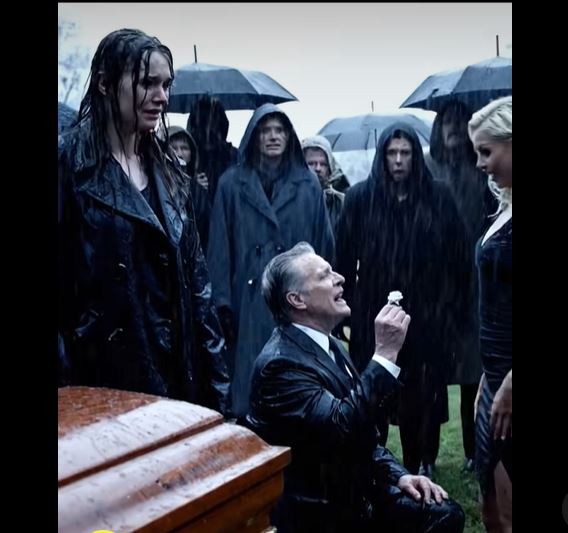
The air was thick with damp fog that morning, settling over the cemetery like a heavy, mournful blanket. The sky was the color of ash, a dull gray that seemed to press down on everyone gathered for the service. Flowers were laid carefully on the grave, some fresh and vibrant, others wilting from being left out in the early winter chill. Mourners huddled together, heads bowed, voices low, as if the silence itself were a sign of respect.
Among them stood Charles Whitmore, a man accustomed to having his way. For decades, he had wielded influence like a weapon, bending people to his will with charm, threats, and cold calculation. In the small town where everyone had grown up together, Charles was both feared and resented, a combination that made him dangerous. Today, he believed he could control even this: the funeral of my father. He had dictated every detail, insisting on the preacher, the seating, the order of eulogies, and even which songs would be played. He thought the ceremony would be a display of his power.
He was wrong.
The service began quietly. The pastor spoke in measured tones, recalling a life full of warmth, humor, and generosity. People wiped tears from their eyes. Charles scanned the crowd, satisfied that everyone was listening, that they were behaving exactly as he expected. But I noticed subtle shifts in the faces around him—whispers, glances exchanged, a barely suppressed smirk here and there. The seeds of rebellion were already sprouting, even as the service proceeded.
When it was time for the eulogies, Charles stepped forward first. He cleared his throat and began to speak in that slow, deliberate way that demanded attention. He praised my father, though the words felt hollow, rehearsed. Every phrase seemed carefully chosen to assert dominance, to remind everyone that he had orchestrated this day. But the more he spoke, the more people looked away from him. Eyes drifted to me, to my siblings, to old friends who had known my father intimately. The words on Charles’s lips rang false.
Finally, it was my turn. I stood, my hands trembling slightly, heart pounding in rhythm with the cold wind that swept through the cemetery. I looked out at the crowd, then directly at Charles. For a moment, the world seemed to hold its breath.
“I knew my father for all his life,” I began, voice steady despite the emotion threatening to break through. “And unlike some people here, I knew him for who he really was—not the version that suits someone else’s story.”
Murmurs ran through the crowd, a mixture of agreement and suppressed laughter. Charles’s expression tightened, his carefully constructed composure beginning to crack. I continued, speaking from memory, from love, and from a quiet anger that had been building for years. I recounted stories that made people smile, laugh, even cry, stories that Charles had tried to erase or rewrite in his version of events. Every anecdote reminded the mourners of my father’s true character—his generosity, his humor, his defiance against people like Charles who sought to control him even in death.
The tension in the air grew unbearable for Charles. He shifted uneasily, whispering under his breath, clearly frustrated that the crowd no longer followed him. My words had stolen the stage, peeling away the illusion of his authority like bark from a tree.
Then my sister stepped forward. She was quieter than me, but no less determined. Her voice was calm and clear as she spoke about the lessons my father had taught us—courage, integrity, the importance of standing up for what is right. She reminded everyone that true power is never about control or intimidation. It is about respect earned through deeds, not fear.
By this point, Charles was nearly shaking. His plan to dominate the ceremony had failed spectacularly. People weren’t just ignoring him—they were celebrating my father’s life exactly as it should have been celebrated, in their own words, their own stories, and with genuine emotion.
Even the pastor, who had initially been an ally to Charles in organizing the event, had turned subtly, nodding along as my family spoke. The tone of the ceremony had shifted completely. What had begun as an orchestrated display of power became a tribute fueled by love, memory, and truth.
The final moment came when we laid my father’s casket into the ground. The sky, previously gray and oppressive, seemed to lighten slightly, as if acknowledging the victory of honesty over manipulation. People placed flowers, shared hugs, and whispered personal goodbyes. The energy in the cemetery had changed from one of submission to one of empowerment.