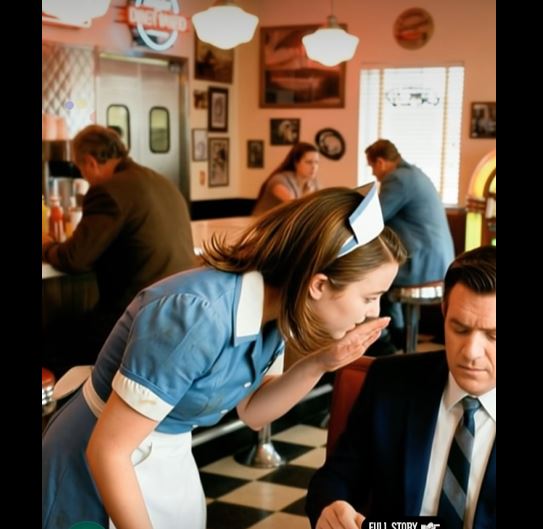
The girl who refilled water glasses before they were empty, memorized complicated orders, and smiled even when customers snapped their fingers instead of saying my name. I wore the same black apron every shift, the same tired sneakers, and the same polite expression that said I belong behind this table, not at it.

My father had raised me to believe that honest work mattered more than titles. He used to say, “You don’t measure a person by where they stand, but by what they build.” Then, one night when I was seventeen, he didn’t come home. A heart attack. Sudden. No warning. No goodbyes.
College dreams were replaced by double shifts. Ambition shrank into rent payments. And my dad’s old briefcase—filled with notebooks and contracts I never understood—ended up buried in the back of my closet, unopened because it hurt too much to touch anything that reminded me of him.
You could feel it before you saw him. The restaurant shifted—managers straightened their backs, servers whispered, and the hostess nervously adjusted her blazer. He wasn’t flashy. No loud laughter. No dramatic entrance. Just a tall man in a tailored suit, calm and controlled, followed by two executives who looked like they lived their lives on deadlines.
I approached with menus, heart steady from years of practice. “Good evening. Welcome. Can I start you with—”
“Sparkling water,” the billionaire said, barely looking up. His voice was smooth, confident, used to being obeyed.
As I poured, I noticed the folder on the table—thick, leather-bound, filled with documents. Business contracts. I tried not to stare, but something about it tugged at me. A familiar logo embossed in the corner.
When I returned later to refill drinks, the folder was open. Pages spread neatly across the table. Charts. Signatures. Legal language I didn’t fully understand—but one name stopped me cold.
The room didn’t spin, but it felt like it should have. I stared at the signature, my dad’s handwriting unmistakable—slanted slightly to the right, firm strokes, confident curves. I had seen that signature a thousand times growing up. On birthday cards. On permission slips. On the last note he ever left me.
The billionaire raised his hand, stopping him. His eyes lifted to meet mine for the first time—sharp, assessing, curious.
The billionaire leaned back slowly, studying me as if I were a puzzle he hadn’t expected. “Your father was a genius,” he said finally. “He designed the framework for this entire acquisition. Without him, this company wouldn’t exist.”
He explained that years ago, my father had been offered a massive buyout—enough to make us unimaginably wealthy. But the deal required cutting corners, exploiting smaller partners, and burying risks under legal language.
My father had refused.
“He said success without integrity wasn’t success at all,” the billionaire said, his voice quieter now. “I thought he was naïve. I was wrong.”
I felt tears burn my eyes, but I didn’t let them fall.
All my life, I had wondered why we struggled. Why he never pushed harder. Why we never “made it.” Now I knew. He hadn’t failed. He had chosen.
He nodded once. “Lena, you shouldn’t be here serving tables.”
I straightened instinctively. “With respect, sir, I work hard.”
“I know,” he said. “That’s why I’m offering you something.”
The next words didn’t sound real.
A position. Training. Full access to the company my father helped build. Not charity—not pity—but opportunity. He said my father had once told him, “If my daughter ever wants to build something, give her the chance I refused.”
I felt like the air had been knocked out of me.
The manager stood frozen nearby, listening in disbelief. The executives exchanged stunned looks.
“I don’t understand,” I whispered. “Why now?”
“Because tonight,” the billionaire said, “I finally met the proof that Daniel Rivera’s legacy didn’t end with him.”
I finished my shift. I cleared tables. I tied my apron with the same hands—but everything felt different. I wasn’t invisible anymore. Not to myself.
Weeks later, I walked into a glass building instead of a restaurant. I wore a badge with my name on it—not as a server, but as an associate. I brought my father’s briefcase with me, finally opened, filled with ideas years ahead of their time.
And sometimes, when I pass by conference rooms filled with powerful people, I think about that girl refilling water glasses.
But the truth had been there all along—written in ink, in integrity, and in a signature that refused to be forgotten.