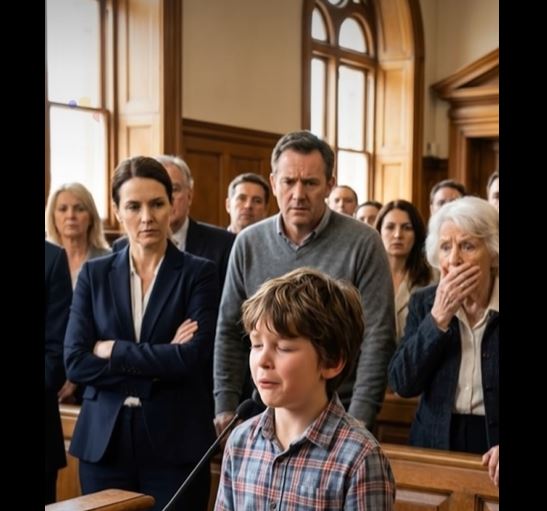
He was seven years old when the social worker brought him to my small house on a rainy Tuesday afternoon. He stood in the doorway with a backpack clutched to his chest, shoes soaked through, eyes fixed on the floor. He didn’t cry. He didn’t ask questions. He didn’t say hello.

“He hasn’t spoken in over two years,” the social worker explained gently. “Doctors say it’s trauma-related. Severe neglect. Possibly abuse.”
I nodded, even though my heart felt too heavy for my chest.
That night, I made spaghetti and sat across from him at the table. I talked about nothing—about the weather, the neighbor’s dog, the smell of rain. Ethan ate quietly, methodically, never once looking up. When he finished, he placed his plate in the sink exactly where he’d seen me put mine.
No words. Not even a sound.
Days turned into weeks. Weeks into months.
Ethan communicated through small gestures. A nod. A shake of the head. Sometimes he would push a crayon toward me if he wanted paper. At night, he lined his shoes up perfectly by the door, as if ready to leave at any moment.
I never pressured him to speak.
I read that forcing words out of a traumatized child was like trying to pull a bird from a closed fist—it only made them retreat further. So instead, I showed up. Every day. I packed his lunch. I sat beside him during homework. I left a nightlight on because I noticed he slept better that way.
Still, the silence remained.
At school, teachers called him “well-behaved but unreachable.” Other kids stopped trying to talk to him. Some whispered that he was “weird.” One boy asked loudly if Ethan was “broken.”
That night, I found Ethan sitting in his closet, knees pulled to his chest.
I sat outside the door and said nothing. I just stayed.
After nearly a year, the state scheduled a permanent placement hearing. Either Ethan would officially become my son, or he would be moved again. Another house. Another adjustment. Another chance to disappear into silence.
The courtroom was cold and too bright. Ethan sat beside me, hands folded tightly in his lap. The judge—a woman with kind eyes and a tired face—flipped through a thick file.
“So,” she said, looking up, “this is the child who hasn’t spoken.”
The words felt sharp, even if she didn’t mean them that way.
She turned to me. “You’re requesting permanent guardianship?”
“Yes,” I said, my voice steady. “If the court allows it.”
The judge nodded, then looked down at Ethan. “Hello, Ethan.”
He didn’t respond.
She waited a moment, then continued gently. “I’ve read your file. I know you’ve had a hard life. And I know adults haven’t always kept you safe.”
My heart pounded.
Then she asked the question no one expected.
“Ethan,” she said softly, leaning forward, “do you feel safe with her?”
The room seemed to stop breathing.
For a long moment, nothing happened. Ethan stared at the floor like he always did. I told myself not to hope. Not to expect. Silence had been his armor for years.
Then his fingers twitched.
He swallowed.
And for the first time since I had known him, Ethan lifted his head.
“Yes.”
The word was barely above a whisper. Thin. Fragile. But unmistakably real.
The sound of it hit me like a wave. My vision blurred instantly. I heard someone inhale sharply behind us. The judge froze, her pen suspended midair.
“Yes,” Ethan repeated, louder this time. His voice cracked, but he didn’t stop. “I feel safe.”
Tears slid down his cheeks, but he didn’t wipe them away. He looked at the judge, then—slowly—at me.
“She stays,” he added. “Even when I don’t talk.”
I couldn’t breathe.
The judge removed her glasses, blinking rapidly. “Thank you, Ethan,” she said quietly. “That was very brave.”
The ruling took less than five minutes.
Permanent guardianship granted.
As we left the courtroom, Ethan slipped his hand into mine. It was the first time he’d ever done that without prompting.
That night, I tucked him into bed like always. I turned on the nightlight. I started to leave the room when I heard it.
“Will you… stay?”
I turned around, heart pounding.
“Of course,” I said, sitting back down.
He stared at the ceiling, voice barely steady. “I didn’t talk because… when I did before, bad things happened.”
Ethan didn’t suddenly become chatty. He didn’t wake up the next day healed. Some days, words still felt too heavy. On those days, we went back to gestures, drawings, quiet understanding.