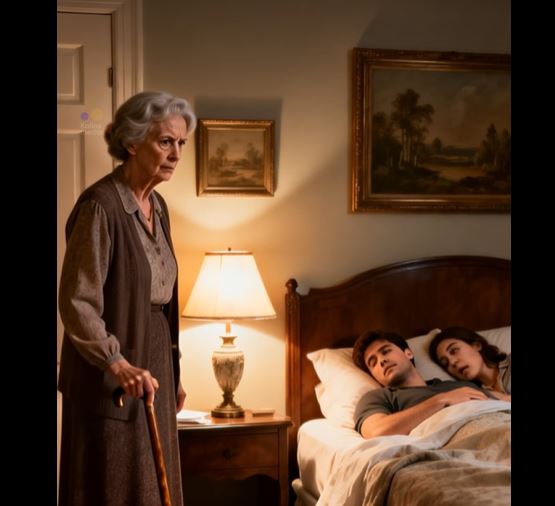
For nearly two years, the house had carried a quiet tension that never fully disappeared. It wasn’t loud arguments or slammed doors—those would have been easier to face. Instead, it was the silence, the polite smiles, the carefully chosen words that never quite said what anyone was feeling. Elena felt it every morning when she stepped into the kitchen and sensed her mother-in-law’s presence before she even spoke.

Maria had been a widow for ten years, strong-willed and proud, a woman who believed discipline and routine were the backbone of a good family. She woke up at dawn, prepared breakfast by habit, and believed that a well-run home reflected respect for everyone inside it. Elena, on the other hand, was different. She was gentle, quiet, and often overwhelmed. She loved Maria’s son deeply, but living under the same roof as his mother had never been part of the plan—until finances and circumstances made it unavoidable.
Their conflict had never been openly declared, but it lived in small moments. The way Maria corrected how Elena folded laundry. The way Elena avoided the living room when Maria was there. The way breakfast sometimes felt like a test Elena didn’t know she was taking.
That morning, the house was unusually quiet.
Maria woke at her usual time, just before six. She moved through the kitchen with practiced ease, placing the kettle on the stove and opening the curtains to let in the pale morning light. She expected to hear Elena’s footsteps soon after—Elena normally woke early to prepare for work, even when she was exhausted.
But the minutes passed.
Six-thirty came and went. The kettle boiled dry. Still no sound from upstairs.
Maria frowned. Her first instinct was irritation. Oversleeping, in her mind, was carelessness. Responsibility mattered. Especially in a shared home. She set the kettle back on the stove and glanced at the staircase.
“Unbelievable,” she muttered under her breath.
At seven, Maria’s irritation hardened into judgment. She imagined Elena sleeping peacefully while the rest of the house moved on without her. The thought stirred all the frustrations she had never voiced—the feeling that Elena didn’t appreciate structure, that she took too much space without fully contributing.
Finally, Maria climbed the stairs.
She paused outside Elena’s bedroom door, hand raised to knock sharply. But something stopped her. The door was slightly open, and the room beyond was unusually still. No alarm ringing. No movement.
She knocked once, softly. No response.
“Elena?” she called.
Still nothing.
A flicker of unease replaced Maria’s irritation. She pushed the door open.
Elena lay curled on the bed, fully dressed, her face pale, dark circles beneath her eyes. Her hair was damp with sweat, and her breathing was shallow and uneven. One arm rested awkwardly over her stomach, fingers clenched as if holding onto pain.
She stepped closer, noticing details she had never truly looked for before. The unopened medicine on the nightstand. The folded work uniform untouched. The phone, dead, with several missed alarms on the screen.
She was burning with fever.
Elena stirred slightly, her lips moving without sound. Maria leaned closer and heard a faint whisper. “I’m sorry… I tried to wake up.”
The words landed harder than Maria expected.
In that moment, something shifted.
Maria sat down on the edge of the bed, memories rising uninvited—of herself as a young daughter-in-law decades earlier, living with her own mother-in-law, struggling silently through exhaustion, never daring to complain. She remembered how much she had wanted someone to notice before she broke.
She had sworn she would never be that woman.
And yet, here she was.
Maria gently shook Elena awake. “You’re sick,” she said firmly, but without anger. “Why didn’t you say anything?”
Elena opened her eyes, panic flashing across her face. “I didn’t want to cause problems,” she murmured. “You already think I’m lazy.”
The words pierced straight through Maria’s chest.
“I never said that,” Maria replied automatically—then stopped. She realized how little that mattered if Elena had felt it every day.
“You’re not lazy,” Maria said again, more slowly this time. “You’re exhausted.”
Tears slid silently down Elena’s temples. “I didn’t want you to be disappointed.”
Maria stood up abruptly and left the room. Elena feared the worst, her chest tightening with shame. She braced herself for criticism, for the quiet disappointment she had grown used to.
But Maria returned minutes later with a damp cloth, a thermometer, and a glass of water.
“Drink,” she said, supporting Elena’s shoulders as she helped her sit up. “You’re staying home today. I’ll call your workplace.”