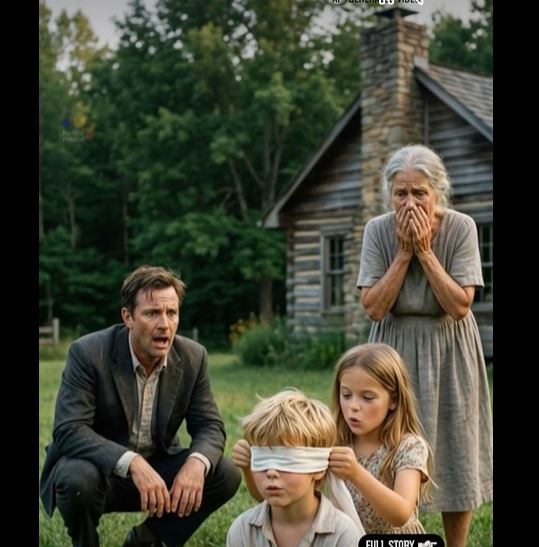
The cabin sat at the edge of the forest, far from the nearest town, where the only sounds were the rustling of leaves, the distant call of birds, and the occasional crackle of the fireplace. From the outside, it looked modest—a small, weathered structure with smoke curling from the chimney, surrounded by towering pines. But to anyone who visited, it promised an experience that went far beyond its appearance.
I arrived on a brisk Monday morning, my car loaded with supplies, books, and a sense of anticipation. People had warned me about going alone. “It’s too remote,” they said. “You’ll get bored or lonely.” Some even chuckled when I mentioned it in casual conversations, imagining a solitary week of staring at walls and talking to myself. They pictured me as idle, perhaps weak, incapable of enduring the quiet. I didn’t tell them my reasons for seeking solitude, but I knew what they assumed: I was escaping, or perhaps hiding.
The first day was deceptively simple. I unpacked, organized my small kitchen, lit the fire, and prepared a modest lunch. Outside, the sun filtered through the canopy, painting the forest floor in dappled gold. At first, I felt the tension of expectations pressing against me—the idea that I needed to “do something” to prove my worth, even in the emptiness of the woods.
By the second day, those assumptions began to crumble. I woke early to the sound of birdsong, brewed coffee, and stepped outside with a notebook. I began sketching the forest, capturing the intricate patterns of bark and leaves, the way sunlight danced across moss-covered rocks. People had assumed I would be idle, but I was anything but. Each moment became intentional—an exercise in observation, reflection, and creativity.
By midweek, I had constructed a small routine that balanced physical labor, mental engagement, and relaxation. I chopped wood for the fireplace, repaired a leaky section of the roof, and explored hidden trails that led to a nearby creek. I had anticipated solitude would feel oppressive, but instead, it became liberating. My mind cleared, my energy returned, and the forest became a companion rather than a backdrop.
The turning point came unexpectedly on Thursday afternoon. I had heard movement near the creek—a rustle, a splash—and assumed it was a deer or a fox. But when I approached, I discovered a small, injured fawn caught in a tangle of branches. Its eyes were wide with fear, its leg bent awkwardly. I could have panicked. I could have called for help and left the rest to professionals. But instead, I knelt carefully and freed it, supporting its leg until it could stand. I watched as it limped back into the forest, glancing once toward me as if to say thank you.
That moment encapsulated what the week had become: a test of patience, kindness, and resourcefulness that nobody could have predicted. The neighbors and friends who had doubted me assumed I was fragile, unprepared, and dependent. They imagined a week of inactivity. Yet here I was, making decisions that mattered, saving a life, and learning about my own resilience.
The evenings were the most transformative. I lit candles, prepared simple meals, and journaled about my experiences. Without distractions, I reflected on choices I had postponed, dreams I had ignored, and relationships I had taken for granted. The quietness forced introspection, and with it came a clarity that no city noise could have offered. By Friday, I felt not just rested but fundamentally changed.
Word of my week eventually reached a few friends and distant relatives. They assumed I had spent it languishing, perhaps anxious and lonely. When I recounted my experiences—how I repaired the cabin, helped the fawn, explored hidden parts of the forest, and rediscovered my creativity—they were astonished. Some expressed genuine surprise, unable to reconcile their assumptions with reality.
The week concluded on Sunday, with a quiet walk at dawn along a ridge that overlooked the valley. The sky glowed pink and gold, mist rising from the river below. I felt a profound sense of accomplishment, not from external validation, but from proving to myself that the assumptions others made about me—about my abilities, my endurance, my resourcefulness—were entirely misplaced.
When I returned home, I noticed subtle changes in how people treated me. There was curiosity, respect, and a quiet acknowledgment that I was not the person they thought I was. They had expected weakness; they found strength. They had imagined idleness; they found initiative. And most importantly, I found the confidence to trust myself, even when the world doubted me.