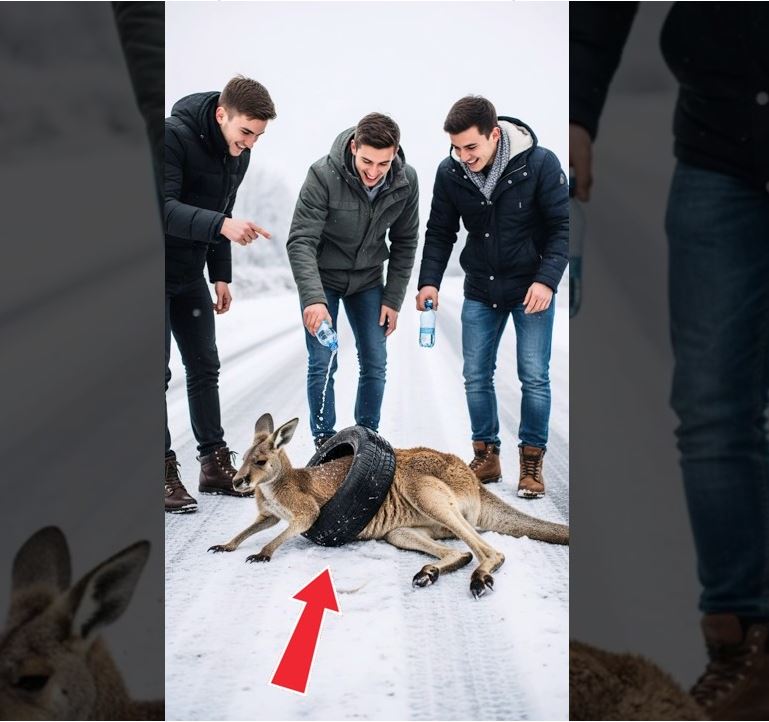
The road cutting through the edge of the Australian outback was the kind most people sped through without a second thought. Long, empty stretches of red earth, scattered gum trees, and the constant hum of tires on asphalt made it feel endless. For Mark, a middle-aged wildlife volunteer who often traveled these routes, the silence was familiar and comforting. He had learned that in places like this, quiet didn’t mean nothing was happening—it meant you had to pay closer attention.
It was late afternoon when he noticed something unusual near the roadside. At first, it looked like a dark bundle lying still in the shade of a tree. Roadkill wasn’t uncommon in this region, especially at dusk. Mark slowed his vehicle, something he did almost instinctively. As he got closer, he realized the shape was wrong. Too upright. Too deliberate.
The animal was sitting awkwardly, its long tail stretched stiff behind it, its head lowered. One of its legs appeared twisted at an unnatural angle. The kangaroo didn’t flee when the car stopped nearby, which immediately told Mark something was seriously wrong. Healthy kangaroos don’t wait around for humans. They bolt.
Mark parked a safe distance away and stepped out slowly, careful not to startle the animal. He spoke softly, not because he expected the kangaroo to understand his words, but because calm had a way of carrying through tone. The kangaroo lifted its head slightly, eyes wide but exhausted, chest rising and falling unevenly.
As Mark moved closer, he noticed something else that made his stomach tighten. A small joey was tucked into the pouch, its tiny face barely visible, clinging instinctively to its mother. The adult kangaroo wasn’t just injured—it was fighting to stay upright for its baby.
Mark knelt down several meters away and assessed the situation. There were no obvious signs of blood, but the leg injury looked severe, possibly caused by a vehicle. The kangaroo’s breathing was labored, and its body trembled with fatigue. Calling a wildlife rescue was the right thing to do, but Mark knew response times in remote areas could be long. Too long.
He removed his jacket and placed it gently on the ground, inching it closer without making sudden movements. The kangaroo watched every motion but didn’t move away. That alone spoke volumes. Wild animals don’t surrender their space unless they have no choice.
Using slow, deliberate motions, Mark positioned the jacket near the kangaroo’s injured side, creating a soft barrier between her and the cold ground. He backed away slightly, giving her space, then called the nearest wildlife rescue center. As expected, they confirmed help was on the way—but it would take at least an hour.
The sun dipped lower, and the temperature began to drop. Mark stayed nearby, not too close, not too far. He shielded the kangaroo from passing traffic using his vehicle and hazard lights, ensuring no one came too close. Each time a car passed, the kangaroo flinched, but she never tried to flee. Her strength was spent on staying conscious and protecting the joey.
At one point, the joey shifted in the pouch, letting out a faint sound. The mother responded instantly, lifting her head despite the pain. Mark felt a tightness in his chest at the sight. There was something profoundly humbling about witnessing that kind of devotion in silence, without spectacle.
When the rescue team finally arrived, they moved with practiced care. They praised Mark for staying calm and doing exactly what was needed—nothing more, nothing less. The kangaroo was gently sedated to prevent further injury, and the joey was carefully checked. Miraculously, the baby was unharmed.
As they lifted the kangaroo onto a stretcher, one of the rescuers explained that the leg injury was serious but treatable. With surgery and rehabilitation, there was a good chance she would walk—and hop—again. The joey would stay with her throughout recovery, ensuring minimal stress for both.
One morning, Mark received a call from the rescue center. The kangaroo had survived surgery. The leg was healing well, and the joey was thriving. They planned to release them back into the wild once rehabilitation was complete. The rescuer on the phone mentioned something that stuck with him.
Months later, he attended the release quietly, standing back as the gate opened. The kangaroo hesitated for just a moment before bounding forward, stronger now, her movements cautious but confident. The joey peeked out from the pouch, alive and curious. Within seconds, they disappeared into the bush, swallowed by the vastness of their world.