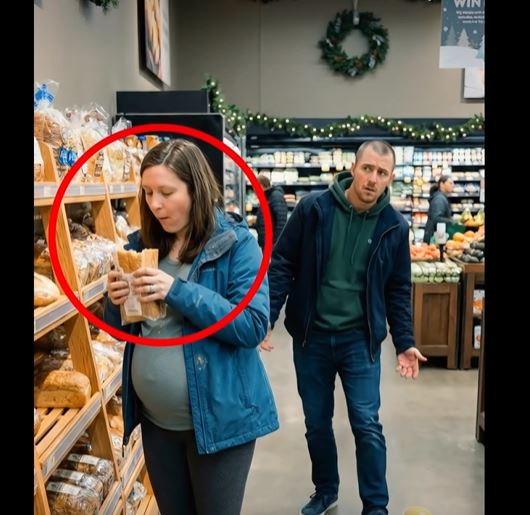
The mall was already crowded when she stepped through the revolving doors, the kind of crowded that made people impatient and distracted. Holiday lights blinked overhead, music played softly through hidden speakers, and the smell of coffee and baked pretzels lingered in the air. Most shoppers moved quickly, focused on their lists and their phones. Almost no one noticed the woman at first.
She stood just inside the entrance, clutching a worn canvas bag to her chest, her shoulders slightly hunched as if she were trying to take up less space. Her coat was too thin for the season, the sleeves frayed at the cuffs. Her hair was pulled back hastily, and there were dark circles beneath her eyes that told a story of sleepless nights. She looked around slowly, unsure, as though she were bracing herself for something unpleasant.
A few glances lingered too long. A couple whispered. One woman subtly pulled her child closer. The unspoken assumption hung in the air, heavy and unfair. She didn’t look like she belonged, and that alone made her suspect.
His name was Marcus, and he had worked mall security for nearly twelve years. In that time, he had learned one important truth: people often judged a situation within seconds, and they were usually wrong. He had seen teenagers labeled as troublemakers who were just bored, elderly men mistaken for drifters when they were waiting for rides, and struggling parents treated like criminals for mistakes anyone could make.
From his post near the entrance, Marcus watched the woman carefully—not with suspicion, but with attention. She wasn’t pacing aggressively. She wasn’t scanning stores nervously. She wasn’t bothering anyone. She simply stood there, breathing shallowly, eyes darting as if she were overwhelmed by the noise and movement.
He approached slowly, deliberately, making sure his posture was open and non-threatening. He knew the uniform alone could intimidate people, especially those already carrying fear.
“Ma’am,” he said gently, stopping a few feet away. “You okay?”
The woman startled, gripping her bag tighter. For a moment, panic flashed across her face, the kind that came from someone who had learned to expect the worst from authority figures.
“There’s a bench over there,” he said, nodding toward a quieter corner near a potted plant. “It’s a little less noisy. You’re welcome to sit if you want.”
She hesitated, then nodded slowly. He walked beside her—not ahead, not behind—matching her pace. When they reached the bench, she sat down heavily, as though her legs had been holding her upright through sheer will.
That was when the tears finally spilled over. She covered her face with trembling hands, shoulders shaking as years of exhaustion and restraint came pouring out. Shoppers walked by, some glancing briefly, most ignoring the scene entirely.
“I lost my job two months ago,” she said between sobs. “Then my apartment. I’ve been staying wherever I can. Shelters are full. Today was just… really hard.”
She explained how she had come to the mall not to steal or beg, but because it was warm and public, because she felt safer there than on the street. She told him about her daughter, staying temporarily with a friend in another city. About how she sent messages she couldn’t afford to send, pretending everything was okay.
“I don’t want people to think I’m a bad person,” she said softly. “I just ran out of options.”
Marcus listened without interrupting, without judgment. When she finished, he nodded slowly.
He told her about a local outreach center that partnered with the mall during the winter months. He explained where it was, who to ask for, what services they offered. He offered to call them to check for space before she went. He even brought her a cup of hot water from the café nearby and asked the barista to add a tea bag.
From across the atrium, the woman caught his eye. She stood up straighter now, holding the warm cup between her hands. She gave him a small, grateful smile—one that carried relief, disbelief, and hope all at once.
That day, dozens of people walked past her and saw only what they expected to see. One man chose to see something else.
Instead of judging her, the security guard chose compassion—and in doing so, reminded everyone, whether they noticed or not, that kindness doesn’t require authority, approval, or perfection. It only requires the willingness to pause, look closer, and treat another human being like they matter.