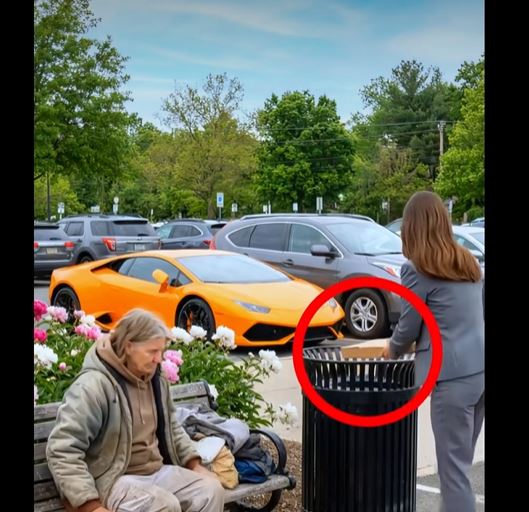
The pizza box lay half-open beside the trash bin, its greasy cardboard darkened by the cold night air. It had been placed there carefully, not thrown, as if whoever left it hesitated at the last moment. Inside were a few slices—uneven, crusts hard, cheese congealed—but still edible. To most people walking past, it was invisible. Just another forgotten thing on the sidewalk. But to her, it was food.
She paused for a moment, glancing around the dimly lit parking lot. Cars passed in the distance, engines humming, headlights sweeping briefly across the concrete. Her stomach tightened—not just from hunger, but from the familiar fear of being seen. She had learned to move quickly, quietly, to avoid eye contact, to exist between moments when no one was looking.
A few steps away, another woman had just finished loading groceries into her car. She was tired, her day stretched long with errands, work emails, and the kind of small stresses that pile up unnoticed. She shut the trunk and turned, keys in hand, already thinking about what to cook for dinner. That was when she saw it.
At first, her brain resisted the image. It didn’t fit neatly into her world. A woman standing by the trash, hesitating over leftover pizza—it felt unreal, like something from a story she’d scroll past online. But this wasn’t a screen. This was happening right in front of her.
The hungry woman lifted a slice, her fingers trembling slightly. She wasn’t careless; she inspected it, brushed off a bit of dust from the crust. Shame burned quietly behind her eyes, but hunger was louder. Hunger always won.
In that instant, a thousand thoughts raced through her mind. Should she say something? Would that embarrass her? Was it even her place to interfere? The easy choice—the one most people made without realizing it—was to look away. Pretend she hadn’t noticed. Get in the car. Go home.
But then the hungry woman caught her reflection in the dark window of a nearby shop. She flinched, expecting judgment, maybe a sharp word, maybe laughter. Her shoulders tensed, ready to defend herself or flee.
“I’m sorry,” she said. “I don’t want to make you uncomfortable. I just… please don’t eat that.”
Silence stretched between them, thick and awkward. The hungry woman’s first instinct was anger. Who was this stranger to tell her what she could or couldn’t do? Did she think she enjoyed this? Did she think this was a choice?
The hungry woman stood there, confused, embarrassed, and suddenly unsure. Her grip on the pizza loosened. She considered running, disappearing into the night like she always did. But something about the tone—gentle, almost nervous—made her wait.
The other woman opened the trunk again and pulled out a reusable grocery bag. Then another. She paused, thinking, and added a third. She walked back slowly, deliberately, as if afraid to startle a wounded animal.
When she reached the trash bin, she didn’t look at the pizza. She didn’t look at the woman’s clothes, her hands, her face. Instead, she placed the bags on the ground between them.
“There’s food here,” she said quietly. “Fresh stuff. Nothing fancy, but… it’s yours. All of it.”
The hungry woman stared at the bags, not moving. The smell of bread, fruit, and something warm—maybe rotisserie chicken—rose into the air. Her throat tightened painfully.
Tears came without warning. Not dramatic sobs, just silent streams carving paths down a face that had learned to stay composed. It wasn’t just the food. It was the way the woman spoke to her—not with pity, not with disgust, but with respect. As if she mattered.
“Thank you,” the hungry woman replied, her voice steadier now. “For seeing me.”
The other woman nodded once, then got into her car and drove away.
Later that night, sitting on a park bench under a flickering streetlight, the hungry woman ate slowly. Not because she had to ration—though she was used to that—but because she wanted to savor the feeling. The warmth of real food. The unfamiliar weight of fullness. The memory of kindness that hadn’t asked for anything in return.
Elsewhere, in a quiet kitchen, the other woman unpacked what groceries she had left. She realized she would need to improvise dinner. She smiled to herself, surprised by how light she felt.
Because sometimes, kindness isn’t loud. It doesn’t announce itself or demand recognition. Sometimes, it’s just a pause. A decision not to look away. A choice to protect someone’s dignity when they’re at their most vulnerable.