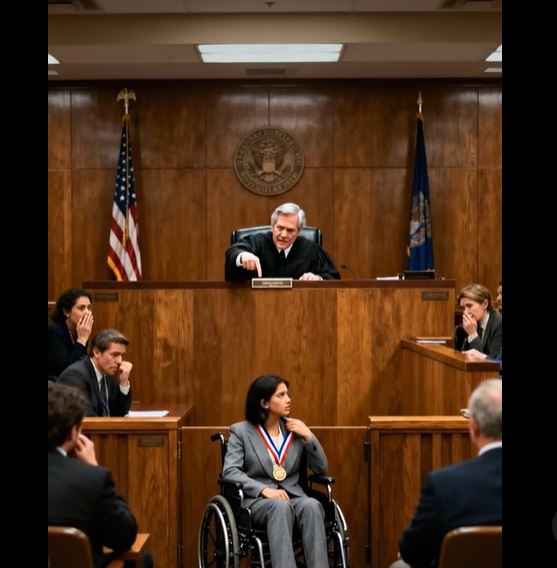
The courtroom was colder than it needed to be, the kind of chill that seeped into your bones and made people sit straighter than usual. Wooden benches creaked softly as observers shifted their weight, and the smell of old paper and polished floors hung in the air. For most people present that morning, it was just another routine hearing.
For her, it was something else entirely.
She sat quietly at the defense table, hands folded, posture calm, eyes focused straight ahead. Her suit was simple—dark, well-fitted, unremarkable. No jewelry except a small watch on her wrist. No dramatic gestures. No attempt to draw attention.
She had learned long ago that power didn’t need to announce itself.
Across the room, the opposing attorney stood with confidence bordering on arrogance. He was well-known in the county—loud, aggressive, and fond of theatrical performances. He thrived on moments like this, on the feeling of control that came from dominating a room.
And he believed he had it.
The case itself seemed straightforward on the surface: a civil dispute involving financial misconduct, forged documents, and alleged misrepresentation. His client, a large corporation, claimed they had been deceived by an “independent consultant” who had exaggerated credentials and falsified reports.
That consultant was the woman sitting quietly at the table.
The attorney cleared his throat and began pacing slowly as he addressed the judge.
“Your Honor,” he said loudly, gesturing toward her without looking directly at her, “this case is about deception. About someone who built an entire career on lies.”
She didn’t flinch.
“This woman,” he continued, his voice sharp, “presented herself as an expert. A professional. But when you strip away the titles she gave herself, what you’re left with is a fraud.”
A murmur rippled through the gallery.
The word hung in the air—fraud—heavy and deliberate.
He turned then, finally facing her, a thin smile playing on his lips. “She wants this court to believe she’s credible. That she deserves to be taken seriously.”
He shook his head, scoffing. “But credentials can be printed. Reports can be copied. And confidence can be faked.”
Her attorney shifted slightly beside her, jaw tightening, but she gently raised a hand, signaling him to wait.
The judge watched carefully, expression unreadable.
The attorney went on, emboldened by the silence. “We will show that this woman has no real authority, no legitimate standing, and no place presenting herself as anything other than what she is—a professional impersonator.”
He paused for effect, then added, “A fraud, Your Honor.”
Still, she said nothing.
Not because she was intimidated.
But because she knew exactly what was coming next.
When the attorney finished, he returned to his seat with visible satisfaction, straightening his tie as if he’d just delivered a winning blow. He avoided her gaze entirely, already convinced the narrative was his.
The judge nodded slowly. “Defense,” he said, “you may respond.”
Her attorney stood—but before he could speak, she rose from her chair.
“Your Honor,” she said calmly, her voice steady and clear, “with the court’s permission, I’d like to address a few points directly.”
The judge studied her for a moment, then nodded. “You may.”
She stepped forward, hands still relaxed at her sides. When she spoke again, the room felt quieter, as if everyone leaned in without realizing it.
“I’ve been called many things in my career,” she said. “Some accurate. Some not. But ‘fraud’ is a serious accusation, and it deserves a serious response.”
She turned slightly, not toward the attorney, but toward the judge.
“I didn’t fabricate my credentials. I didn’t exaggerate my experience. And I certainly didn’t misrepresent my authority.”
She reached into her folder and placed a document on the table.
“This is my professional license,” she continued. “Issued twenty years ago. Still active.”
Another document followed.
“These are my certifications. Verified. Up to date.”
Another.
“And these,” she said, her tone unchanged, “are court records from previous cases in which I testified as an expert witness. Federal cases. State cases. Some of which,” she added gently, “set legal precedent.”
A subtle shift moved through the courtroom.
The attorney’s confident posture faltered just slightly.
She finally turned to face him.
“You accused me of printing titles,” she said. “Of copying reports.”
She paused, meeting his eyes for the first time.
“Did you read the authorship on the documents you submitted as evidence?”
He frowned. “Of course.”
“Did you notice the name listed as the original author?” she asked.
He hesitated. Just for a second.
Then she said it.