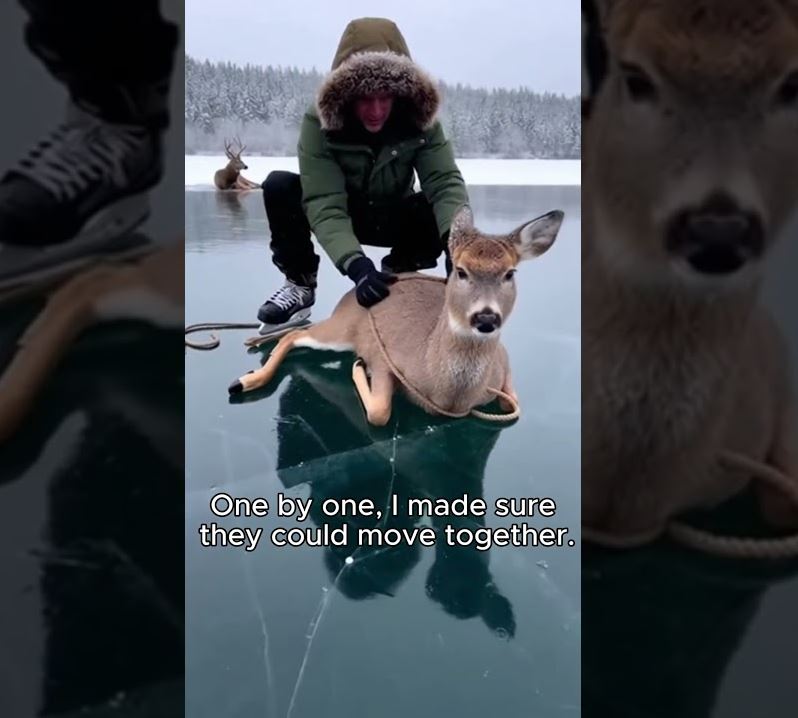
The lake had frozen early that winter, earlier than anyone in the small northern town could remember. A thin layer of snow dusted the surface, disguising patches of ice that were still fragile beneath.
To the untrained eye, it looked solid and harmless, like a wide white field stretching calmly between the trees. For the deer that wandered near it every winter, the lake had always been a shortcut—a familiar crossing that saved time and energy during the coldest months. But this year, the ice was deceptive, and one quiet morning, that familiarity turned into danger.
It started with a doe and her two young fawns. Hunger had pushed them closer to the lake’s edge, where sparse shrubs poked through the snow. The mother stepped carefully, testing the ground as she always did, her instincts alert but calm. The first few steps across the ice held firm, and soon the fawns followed, their smaller hooves tapping lightly as they tried to keep close to her side. For a brief moment, everything seemed fine. Then came a sharp crack—loud enough to echo across the frozen surface—and the ice beneath one of the fawns gave way.
The sound startled the entire family. The fawn slipped, its legs scrambling wildly as icy water surged up around its chest. The doe rushed back instantly, panic replacing her cautious calm. She nudged and pushed, trying to help her struggling baby find solid footing, but every movement weakened the ice further. Within seconds, another section collapsed, and the doe herself plunged in, the freezing water stealing her breath. The second fawn stood frozen in fear, trapped between instinct to flee and the terror of leaving its family behind.
From the shore, a man walking his dog heard the cracking ice and looked up. What he saw made his stomach drop. Three deer were trapped on the lake, flailing in the freezing water, their movements frantic and uncoordinated. The dog began barking, sensing the urgency, while the man pulled out his phone with shaking hands and called emergency services. He knew better than to rush onto the ice himself—doing so would only add another life to the danger—but standing there helpless felt unbearable.
As minutes passed, the situation grew worse. The doe tried to keep her head above water while nudging the fawn closer to the remaining ice. Her movements were slowing, the cold sapping her strength. The trapped fawn’s cries echoed across the lake, sharp and desperate, while the second fawn paced near the edge, slipping occasionally and barely managing to stay upright. Every second mattered, and the lake offered no mercy.
Soon, a small group of people gathered on the shore, drawn by the noise and the growing tension in the air. Among them were local firefighters and wildlife officers, who arrived with ropes, ladders, and flotation equipment. They worked quickly but carefully, fully aware that one wrong step could send them into the same freezing water. The lake ice groaned under pressure, reminding everyone how thin and unstable it was.
One firefighter lay flat on his stomach, inching forward on a ladder pushed out over the ice to distribute his weight. Another secured a rope around his waist, while a wildlife officer prepared a large rescue net. The plan was simple but risky: reach the doe first, secure her, then help the fawns one by one. The deer, terrified and exhausted, didn’t understand what was happening. They kicked and struggled, driven by fear rather than trust.
When the firefighter finally reached the doe, she thrashed weakly, nearly pulling both of them deeper into the water. The rope went taut as those on shore braced themselves. Slowly, inch by inch, they managed to guide her toward thicker ice, then toward the ladder. Her body was heavy with water, her movements sluggish, but somehow, she found the strength to push with her hind legs. With one final heave, she was pulled onto the ice, where she collapsed, trembling violently.
There was no time to celebrate. One fawn was still in the water, barely keeping its head above the surface. The second fawn, still on the ice, had begun to slip closer to the broken edge, drawn by the sound of its sibling’s cries. The rescuers adjusted quickly, repositioning the ladder and reaching for the smaller animal. The fawn’s legs flailed uselessly as the net slipped under its body. For a moment, it seemed like it might fall again—but then it was lifted, water streaming from its fur, and pulled to safety.