The training field was immaculate, almost sterile in its precision. Rows of soldiers stood at attention, their polished boots reflecting the midday sun, the glint of weapons sharpened to perfection. This was the heart of modern military pride, the place where elite units prided themselves on discipline, technology, and strategy. To anyone looking in, it was a showcase of power, skill, and confidence—so much confidence that arrogance had crept into the ranks like a silent, uninvited companion.

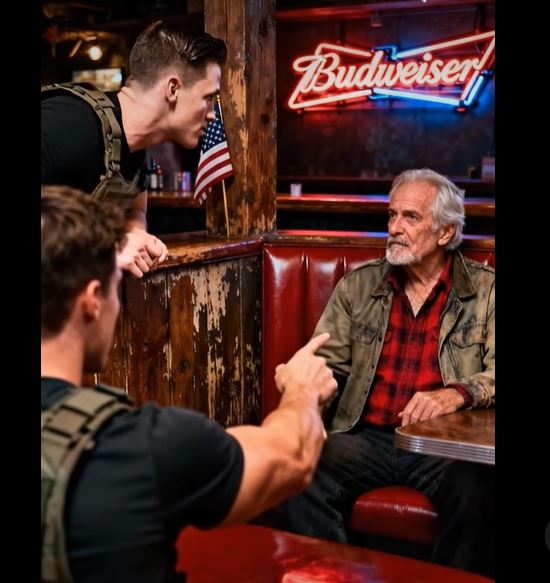
No one in the modern units had seen him in years. Some whispered his name, stories of his exploits shared over drinks in the barracks or around campfires during quieter nights of deployment. But few believed the tales. After all, he belonged to another era—a time when intuition, patience, and raw understanding of human nature counted more than advanced optics and satellite-guided precision. His name was Captain Elias Thornton. Retired decades ago, decorated with honors that the younger soldiers had only read about in books. He was the kind of man whose reputation preceded him, the kind whose presence alone demanded attention.
The day he arrived, the arrogance of the soldiers was palpable. They lined up, standing taller, adjusting their gear to appear even more perfect, exchanging knowing glances. “This is just another drill,” one whispered. “Old man or not, we’ve trained for every scenario.”
Thornton did not speak at first. He walked slowly along the rows, examining each soldier with a gaze that seemed to penetrate past armor and bravado straight into their intentions. He did not need to say anything—his silence was enough to make even the most confident soldier uneasy.
Then the exercise began. It was a simulated battlefield, designed to test skill under pressure. The soldiers moved with precision, following their calculated strategies, relying on technology and coordination to anticipate every challenge. They were fast, lethal, seemingly flawless. And then Thornton entered the arena—not with weapons, not with strategy, not with the commands they expected. He simply walked, calm, deliberate, observing every movement, every decision.
At first, it was almost comical. Soldiers tried to engage him, to outmaneuver a man they assumed was past his prime. He didn’t dodge. He didn’t fight. He let them make the first moves, stepping aside only when necessary, each movement effortless, precise. And yet, with every passing second, he revealed the cracks in their confidence.
A young officer charged recklessly, relying on speed and aggression to win. Thornton sidestepped with a single motion, redirecting the momentum so that the soldier stumbled past him. A unit tried to coordinate a pincer attack, relying on electronic comms and drones for perfect timing. Thornton anticipated every move, exploiting gaps, forcing errors the soldiers hadn’t seen coming.
It was not brute strength or superior weapons that defined his dominance—it was understanding, patience, and mastery over both himself and the environment. Every action he took demonstrated lessons the soldiers had forgotten: strategy without flexibility is blind, precision without perception is hollow, and arrogance is a weapon that cuts its wielder first.
By the end of the exercise, the young soldiers were exhausted, their pride diminished. They realized, collectively, that no amount of modern technology could replace intuition and experience. Their confidence had been shaken, not by force, but by the quiet authority of a man they had written off as irrelevant.
Thornton finally spoke. His voice was calm, commanding, and filled with the weight of decades of hard-earned wisdom.
“You call yourselves warriors,” he said. “Yet you forget the first rule of the spear: it is not the weapon that makes you deadly. It is the mind behind it, the patience in your movements, and the respect for the forces you face. Pride without discipline will always betray you.”
Silence fell. Heads hung. Armor and weapons could not shield them from this truth. The arrogance that had been so ingrained—the sense that modernity alone was enough—had been stripped away in moments. The soldiers who had thought themselves untouchable now understood something far older, far more profound: true mastery transcends time.
Thornton left the field as quietly as he had arrived. No fanfare. No applause. Yet the lesson lingered, etched into the minds of those who had witnessed it. They spoke of it in hushed tones afterward, over coffee and during debriefs, passing on the story to new recruits who had no idea what awaited them in the arena of discipline and experience.
That single moment became legendary—not because of spectacle or destruction, but because it reminded a generation of warriors that humility, patience, and knowledge were the true tip of the spear. It was a lesson in restraint, perception, and respect that would echo long after the weapons had been stored and the uniforms hung.