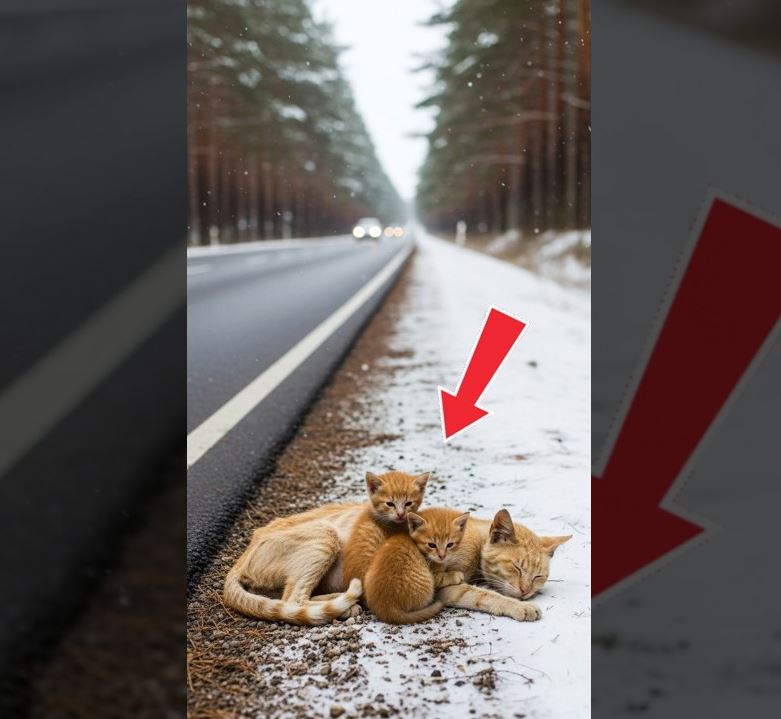
The old man had walked this street every morning for nearly twenty years. Same pace, same path, same quiet rhythm that came with age and routine. His name was Thomas, though most people in the neighborhood simply called him “Grandpa Tom,” even if they weren’t related to him. He liked the title. It made him feel useful in a world that often hurried past people like him.
That morning, the air was colder than usual, sharp against his lungs. Winter had arrived early, and the kind of cold that slipped through coats and settled into bones had already taken hold. Thomas pulled his scarf tighter and continued walking, his cane tapping softly against the pavement.
That was when he heard it.
At first, he thought it was the wind—thin, broken, almost fragile. Then he stopped. The sound came again. A weak, desperate cry.
Cats.
Thomas followed the sound to the edge of an abandoned lot, a place most people avoided. Weeds grew wild there, trash collected in corners, and a rusted fence leaned as if exhausted by time. Near the back, tucked beneath a broken wooden pallet, he saw movement.
He crouched slowly, his knees protesting, and lifted the edge of the pallet just enough to look underneath.
What he saw made his chest tighten.
A mother cat lay curled tightly around three tiny kittens. They were impossibly small, their eyes barely open, their bodies trembling. The mother’s fur was thin, patchy in places, her ribs visible beneath her skin. She hissed weakly when she saw him, trying to protect what little she had left.
Thomas lowered the pallet gently.
“It’s alright,” he whispered, though he knew she couldn’t understand his words. “I’m not here to hurt you.”
He straightened with effort, leaning heavily on his cane. Most people would have walked away. Some would have said it wasn’t their problem. Others might have felt sympathy but convinced themselves they were too busy, too old, too tired.
Thomas felt all those things.
And still, he stayed.
He went home first, his walk no longer leisurely but determined. Inside his small apartment, he gathered what he could: an old blanket, a cardboard box, a small bowl, and the last can of tuna he’d been saving for himself. He hesitated for only a moment before taking it.
“I can manage,” he said quietly to the empty room.
When he returned, the cats were still there. The kittens cried softly, and the mother looked weaker than before. Thomas moved slowly, carefully placing the box nearby, lining it with the blanket. He opened the tuna and set it a short distance away, then stepped back and waited.
Minutes passed.
The mother cat watched him with wary eyes. Hunger eventually overcame fear. She crept forward, every movement protective, never turning her back on the kittens. She ate quickly, desperately, then returned to them, her body relaxing just slightly.
Thomas exhaled.
That became his routine.
Every morning and every evening, he returned. Sometimes with food, sometimes with water, sometimes just to check that they were still alive. He worried constantly—about the cold, about rain, about people who might not be kind. He adjusted the box, added more insulation, and even brought a small piece of plastic to shield them from the wind.
Neighbors began to notice.
At first, they watched from a distance. Then someone asked him what he was doing.
“Looking after a family,” Thomas replied simply.
Word spread. One neighbor brought cat food. Another donated a thicker blanket. A young woman offered to call a rescue organization, but they said they were full. Thomas nodded when she told him, already expecting the answer.
One night, a storm hit harder than anyone predicted. The wind howled, rain turned to sleet, and temperatures dropped dangerously low. Thomas barely slept. He sat in his chair, staring at the clock, worrying about the small lives huddled in that lot.
Ignoring the ache in his joints and the stiffness in his hands, he dressed and went back out into the storm. When he reached the lot, his heart sank. The box was soaked. The blanket was damp. The kittens were quiet in a way that frightened him.
Inside his apartment, he set the box near the heater and wrapped them in dry towels. He warmed water and gently placed a bottle nearby to create heat. He sat on the floor for hours, watching their tiny chests rise and fall, listening for breath, counting heartbeats.
Later that day, a neighbor came by and insisted on taking them to a veterinarian. The diagnosis was clear: another night outside, and none of them would have survived. The mother was malnourished, exhausted, but strong. The kittens were fragile—but alive.