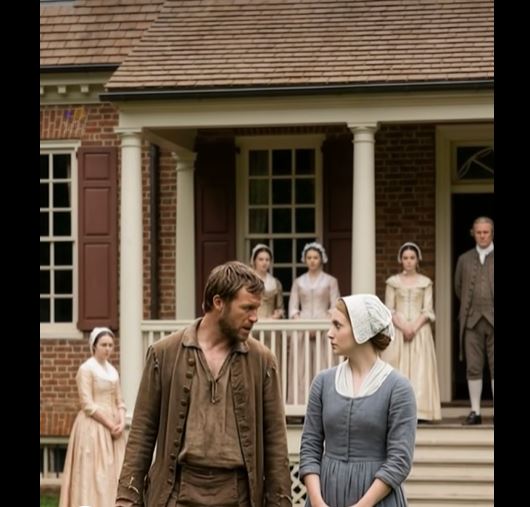
The baron’s mansion sat perched on a hill overlooking the small village below, its grandeur unmistakable even from a distance. Marble steps led to towering oak doors, and manicured gardens sprawled across acres of land.

Yet for all its splendor, the baron, Edward Sinclair, chose to conceal it from the world. Widowed for five years and weary of shallow attention from fortune hunters, he lived quietly, posing as a modest, unassuming man. He would wander through the village, dressed in simple clothes, his expensive carriage replaced by a humble cart, and never revealed his true wealth to anyone. To the villagers, he was just another quiet man, passing through their streets unnoticed.
Edward had learned the hard way that wealth often attracted the wrong kind of attention. After the untimely death of his wife, he found himself surrounded by people eager to claim part of his fortune, or to insert themselves into his life for convenience rather than affection. Heartbroken and wary, he resolved to live in anonymity, a ghost in plain sight, allowing only himself to choose who could see the man beneath the title.
It was during one of these quiet strolls through the village market that he first noticed her. Clara was a seamstress, known for her kindness, honesty, and gentle demeanor. She moved through the market with ease, arranging her fabrics, helping customers, and laughing softly with children who often gathered near her stand. She seemed unaware of status, wealth, or the power those things wielded over people. She treated everyone equally—with warmth and a generosity of spirit that drew people to her naturally.
Edward, curious and cautious, approached her stand pretending to be a poor traveler seeking cloth. He asked about a simple, inexpensive piece of linen, engaging her in casual conversation about patterns and fabric quality. Clara spoke freely, without judgment or pretense. She treated him like any other customer, and in that simplicity, Edward found something rare: authenticity. He returned the next day, and the day after, each time posing as the humble man he wished to be, seeking only conversation and connection rather than admiration or flattery.
Weeks passed, and Edward found himself drawn to Clara in ways he hadn’t felt in years. He watched her care for her neighbors, noticed the way she listened patiently to their worries, and observed her quiet acts of kindness—giving extra fabric to a struggling mother, helping an elderly man carry his purchases, sharing smiles with children who tugged at her apron. With every encounter, Edward’s affection deepened, though he kept his true identity a secret.
Clara, for her part, found herself intrigued by the man. There was a quiet dignity to him, a gentleness and thoughtfulness that seemed unusual in the world she knew. She noticed the subtle gestures—the way he helped an old woman up the market steps, the soft tone in which he spoke to children, the careful attention to detail in every word he said. He seemed to care not about appearances or possessions, but about people, and that sincerity touched her.
One autumn evening, as the sun dipped low and the market was closing, a sudden commotion broke out. A cart had overturned near the town square, spilling produce and scattering vendors. Clara rushed to help, but before she could reach the struggling vendor, Edward was there, lifting sacks of goods with ease, guiding frightened animals back into place, and offering calm words to distressed villagers.
Clara watched, impressed not just by his strength but by his composure and concern for others. When the chaos subsided, she turned to him. “You didn’t have to stay and help,” she said quietly.
Edward smiled, a small, unguarded expression that revealed more than words ever could. “I couldn’t just stand by,” he replied simply. “Someone has to care.”
In that moment, Clara saw something that no one else had—a glimpse of the heart beneath the baron’s carefully constructed disguise.
She realized that his wealth, his title, and his solitude were shields he wore to protect himself, and that behind them was a man capable of profound kindness and empathy. She also understood why he had chosen anonymity, respecting his privacy and allowing her to know him first for who he truly was, not for what he owned.
The days that followed brought a quiet understanding between them. Edward continued to conceal his wealth, and Clara continued her work, yet there was a growing bond, a subtle intimacy born from honesty and shared values. They spoke of hopes, fears, and memories of loved ones lost. Edward confided in her gently, never revealing everything at once, trusting that Clara would see the truth of him gradually, without influence of fortune or status.