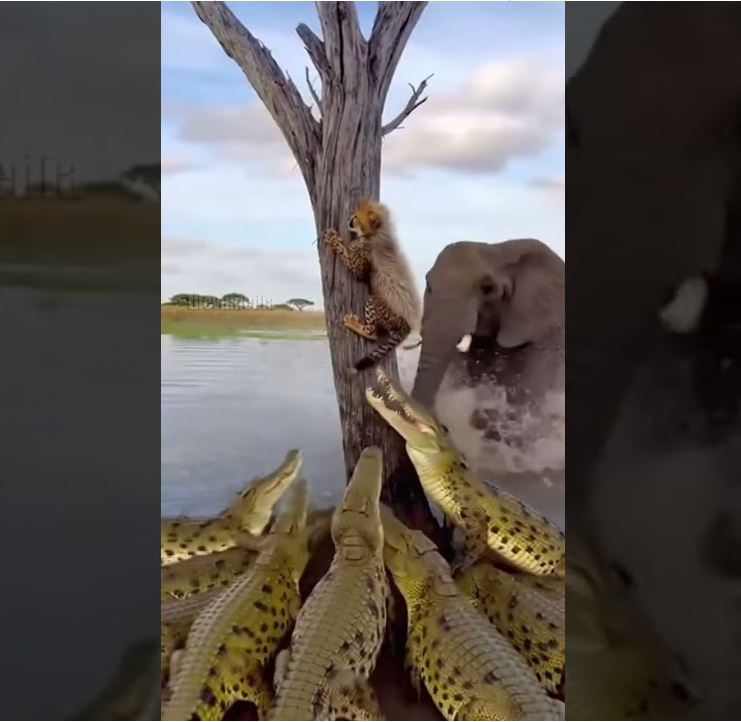
The heat in the savannah that afternoon was unforgiving. The sun pressed down on the dry grasslands, turning the air heavy and still. Near a shallow ravine carved by seasonal floods, a small cheetah cub lay trapped, its thin cries barely carrying across the vast open land.
The cub had wandered too close to the edge while following its mother, and the soft soil had collapsed beneath its paws. Now it was stuck, unable to climb out, its tiny body trembling with exhaustion and fear.
The mother cheetah paced above the ravine, her movements frantic and desperate. She tried again and again to descend the steep slope, but every attempt sent loose dirt sliding down, making the situation worse. Her instincts told her to stay close, to protect her cub, yet every second increased the risk. Predators could sense weakness. Hyenas, lions, even vultures circling above were drawn to distress like magnets. The savannah was beautiful, but it was merciless.
As the cub cried out again, a low rumble echoed across the plain. At first, it seemed like distant thunder. Then the ground began to vibrate. From behind a cluster of acacia trees emerged a massive elephant bull, his long tusks curved and worn, his skin marked with the scars of age and survival. He moved slowly but purposefully, each step deliberate, his ears fanning gently as he assessed the scene before him.
Elephants were known for their intelligence and emotional awareness, but encounters between elephants and cheetahs were rare and unpredictable. The mother cheetah froze, her muscles taut, prepared to flee or fight if necessary. The elephant stopped several meters away, lifting his trunk to test the air. He could hear the cub’s cries clearly now, sharp and panicked, cutting through the silence of the savannah.
The elephant took another step forward, then paused. Instead of charging or asserting dominance, he angled his body away slightly, a subtle signal of non-aggression. His eyes focused on the ravine, not on the cheetah mother. Slowly, he approached the edge, peering down into the shallow pit where the cub lay struggling.
The cub, sensing movement above, cried louder. The sound seemed to stir something deep within the elephant. He rumbled softly, a low, calming vibration that resonated through the ground. The cheetah mother watched, torn between fear and hope, unsure whether to intervene or trust what she was witnessing.
Carefully, the elephant lowered his trunk into the ravine. The cub recoiled at first, startled by the unfamiliar scent and size of the strange creature reaching toward it. But the elephant did not rush. He moved with extraordinary gentleness, brushing the dirt away, clearing loose soil from around the cub’s legs. His trunk, powerful enough to uproot trees, adjusted its grip with remarkable precision.
The cub slipped once, sliding further down, and the mother cheetah let out a sharp cry of alarm. The elephant responded immediately, placing his foot firmly against the edge of the ravine to stabilize the soil. Dust rose into the air, but the ground held. He lowered his trunk again, this time curling it slightly around the cub’s torso—not squeezing, not restraining, just enough to support.
With a careful, steady motion, the elephant lifted. The cub dangled for a moment, limbs flailing, then was gently placed back onto solid ground beside the ravine. The entire rescue took less than a minute, but it felt like an eternity to those watching.
The cub scrambled away, stumbling toward its mother, who immediately pressed her body over it, licking and inspecting it frantically to ensure it was unharmed. The cub’s cries faded, replaced by soft, relieved chirps. The danger had passed.
The elephant stepped back, giving the cheetahs space. He did not linger, did not demand acknowledgment or reward. He stood quietly, watching for a moment as the mother gathered her cub and guided it away from the ravine. Only when he was certain they were safe did he turn and begin to walk back toward the trees.
From a nearby research vehicle, wildlife conservationists who had been monitoring elephant migration patterns sat frozen in disbelief. Cameras continued recording, but none of them spoke. They had witnessed something extraordinary—not a trained response, not a learned behavior, but a spontaneous act of interspecies compassion.
Later analysis of the footage would confirm that the elephant had no prior interaction with cheetahs. There was no survival benefit, no territorial advantage in helping the cub. The act appeared driven purely by awareness and empathy. It challenged long-held assumptions about animal behavior, forcing experts to reconsider the emotional depth and moral complexity of non-human species.