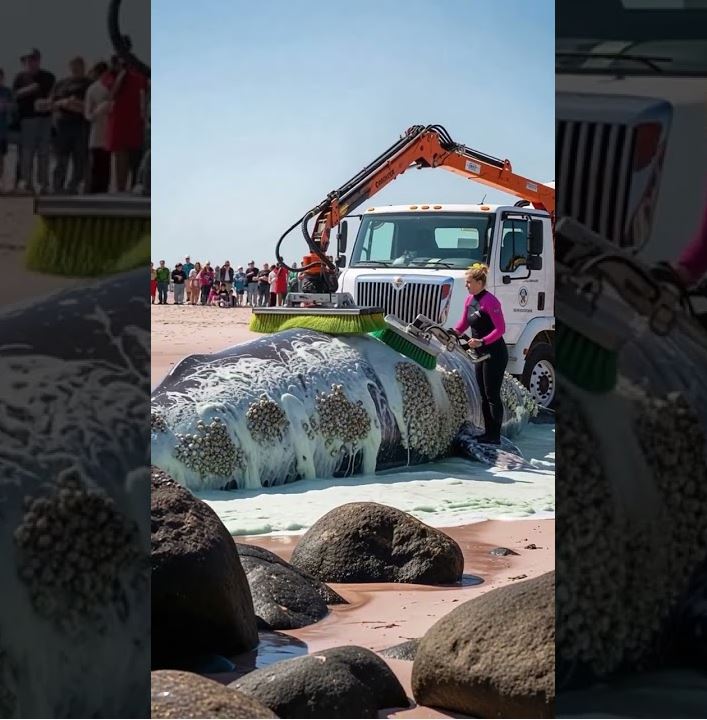
The ocean was unusually calm that morning, a vast sheet of steel-blue water stretching endlessly beneath a pale sky. A small research vessel moved slowly along the coastline, its crew scanning the surface for signs of marine life. What they found instead was something far more urgent—and heartbreaking. Just a few hundred meters from shore, a massive whale lay motionless, its dark body partially exposed by the receding tide. It was stranded, helpless, and running out of time.
At first, the crew thought the whale might already be dead. Its sheer size, nearly fifty feet long, made it difficult to tell whether it was breathing. But then one of the researchers noticed a subtle movement—a slow rise and fall near the blowhole. The whale was alive. Barely.
The captain immediately radioed for help. Every minute mattered. A stranded whale faces overwhelming odds; without the buoyancy of water, its own weight crushes its organs, and dehydration and overheating set in quickly. The tide had gone out hours earlier, and the next high tide was still a long way off. If nothing was done, the whale would not survive.
Within minutes, the beach transformed from a quiet stretch of sand into a scene of controlled urgency. Marine biologists, local authorities, volunteers, and rescue teams arrived, carrying equipment, buckets, tarps, and ropes. The whale, a young humpback, lay on its side, its eye half-open, glossy and dark. Each slow breath sounded like an effort, as if the animal were fighting gravity itself.
Rescuers moved carefully. They spoke softly, even though the whale could not understand their words. Experience had taught them that calm voices helped maintain calm movements. Panic, even among humans, could make the situation worse. Someone gently poured seawater over the whale’s skin to keep it moist and prevent cracking under the sun. Others positioned large, wet cloths across its massive back, shielding it from heat.
The whale’s eye followed them.
That was the moment when many of the volunteers realized this wasn’t just a rescue—it was a conversation between species. The whale was aware. It knew something was happening. And somehow, it seemed to be holding on.
As the minutes passed, the situation grew more critical. The tide schedule was not in their favor, and moving a whale of this size was no simple task. Heavy machinery couldn’t be used without risking injury. Every decision had to be precise. Marine biologists assessed the whale’s condition, noting abrasions likely caused by rocks during the stranding. Its breathing was shallow. Time was slipping away.
A plan was formed quickly. The only chance was to realign the whale and guide it toward deeper water when the tide rose just enough to assist. Until then, they had to keep it alive.
Volunteers formed a rotation, continuously pouring water, monitoring breathing, and adjusting the whale’s position slightly to relieve pressure on its organs. Some knelt in the sand for hours, arms aching, clothes soaked, faces tense with focus. No one complained. No one left.
Children who had wandered onto the beach earlier were quietly guided away. This was not a spectacle. This was a fight for life.
At one point, the whale released a low, resonant sound—not a full song, but a deep vibration that could be felt through the sand. Several rescuers froze. Some felt chills run down their spines. It wasn’t fear. It was awe. The sound felt like communication, like pain, like endurance.
The tide began to shift.
Slowly, almost imperceptibly at first, the water crept closer. Rescuers used inflatable pontoons and specialized mats beneath the whale’s body, preparing to lift and guide it once buoyancy returned. The whale moved slightly as the water touched its side, its eye opening wider.
Hope returned—but cautiously.
The most dangerous moment came when the whale attempted to move on its own. A sudden, powerful shift could injure both the animal and the people helping it. Rescuers backed away just enough to stay safe while guiding gently with ropes. Everyone shouted coordinated instructions. There was no room for error.
Then, finally, the water lifted the whale’s massive body.
It was only a few inches, but it was enough.
The whale’s breathing deepened. Its tail twitched. As more water rushed in, the rescue team worked together, pushing, guiding, aligning. Muscles strained. Hands shook. Hearts raced.
And then, with a powerful sweep of its tail, the whale moved forward.
Cheers erupted, but quickly fell silent as the team watched, holding their breath. The whale hesitated, then surged again, its body now fully supported by the ocean. For a moment, it floated just offshore, as if gathering strength.