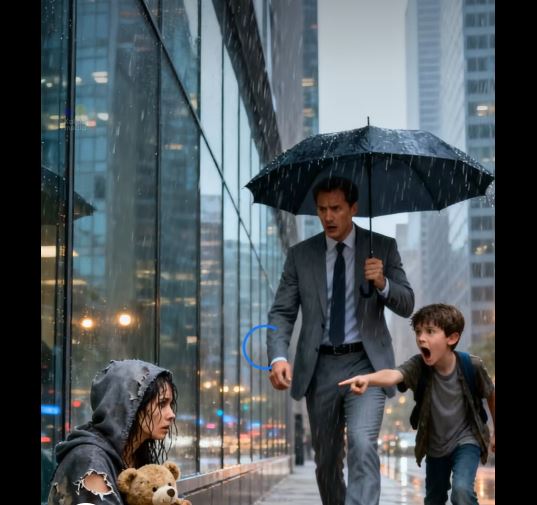
It was a crisp autumn morning in the heart of the city. The streets were busy with commuters, street vendors, and the occasional stray dog weaving through the crowd.

Among them walked Henry Caldwell, a man in his late forties whose polished shoes clicked against the cobblestones. He was impeccably dressed—tailored suit, silk tie, gold watch—and his attention was fixed on his phone as he hurried toward the bank. Business awaited, appointments lined up, and in Henry’s world, there was no time for distractions.
Yet, on the corner near the fountain, sat a man wrapped in layers of tattered clothing. His beard was unkempt, his hands trembling as he held out a paper cup. “Spare some change, sir?” he asked softly, his voice almost drowned by the city’s din.
Henry glanced briefly, his lips tightening. He had passed dozens of beggars over the years and had learned a practiced, polite indifference. Today was no different. He avoided eye contact, quickened his pace, and pretended the man wasn’t there.
Beside him, his six-year-old son, Ethan, walked holding his hand. The boy had noticed the man immediately. “Dad,” Ethan said quietly, tugging at Henry’s sleeve. “Why isn’t he wearing shoes?”
Henry sighed impatiently. “Ethan, we don’t have time for this. Not everyone you see can be helped.”
“But he looks cold,” Ethan persisted. His small face scrunched with concern. “Shouldn’t we help him?”
Henry’s frustration rose. “We are helping people, Ethan. Your mother and I donate. But we can’t stop for every beggar on the street.”
Ethan looked down at the man, then back at his father. His tiny finger pointed toward the cup. “But… Dad… maybe he’s hungry.”
Henry’s grip on Ethan’s hand tightened, trying to pull him along. “I said we don’t have time, Ethan. Stop asking.”
Ethan didn’t respond immediately. He walked silently for a few steps, then spoke again. Just one word.
“Please.”
Henry froze mid-step. He turned to look at his son. Ethan’s eyes were wide and earnest. There was no mischief, no impatience, just a raw appeal to humanity. The word hung in the air, heavier than Henry expected.
The beggar’s eyes lifted at that moment. They were tired, wary, but something in them softened as he noticed the boy staring up at him. Henry felt an unfamiliar tightness in his chest—a discomfort he hadn’t expected.
He looked at his son, then at the man again. His mind raced. He thought of meetings, schedules, and appearances. And yet, there was something undeniable in the simplicity of Ethan’s word. It was not demanding. It was not judgmental. It was a plea for kindness.
Henry swallowed. For the first time in years, he realized that wealth and power could not shield him from the quiet truths that a child could see plainly. He knelt slightly and pulled a few bills from his wallet, placing them gently in the man’s cup.
The beggar’s lips parted in surprise, his eyes misting. “Thank you, sir,” he whispered, his voice trembling. “God bless you.”
Ethan smiled, a small beam of light in the crisp morning. “You’re welcome,” he said. Then, as if on instinct, he reached out his tiny hand and offered the man half of his breakfast sandwich. The man shook his head at first, hesitant to accept, but the child’s sincerity was impossible to resist. Slowly, he took the sandwich, his hands shaking, and nodded.
Henry watched quietly, a mixture of pride and shame washing over him. Pride for his son, who saw the world in its simplest truths. Shame for himself, who had looked away for so long. He realized that the boy’s innocence had reminded him of something essential—something money, status, and success could never provide: compassion.
Henry nodded, unable to speak. He felt a strange warmth in his chest, a gentle reminder of the humanity he had buried under deadlines and wealth. He knelt beside his son and the man, placing a reassuring hand on Ethan’s shoulder. “You’re right,” he admitted, finally. “Sometimes, noticing someone is the most important thing we can do.”
Henry laughed softly, a sound that had not come easily in years. He felt lighter than he had in a long time. In that moment, surrounded by the rush of the city, the boy who had reminded him of what truly mattered, and a man who had received not just money but recognition and dignity, Henry realized that the world could be different—if only we took the time to see it through the eyes of compassion.