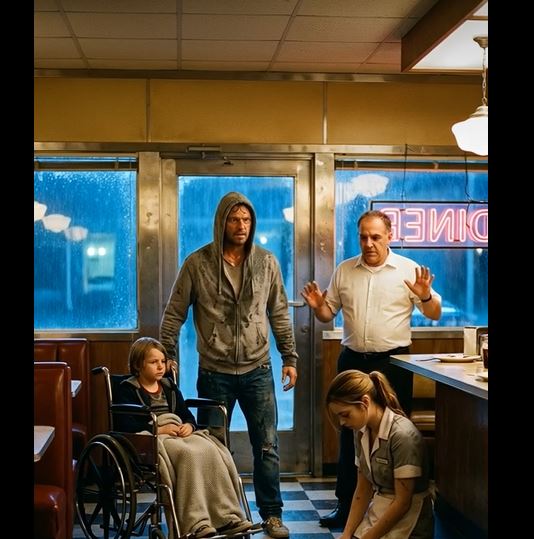
I learned early that invisibility could be a kind of shelter. When people don’t expect much from you, they don’t ask difficult questions or demand explanations you’re too tired to give. They pass by without judgment, without curiosity. After a while, I stopped correcting them. I let the world believe I was ordinary, forgettable, maybe even a little pathetic. It was easier that way.

Years earlier, my life had looked very different. I once owned a thriving logistics company, employed hundreds of people, and spent my days making decisions that affected entire supply chains. Then a trusted partner falsified documents, loans collapsed overnight, and a legal battle drained not only my finances but my will to fight. By the time it ended, the company was gone, my marriage had crumbled under the weight of stress, and my name—once respected—felt like a liability.
So I stepped back. I sold what little remained, invested quietly, and chose a life where no one looked twice at me. I rented a small apartment, wore plain clothes, and took a modest office job that paid enough to keep me comfortable but unimpressive enough to keep me invisible. I spoke little, smiled politely, and never volunteered personal details. When coworkers assumed I was struggling, I didn’t correct them.
On most evenings, I ate alone. I told myself I preferred it that way. There was a small diner a few blocks from my apartment—nothing fancy, just a long counter, cracked vinyl booths, and the constant smell of coffee. The food was cheap and predictable, which suited me perfectly. I always sat in the same booth near the window and ordered the same meal. No one ever asked why.
That’s where she worked.
The first time I noticed her, it wasn’t because she stood out. It was because she didn’t. She moved quietly between tables, hair tied back, uniform slightly faded. Her shoes were worn, and she carried herself with the careful precision of someone trying not to make mistakes. When she approached my table, her smile was polite but tired.
“Coffee?” she asked.
“Yes,” I replied.
She poured it slowly, as if measuring each second. When she placed the cup down, I noticed her hands were red from constant washing. Her name tag read Lena.
She didn’t make small talk that first night, and I appreciated that. But over the next few weeks, I realized something about her. She remembered details. How I took my coffee. Which days I stayed longer. When I looked distracted. Most people in service jobs learned routines, but Lena paid attention in a different way.
One night, I came in later than usual. The diner was nearly empty. Lena brought my coffee and lingered.
“Long day?” she asked.
“Something like that,” I said.
She nodded, as if she understood more than I’d said. “Those are the hardest ones.”
There was no pity in her voice, just recognition.
Over time, she shared small pieces of her life without drama or complaint. She worked two jobs. She sent money home to her younger brother. Her mother had health issues that insurance barely covered. She joked about being “temporarily broke,” but I could see the truth in the way she counted her tips at the end of a shift.
One evening, a customer snapped at her for a delayed order. The kitchen had messed up, but she took the blame without arguing. After he left, she stood behind the counter, shoulders tense, breathing shallowly.
“You didn’t deserve that,” I said when she came back to my table.
She forced a smile. “It’s fine. I’ve been called worse.”
That bothered me more than I expected.
Weeks later, during a particularly slow night, Lena asked if she could sit for a moment. Her feet hurt, she said. I agreed. She slid into the booth across from me, carefully, as if worried she might be crossing some invisible line.
“You don’t talk about yourself much,” she said.
“I don’t think there’s much to say.”
She studied me, eyes sharp despite the exhaustion. “I don’t believe that.”
I laughed quietly. “Most people do.”
“Well,” she replied, “most people don’t really look.”
Her words stayed with me long after I left the diner.
The turning point came on a rainy Tuesday. I walked in to find Lena in the back hallway, sitting on a crate, her face buried in her hands. Another waitress whispered that Lena had just received a call from the hospital. Her mother’s condition had worsened. The next treatment was expensive, and without it, the prognosis wasn’t good.