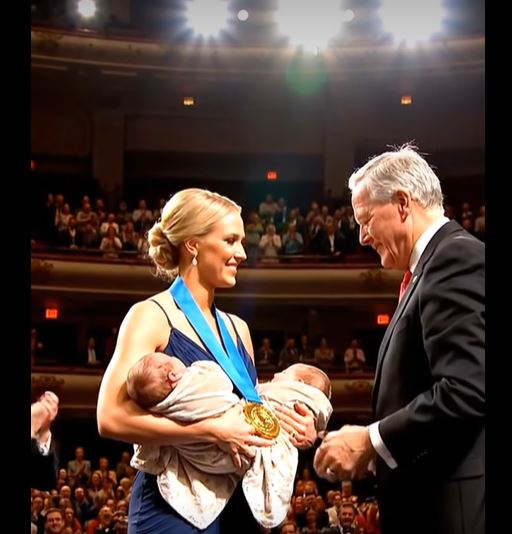
I still remember the sound of the hospital doors closing behind him. It wasn’t loud, not dramatic, but it echoed in my chest in a way I don’t think I will ever forget. One moment, my husband was standing beside my hospital bed, looking down at our newborn twins, and the next, he was walking away.
No kiss on my forehead. No promise to come back. Just a stiff nod and a look of quiet defeat, as if the decision had already been made long before that day.
Our twins were only three days old. They slept curled against each other, unaware that their world had already shifted. I watched their tiny chests rise and fall and tried to make sense of what had just happened. My husband hadn’t argued. He hadn’t cried. He had simply said, “I’m sorry,” and left. At the time, I didn’t know why. I only knew that I was suddenly alone.
The truth came hours later, delivered not by him, but by his mother.
She arrived at the hospital dressed in elegant black, her jewelry understated but unmistakably expensive. She didn’t ask how I was recovering. She barely glanced at the babies. Instead, she sat down across from me and folded her hands neatly in her lap, as if this were a business meeting rather than the aftermath of a family breaking apart.
“I gave my son a choice,” she said calmly. “You and the children, or the life I built for him.”
Her words landed harder than any insult ever could.
She explained it without emotion. The trust fund. The family business. The properties. The connections that had ensured her son would never struggle a day in his life. She told me that if he stayed with me, all of it would be gone. No inheritance. No access. No safety net. She had made it clear that she would not support a life she hadn’t approved of.
I wanted to scream. I wanted to throw her out of the room. But I was weak, stitched, exhausted, holding two fragile lives in my arms. All I could do was stare at her and realize that my husband had been raised to value comfort over commitment, wealth over responsibility.
When she left, she didn’t say goodbye.
The days that followed blurred together. Nurses came and went. Paperwork piled up. Friends sent messages full of shock and pity. My husband never returned. He didn’t call. He didn’t ask about the babies. The man I thought I knew had vanished, replaced by someone who could walk away from his own children because someone richer and louder told him to.
When I was discharged, I went home to a half-empty apartment. His clothes were gone. His side of the bed untouched. It felt as if he had erased himself, leaving behind only questions and silence. At night, I fed the twins in shifts, crying quietly so I wouldn’t wake them. I was terrified—not just of raising two newborns alone, but of the future I had suddenly been forced into.
Bills arrived quickly. Diapers. Formula. Medical expenses. I applied for assistance, swallowed my pride, and accepted help where I could find it. I learned how strong exhaustion could make you, how survival sharpens focus. There was no time to grieve the marriage I had lost. Two tiny humans depended on me.
Weeks later, I received a letter from my husband’s mother. Inside was a check and a note stating it was a “one-time gesture of goodwill.” There were conditions attached—confidentiality, no public claims, no contact. It wasn’t help. It was hush money.
I didn’t hear from my husband for months. When he finally reached out, it was through an email. Short. Polite. Detached. He said he hoped I was “managing okay.” He didn’t ask to see the twins. He didn’t ask for pictures. He didn’t apologize. Reading it, I realized something painful but freeing: the man I loved was gone, and the man who remained was a stranger.
As the months passed, something inside me hardened—not into bitterness, but into clarity. I stopped waiting for him to come back. I stopped hoping his mother would suddenly grow a conscience. I built a routine. I found joy in small victories: the twins’ first smiles, their first laughs, the way they reached for each other instinctively. They were enough. More than enough.
I went back to work earlier than planned. I learned to budget carefully. I leaned on friends who showed up without being asked. Slowly, I rebuilt my sense of self—not as a wife abandoned, but as a mother who refused to fail.