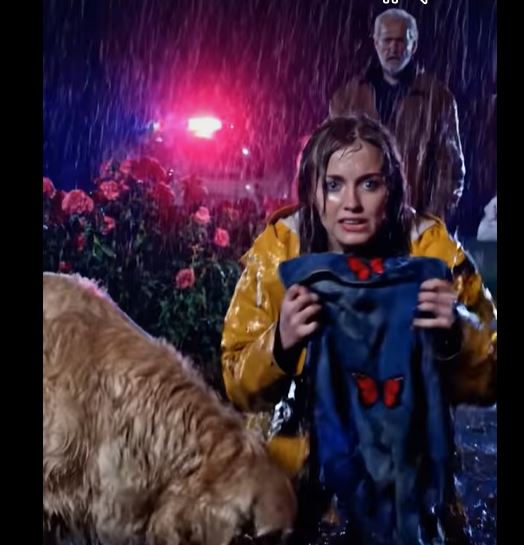
For weeks, I couldn’t figure out what was happening in our quiet suburban neighborhood. Every morning, the roses along Mrs. Hargrove’s fence—her prized, perfectly cultivated roses—were disturbed.
Soil was turned over, petals scattered, and the roots of her delicate plants exposed. At first, I assumed it was some random animal. Maybe a raccoon or a neighborhood cat. But the pattern was too consistent, too precise. And then, one morning, I saw the culprit: Max, my Golden Retriever.
Max was a gentle, friendly dog, usually more interested in belly rubs than trouble. He had always been well-behaved, never even a hint of mischief in his long, golden fur. Yet there he was, crouched low in the moonlight, paws furiously digging, his nose buried in the dirt, completely focused on the roses. I ran outside, flashlight in hand, my heart pounding with a mix of irritation and disbelief.
“Max! Stop it!” I shouted. He froze for a moment, his ears flicking back, but then, as soon as I took a step closer, he went back to digging. It wasn’t random digging. It was almost methodical, as though he were searching for something very specific.
I tried scolding him, tried keeping him on a leash at night, tried closing him inside, but nothing worked. Every morning, the roses were disturbed. Mrs. Hargrove was patient at first, though I could see the frustration in her eyes. She loved her garden more than anything, and my dog’s nocturnal visits were destroying it. She even threatened to call animal control if the behavior didn’t stop.
One night, I decided to follow him. I slipped quietly out of bed and tiptoed to the back door. Max was already restless, pacing and whining near the gate. As soon as I opened the door, he bolted, his paws silent on the damp grass. I crept behind him, careful not to make a sound, flashlight shaking in my hand.
He led me straight to Mrs. Hargrove’s rose bushes. I froze when I saw what he was doing. Max was digging in a specific spot near the base of the largest rose bush. But this time, I noticed something strange: the soil looked loose not just from his paws. There was a faint, metallic glint in the dirt.
Curiosity overcame my frustration. I crouched down and brushed aside some dirt, revealing a small, buried tin box. Max sniffed it excitedly, wagging his tail furiously. My hands trembled as I opened the rusted lid. Inside was a collection of old photographs, letters, and jewelry—pieces of Mrs. Hargrove’s family history that had been missing for years.
I couldn’t believe it. I knew she had once mentioned losing some family heirlooms during a storm, and I had assumed they were gone forever. Somehow, Max had sensed it buried under the earth. The dog wasn’t being mischievous or destructive. He had been trying to help, to recover something precious without me even realizing it.
The next morning, I went straight to Mrs. Hargrove’s house with the tin box. I rang the bell, and when she opened the door, I handed it to her, still covered in dirt. Her eyes widened, and then tears formed.
“Where did you find this?” she asked, voice shaking.
I explained everything: how Max had been digging at night, how I followed him, and how he had led me to the buried treasure. Her hands shook as she took the box, and for the first time in weeks, I saw her smile—not just polite, but genuine, filled with gratitude.
From that day on, the rose bush remained safe. Max still sniffed around at night, but he never dug again. I think he knew he had done his job. He had been patient, persistent, and loyal, acting on instincts none of us understood at first.
Mrs. Hargrove became even friendlier after that. She often brought Max treats and fresh water, praising him in a way that made him wag his tail proudly. And while I initially viewed his behavior as a nuisance, I came to realize it was something extraordinary. My dog had not just been causing chaos. He had been on a mission, quietly correcting a past wrong and returning something of irreplaceable value to its rightful owner.
That night, as I watched Max curl up at my feet, I thought about how often we misinterpret the actions of those we love. Sometimes, what looks like trouble is actually intuition, loyalty, and a desire to help. And sometimes, the simplest creatures can accomplish the most remarkable feats, if we only take the time to understand them.