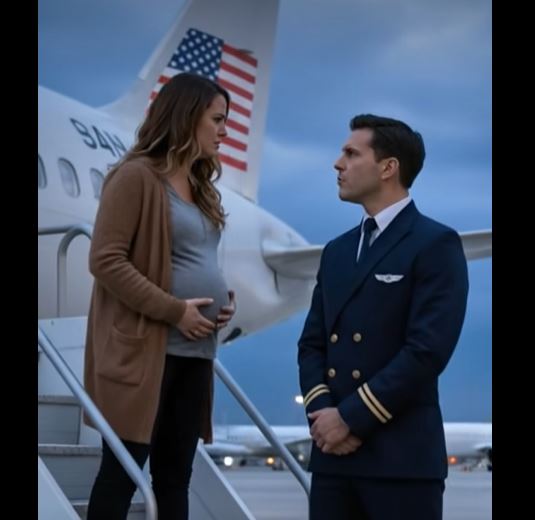
The boarding gate was crowded and loud, filled with the restless energy of travelers eager to get on with their journeys. Rolling suitcases bumped into ankles, announcements echoed overhead, and the smell of burnt coffee lingered in the air.
Most people barely noticed the woman standing near the far wall, her coat thin, her shoes worn, her hair pulled back without much care. She clutched a small canvas bag to her chest and avoided eye contact, as if she were trying to take up as little space as possible.
When boarding began, she joined the line quietly, holding her boarding pass in a trembling hand. The man in front of her glanced back, frowned, and whispered something to his wife. She shifted her weight and stared at the floor, already familiar with that look. She had learned long ago that appearances often spoke louder than words.
At the scanner, the gate agent paused. She looked up, then down, then up again, her expression tightening just slightly. “Ma’am,” she said, forcing a polite smile, “can you step aside for a moment?”
The woman nodded immediately and moved out of line without protest. A few passengers sighed in irritation as the line stalled. Someone muttered, “Figures,” under their breath. Another rolled their eyes.
A second staff member approached, whispering something to the first. Both glanced at the woman, then at her bag. The agent cleared her throat. “We’re going to need you to come with us.”
“Is there a problem?” the woman asked softly.
“We just need to verify a few things,” the agent replied, her tone practiced and vague.
The woman didn’t argue. She followed them a few steps away, past the gate desk, where curious eyes tracked her movement. The whispers grew louder.
“Probably doesn’t even have a real ticket.”
The woman heard every word. She always did.
One of the agents asked her to open her bag. Inside were a few folded clothes, a worn notebook, and a small leather case. Nothing dangerous. Nothing suspicious. Still, the agent frowned.
“Ma’am, have you been living at the airport?” she asked.
The question hung in the air, sharp and humiliating. The woman swallowed. “No.”
Another staff member arrived, this one more authoritative. “We’ve had some concerns raised by passengers,” he said. “Until we clear this up, we’re going to have to remove you from the flight.”
The woman’s fingers tightened around the strap of her bag. “Remove me?” she repeated. “Why?”
“For safety and comfort reasons,” he said carefully.
The words stung more than if he’d just said the truth.
“I paid for that seat,” she said quietly.
“We can rebook you later,” he replied, already gesturing toward the exit.
The woman looked back at the gate. Boarding continued. People stepped around her, avoiding her eyes. A few looked relieved. Others looked curious. No one spoke up.
She allowed herself to be escorted away.
They brought her to a small office near the terminal, offered her a chair, and asked her to wait. She sat down, smoothing her coat, breathing slowly. She had endured worse than this. Much worse.
Fifteen minutes passed. Then thirty.
Finally, a senior supervisor entered the room holding a tablet. He looked at her, then at the screen, then froze.
His expression changed instantly. The professional detachment drained from his face, replaced by alarm. He stood up straighter.
“I’m very sorry,” he said. “There appears to have been a… misunderstanding.”
Outside, at the gate, the flight was now delayed. A pilot stood near the desk, arms crossed, clearly irritated. “Why are we still waiting?” he asked.
The gate agent leaned in and whispered something. His brows furrowed. “What do you mean, removed passenger?”
Before she could answer, another supervisor hurried over, pale. “We have a problem,” he said quietly. “A big one.”
Back in the office, the woman opened the leather case from her bag and placed its contents on the table. Inside was an identification badge, worn but unmistakable. Alongside it were documents, neatly folded.
Dr. Eleanor Hayes was not just any passenger. She was a globally respected humanitarian physician, a woman whose work in disaster zones had saved thousands of lives. Her face had appeared on magazine covers, in medical journals, in international conferences. She had spent the last decade moving between refugee camps, war zones, and outbreak centers, often refusing press and luxury, choosing instead to live as closely as possible to the people she served.
Within minutes, the airport shifted into panic mode. Calls were made. Apologies stacked upon apologies. A senior airport manager rushed in, followed by the airline’s operations director.