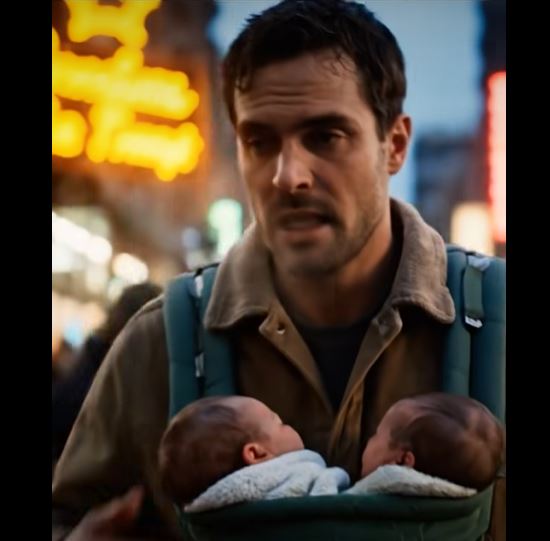
They were left behind. Not literally, but in every way that mattered. As children, Ethan and Lucas spent their early years in a small apartment above their father’s failing workshop, a place where the walls seemed to absorb every sigh, every failure, and every whispered hope that no one would notice.

Their father, Samuel Grant, was a man of quiet brilliance, a craftsman whose mind was full of ideas but whose hands never seemed to have enough hours in the day. Their mother had left when they were barely old enough to remember her face, leaving behind a note that spoke of dreams she would chase alone.
The boys clung to each other, but the weight of absence pressed heavily on their shoulders.
Samuel was different from other fathers, though. He didn’t offer hugs or lullabies or easy comforts. What he offered was expectation. Not a cruel expectation, but one that demanded curiosity, resilience, and persistence.
He showed his sons how to take apart broken clocks, how to repair bicycles that everyone else had thrown away, and how to solve problems that seemed impossible to ordinary minds. He rarely praised them, yet every careful adjustment of a gear, every successful repair, carried his quiet approval.
He had no money, no social standing, and no patience for excuses, but he had vision—and he poured it into his children.
By the time Ethan was thirteen, he had learned to manage the small accounts of his father’s workshop, negotiating with suppliers and calculating profits with a precision that belied his age.
Lucas, two years younger, became the family’s engineer, experimenting with inventions late into the night, guided by the gentle corrections and sharp observations of Samuel. To outsiders, the boys seemed ordinary, but Samuel’s tutelage had forged something deeper: a resilience that could weather both poverty and ridicule.
School wasn’t easy. Other children mocked them for their worn clothes, for lunches that were sometimes bread and nothing more, for the way they smelled faintly of oil and dust. Yet Samuel’s lessons persisted.
“Focus on what you can control,” he would say. “Ignore the noise. Build something real, or the world will forget you.” The boys listened because they had to. There was no one else. And slowly, they began to understand what he meant.
When Samuel passed away unexpectedly, leaving the workshop in debt and the boys nearly destitute, they were forced to make a choice. Most would have crumbled. Most would have taken whatever comfort they could find. But Ethan and Lucas had already been trained by their father’s love—the kind that manifests not in gentle words but in preparation for the storms of life.
They sold the remaining assets, paid off creditors, and pooled their knowledge and determination. Every invention Lucas had sketched in secret, every ledger Ethan had maintained with care, became tools in a new venture they built from nothing.
The first few years were brutal. Investors laughed at them, competitors dismissed them as children who had inherited nothing worth keeping. But the brothers remembered Samuel’s words: “Solve problems no one else sees.
Serve people no one else wants to help. The world rewards persistence.” And so they persisted. They learned from every failure, celebrated every small victory, and never stopped innovating. They reinvested profits into research, into people, into ideas, always guided by the principles their father had instilled: integrity, foresight, and relentless effort.
By the time they turned thirty, Ethan and Lucas had created a company that transformed its industry. They didn’t just make money—they built an empire, one that employed thousands, revolutionized technology, and changed the way people lived.
Yet, in interviews and speeches, they never spoke of luck or timing. They spoke of a man who had left them behind in the way only great fathers do: by challenging them to become something larger than themselves, by refusing to coddle, by teaching them that absence and hardship could be a kind of inheritance if met with courage.
Their success was not just financial. It was emotional, philosophical, spiritual. They credited each other, yes, but at the core of their story was a father who had loved them in the quietest, most demanding way possible.
They built schools, funded scholarships, and created mentorship programs, determined that other children who were overlooked or underestimated would receive the kind of guidance that had propelled them. Samuel’s lessons lived on not only in the brothers’ boardroom victories but in the lives they touched, the opportunities they created, and the values they upheld.