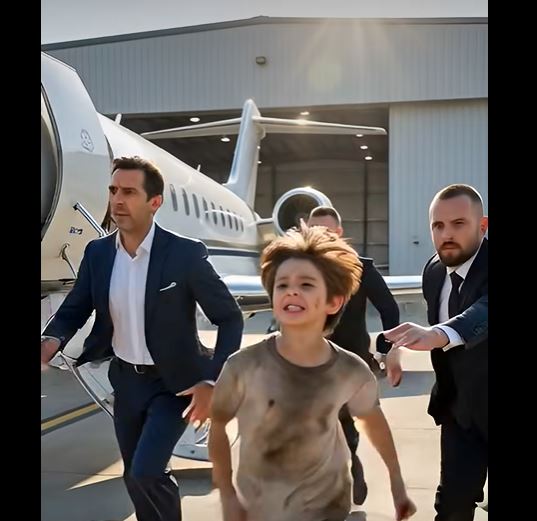
The private terminal was quiet in the way money often creates silence. No crowds, no frantic announcements, no lines. Just polished floors, tinted glass, and people who knew exactly where they were going. Outside, a sleek silver jet waited on the runway, engines already warming, lights blinking patiently against the early morning haze. For billionaire investor Richard Halston, this flight was routine. Another city, another deal, another carefully scheduled day that allowed no room for interruption.
He adjusted his cufflinks as he walked toward the plane, flanked by his assistant and head of security. Everything was on time. Everything was controlled.
Richard stopped, more out of irritation than concern, and turned around. A boy stood near the edge of the terminal entrance, barefoot, his clothes oversized and worn thin. He couldn’t have been more than twelve. His hair was messy, his face smudged with dirt, but his eyes were sharp—wide with urgency that didn’t belong to someone begging for spare change.
Security moved immediately.
“Hey! You can’t be here,” one of the guards snapped, stepping toward the boy.
“Wait,” Richard said, raising a hand. Something about the child’s expression gave him pause. Not fear. Not greed. Panic.
The boy swallowed hard and took a step forward anyway. “Please,” he said again, his voice shaking now. “Don’t go. Something’s wrong with that plane.”
A few people nearby laughed quietly. Richard’s assistant sighed. “Sir, we’re already late. This is probably just a kid trying to—”
“I’m not asking for money!” the boy blurted out, as if reading their thoughts. “I don’t want anything. Just… please don’t get on it.”
Richard studied him more closely now. He had seen desperation before—in boardrooms, in negotiations—but this was different. This was raw, unfiltered fear. The kind you couldn’t fake easily.
“And how would you know that?” Richard asked calmly.
The boy hesitated, then pointed toward the jet. “Because I heard it,” he said. “Last night. This morning too. It’s not right.”
The head mechanic, who had been supervising final checks, let out a short laugh. “Kid, that aircraft is inspected twice before every flight. You wouldn’t even understand what you’re hearing.”
The boy’s face flushed, but he didn’t back down. “I know sounds,” he said quietly. “I sleep under the old bridge by the airport. Planes wake me up every night. I know how they’re supposed to sound when they’re sick.”
That word—sick—hung strangely in the air.
Richard glanced at his watch. Every instinct in him said to move on. He had trusted professionals. He had schedules. He had places to be. And yet, a memory surfaced uninvited: his own childhood, years before wealth erased uncertainty, when adults never listened because he was “just a kid.”
The mechanic shrugged, clearly annoyed, and signaled to his team. They moved toward the jet, muttering under their breath. One of them climbed beneath the wing, another toward the rear engine housing. The boy stood frozen, hands clenched, watching every movement as if his life depended on it.
Richard felt a cold weight settle in his chest. He looked at the plane—his plane—imagining it in the air, miles above the ground, carrying him and his team into nothing but open sky and false certainty.
The flight was canceled immediately. Authorities were notified. Engineers swarmed the aircraft, confirming what could have been a fatal failure midair. News spread fast within the airport, whispers turning into stunned conversations.
But Richard’s focus never left the boy.
Later that day, instead of sitting in a boardroom across the country, Richard sat in a modest office with social workers, lawyers, and doctors. Eli sat beside him, freshly washed, wearing borrowed clothes that were still too big. He barely spoke, still overwhelmed by the way the world had suddenly stopped ignoring him.
Richard did not announce grand gestures. He did not call the press. He simply stayed.
Weeks later, Eli moved into a permanent home. Months later, he started school for the first time in years. Richard funded a scholarship in his name, but more importantly, he showed up—at parent meetings, at school plays, at quiet dinners where Eli slowly learned what safety felt like.
The repaired jet flew again eventually. Richard boarded it many times after that. But never without remembering the morning a barefoot child with nothing to gain stood between him and disaster.
A 12-year-old street kid begged a billionaire not to board a plane.
Seconds later, trained mechanics froze.
And in that frozen moment, two lives—one powerful, one forgotten—were permanently changed, simply because someone chose to listen.