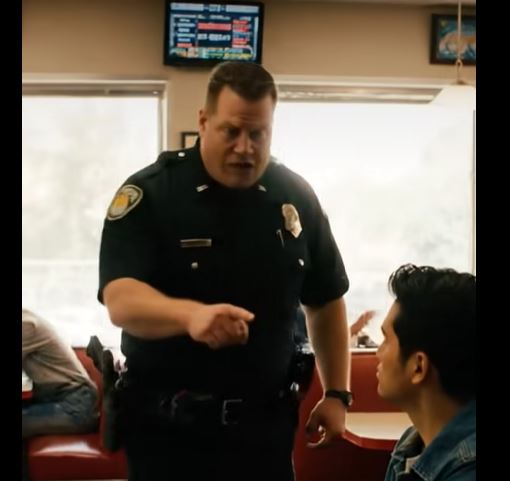
The diner sat just off the highway, the kind of place truck drivers, early commuters, and night-shift workers relied on for hot coffee and familiar faces. It wasn’t glamorous, but it was steady, and for Anna, that was enough.

She had been working there as a waitress for almost six years, memorizing regulars’ orders, refilling mugs before they were empty, and learning how to read people without asking questions. The diner taught her patience, humility, and how to stay calm no matter what walked through the door.
That evening started like any other. The sky outside was already dark, the neon sign buzzing softly, and the diner was half full. Anna moved from table to table with her usual quiet efficiency, balancing plates on her arm and offering polite smiles.
She noticed a young man sitting alone near the window. He looked tired, nervous even, stirring his coffee more than drinking it. His clothes were worn but clean, and his hands trembled slightly when he lifted the mug.
Two police officers stepped inside, scanning the room before their eyes settled on the man by the window. One of them nodded toward him. “Sir, we need to speak with you outside.”
The diner fell into an uneasy silence as the man stood, clearly shaken, and followed the officers out. Through the glass, everyone could see them talking on the sidewalk. One officer asked questions while the other stood with arms crossed. The man kept gesturing toward his pockets, explaining something urgently.
Anna watched carefully.
She had seen police stops before. Some were routine. Some weren’t. What bothered her wasn’t the officers—it was the fear on the man’s face. It was the way his shoulders curled inward, the way he kept nodding too fast, like someone desperate not to make a mistake.
Anna nodded. “I understand. But he came straight from his table to you. He paid for his meal. He hasn’t caused any trouble here.”
The man answered, voice shaking. “I—I match the description of someone you’re looking for, but it’s not me. I just got off work. I’m heading home.”
Anna spoke again, still calm. “He’s been sitting in my section for twenty minutes. He hasn’t left the building. If you need, I can confirm the time.”
The officers exchanged another look. One of them checked something on his radio. After a few tense moments, the first officer sighed. “There was a report nearby. Similar clothing. Looks like we got the wrong guy.”
The man’s knees nearly buckled with relief.
The officer turned to Anna. “You shouldn’t step into situations like this. It can escalate.”
Anna nodded again. “I wasn’t trying to interfere. I just wanted to speak up calmly.”
The officers let the man go with a brief apology before walking back to their car. Anna stayed outside for a moment as the man caught his breath.
“Thank you,” he said quietly. “You didn’t have to do that.”
“I know,” she replied. “But sometimes people just need someone to say something.”
She returned to work like nothing had happened.
The next morning, Anna woke up to her phone buzzing nonstop. Messages. Missed calls. Confused, she opened social media. A video had been posted the night before—someone from the diner had recorded the interaction through the window. It showed Anna stepping outside, speaking calmly, never raising her voice, never showing fear. The caption read:
“Waitress calmly stands up for stranger during police stop. This is what courage looks like.”
Overnight, it had gone viral.
By noon, local news stations were calling the diner. Customers poured in, not for attention, but to shake Anna’s hand. Some thanked her. Some cried. Some said they wished someone had done the same for them once.
The biggest surprise came that afternoon.
A man in a suit walked into the diner and asked for Anna by name. He introduced himself as a representative from a legal advocacy nonprofit that worked on police accountability and bystander education. “We saw the video,” he said. “We’ve been looking for someone exactly like you.”
He explained they wanted her to help train people on how to safely and calmly speak up as witnesses—how to de-escalate, how to support without confrontation.
Within weeks, Anna was attending workshops, sharing her experience, helping others understand that standing up didn’t always mean shouting. Sometimes it meant clarity, respect, and timing.
She didn’t quit the diner right away. She still worked shifts, still poured coffee, still smiled at strangers. But something had changed—not just for her, but for the people who saw themselves in her.