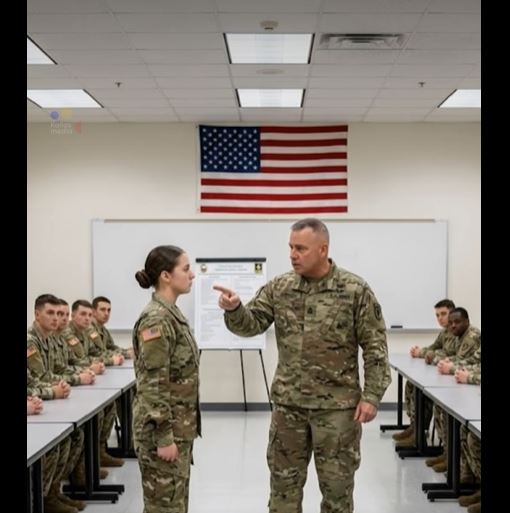
The dusty training grounds of Fort Sterling were a place of brutal heat and even more brutal hierarchies. Staff Sergeant Miller was a man who thrived on that brutality. He was a “career soldier” who measured his worth by the amount of fear he could instill in those below him. He liked his boots polished, his coffee black, and his subordinates silent.
When he saw a woman in a wrinkled, grease-stained utility uniform leaning over the engine of a stalled transport truck in the “off-limits” maintenance bay, his blood began to boil. She didn’t have her cap on, her hair was tied back in a messy knot, and she was whistling a tune that grated on his nerves.
“Private!” Miller bellowed, his voice echoing off the corrugated metal walls.
The woman didn’t jump. She finished tightening a bolt, wiped her forehead with the back of a gloved hand, and slowly turned around. She looked young, her face smudged with oil, and her uniform lacked the flashy divisional patches Miller favored.
“You’re in a restricted zone, you low-rank grease monkey,” Miller hissed, closing the distance until he was inches from her face. “Where’s your respect? Where’s your salute?”
“I was just fixing the fuel line, Sergeant,” she said, her voice calm and level. “This truck needs to be on the convoy by 0600.”
Miller didn’t like her tone. He didn’t like the way she looked him in the eye without blinking. In a moment of blind, unchecked rage—the kind he had used to “discipline” soldiers for a decade—he raised his hand and delivered a sharp, open-palmed strike across her face.
The sound of the slap was like a whip-crack. The woman’s head snapped to the side. A small trickle of blood appeared at the corner of her mouth.
“That’s for speaking back to a superior,” Miller growled. “Now, get on your knees and start scrubbing this floor until I can see my reflection in the oil.”
The woman didn’t get on her knees. She reached into her pocket, pulled out a clean rag, and wiped the blood from her lip. She looked at the blood on the cloth, then back at Miller. The look in her eyes wasn’t fear. It was a cold, clinical curiosity.
“Sergeant Miller,” she said, her voice dropping an octave. “Do you know the penalty for striking a superior officer in a time of heightened readiness?”
Miller laughed, a harsh, jagged sound. “Superior? You’re a Private, a nobody. I’m the law in this bay.”
The woman reached into her grease-stained jacket and pulled out a small, laminated ID card tucked into a hidden pocket. She didn’t hand it to him; she held it up to the light.
Miller’s laughter died in his throat. He squinted at the card. His heart skipped a beat, then began to hammer a frantic rhythm against his ribs. The card wasn’t green for enlisted or silver for junior officers. It was a high-level security clearance gold, embossed with two silver stars.
“I’m not a Private, Sergeant,” she said, stepping into his space. “I grew up in grease pits like this. I like to know how my equipment works before I send men into the field with it. But it seems I have a much bigger problem than a faulty fuel line. I have a systemic failure in my NCO corps.”
Miller’s knees turned to water. He tried to snap to attention, but his body was shaking too hard. “General… I… I didn’t know. You weren’t wearing your… I thought…”
The heavy bay doors groaned open. The sound of polished boots on concrete signaled the arrival of a high-level entourage. Leading the pack was a man whose chest was a mosaic of ribbons and whose presence seemed to pull the very oxygen out of the room.
General Silas Vance, Chairman of the Joint Chiefs of Staff.
The most powerful man in the military stopped five feet away. He looked at the red mark on his daughter’s face, then at the trembling Staff Sergeant standing over her.
“Alexandra,” the elder General said, his voice like grinding stones. “Report.”
“Sergeant Miller here was just teaching me a lesson in ‘respect,’ Father,” she said, her eyes never leaving Miller’s. “He felt that a physical strike was the appropriate response to a maintenance delay.”
The silence that followed was the most terrifying thing Miller had ever experienced. The Chairman didn’t scream. He didn’t even look at Miller. He looked at his daughter.
“Is he a soldier, General?” Silas asked.
“No, Father,” Alexandra replied, reaching out and calmly ripping the Staff Sergeant stripes from Miller’s sleeve with a single, practiced jerk. “He’s a civilian who just doesn’t know it yet.”