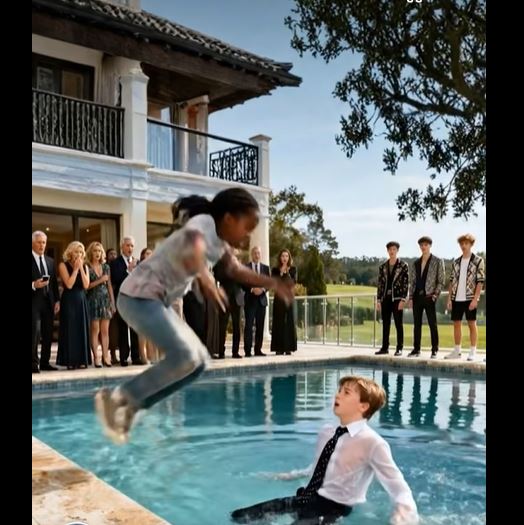
The pool was enormous, a shimmering rectangle of blue surrounded by white stone and tall glass walls. It belonged to the kind of people who never worried about water bills or lifeguard schedules—private, pristine, and silent except for the faint echo of laughter and splashing. That afternoon, the sun reflected sharply off the surface, making it hard to see beneath the ripples.

That was why it took a moment for anyone to realize something was wrong.
The rich kid had slipped under without a sound.
No dramatic thrashing. No shouting. Just a sudden absence where movement should have been. His arms sank first, then his head tilted back, mouth open, eyes wide, pulling in water instead of air. He was drowning the quiet way—the way no one talks about, the way that looks almost peaceful if you don’t know better.
People were nearby. Very nearby.
Adults lounged on chairs with sunglasses tilted low, drinks sweating in their hands. Other kids splashed, laughed, raced each other from one end of the pool to the other. Conversations continued. Music played softly from a speaker on the terrace.
And everyone just watched.
Some noticed and hesitated, unsure. Others glanced and looked away, assuming someone else would act. A few froze completely, minds locked between disbelief and fear. The boy’s expensive watch glinted once as his arm drifted upward, then sank again.
Time stretched in a way that didn’t make sense.
Across the pool, Itzel Morales stood perfectly still.
She had been invited as an afterthought—the daughter of a housekeeper, allowed to tag along for the day as long as she stayed “out of the way.” She wore an old one-piece swimsuit, faded from too many washes, and sandals that were slightly too big. She hadn’t gone into the pool much. She couldn’t afford swimming lessons like the others.
I remember standing there with my mouth open, trying to scream, trying to move, trying to do something. But no sound came out. My chest felt tight, like the air had been stolen from me instead. My eyes blurred—not just from tears, but from the way fear bends reality until everything looks wrong.
She didn’t shout for permission. She didn’t look around for approval. She kicked off her sandals and ran. Her feet slapped against the stone, and for a brief second, someone laughed—thinking it was a game, thinking she was about to show off.
Then she jumped.
The sound of her hitting the water was sharp, louder than it should have been. The laughter died instantly.
Itzel disappeared beneath the surface, eyes open, arms pushing hard against the water she barely knew how to fight. Her lungs burned almost immediately. Panic tried to take over, but she forced it down, reaching blindly until her fingers caught fabric.
Her legs screamed in protest. Her chest felt like it was going to explode. She wasn’t strong, and she wasn’t trained—but she was desperate, and desperation has its own kind of power.
She broke the surface first, gasping, coughing, then hauled him up with her. Water poured from his mouth as she screamed—finally screamed—for help.
That’s when everyone moved.
Chairs scraped back. Someone shouted. An adult finally ran forward and dragged them to the edge. The boy was lifted out, limp and terrifyingly still. Someone started chest compressions. Another called emergency services, voice shaking now, fear replacing the earlier indifference.
I remember standing there, heart pounding so hard it hurt, watching water spill across the stone like proof of what almost happened.
Relief hit like a wave. People laughed nervously. Someone said, “Thank God,” as if God had jumped into the pool Himself. Another adult wrapped the boy in a towel, fussing, apologizing, shaking.
Itzel sat on the ground, arms wrapped around her knees, coughing quietly. No one looked at her at first.
The boy’s mother rushed over, face pale, mascara streaked. She hugged her son tightly, sobbing, thanking everyone—everyone except the girl sitting on the wet stone, shivering.
Later, adults talked about how lucky it was. How fast they’d reacted. How things could have gone much worse. The story slowly changed, smoothing out the uncomfortable truth that most of them had done nothing at all.
That day split my childhood in two: before I understood how people freeze, and after I understood how rare it is not to.
Years have passed since then. The pool is probably still there, still clean, still surrounded by comfort and wealth. The rich kid grew up. So did I.