When the elevator doors opened onto the top floor of the penthouse, silence greeted him. The kind of silence that had become familiar—heavy, echoing, and deeply personal.
Nathaniel Cross, billionaire investor and owner of the sprawling estate, stepped out slowly, loosening his tie as he did every night. Wealth had given him everything except what mattered most, and the quiet halls of his home reminded him of that truth daily.
His mother, Eleanor Cross, lived with him now.
Once a celebrated pianist, a woman who filled rooms with music and laughter, she had slowly faded into confusion and fragments. Alzheimer’s had taken her memories piece by piece, until one day she looked at Nathaniel with polite eyes and asked his name. Since then, he had learned how to grieve someone who was still breathing.
That evening, something felt different.
Soft music floated through the hallway—an old waltz, faint but unmistakable. Nathaniel stopped mid-step, his breath catching. No one ever played music anymore. Eleanor no longer remembered how. The staff knew better than to disturb her routines.
He followed the sound.
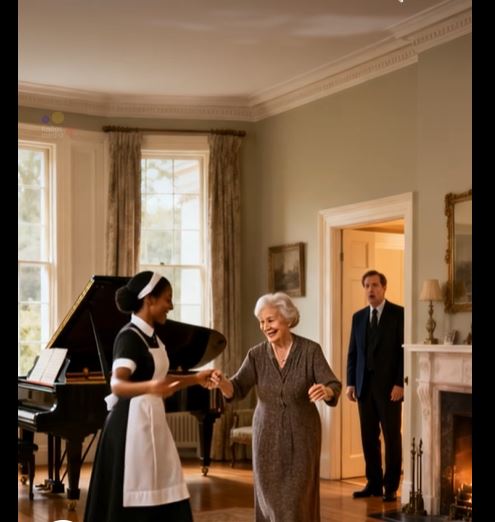
The living room lights were dimmed, curtains drawn just enough to let the city glow spill inside. And there, in the center of the room, he saw them.
His mother was standing.
Her hands were resting gently on the shoulders of a young woman—Lena, one of the newest employees. A quiet caregiver hired just months ago. They were moving slowly, swaying in time with the music, as if the world had narrowed down to only those few steps.
Eleanor was smiling.
Really smiling.
Nathaniel froze in the doorway, unseen.
Lena guided her carefully, not leading, not forcing—just following Eleanor’s pace. Her voice was soft, barely audible over the music.
“You’re doing wonderfully,” she whispered. “Just like before.”
Eleanor laughed—a sound Nathaniel hadn’t heard in years. “I used to dance, didn’t I?” she asked, her words fragile but clear.
“Yes,” Lena replied gently. “You loved it.”
Nathaniel felt something crack inside his chest.
His mother spun slowly, clumsily, but with joy. Her eyes were bright, alive in a way he thought he’d lost forever. She didn’t look confused. She didn’t look afraid.
She looked free.
Nathaniel stepped forward without thinking. The floor creaked softly beneath his shoe.
Eleanor turned.
Her smile didn’t fade—but it didn’t recognize him either.
“Oh,” she said pleasantly. “Are you joining us?”
The words landed harder than any insult ever could.
Nathaniel swallowed. “Mom,” he said quietly.
She tilted her head, studying him like a kind stranger. “Do I know you?”
The room went still.
Lena stiffened, fear flashing across her face. She quickly stepped back, releasing Eleanor’s hands. “Mr. Cross, I’m so sorry. I didn’t mean to—she remembered music today and I thought—”
Nathaniel raised a hand, stopping her.
“It’s alright,” he said, though his voice trembled. His eyes never left his mother.
Eleanor looked between them, suddenly uncertain. “Did I do something wrong?” she asked, her voice small now.
“No,” Nathaniel said immediately, crossing the room. He knelt in front of her, lowering himself so they were eye level. “You did nothing wrong.”
She smiled politely. “You’re very kind.”
The words cut deep.
Lena watched, heart pounding. She had seen this moment before—the realization, the heartbreak—but it never got easier. She had simply wanted to give Eleanor a moment of joy, a moment that didn’t revolve around confusion and fear.
“I used to dance with my son,” Eleanor said suddenly, looking back toward the silent music player. “He loved watching me. I don’t know where he is now.”
The music resumed, and once again, Eleanor began to sway. But this time, Nathaniel didn’t watch from the shadows. He stepped closer, sitting quietly on the sofa, witnessing something he had unknowingly been starving for.
Joy.
Pure, unfiltered joy—given not by medicine, money, or control, but by patience and kindness.
When the song ended, Eleanor grew tired. Lena helped her to a chair, wrapping a blanket around her shoulders. Eleanor yawned softly, her eyes fluttering.
“You’re a lovely girl,” she murmured. “Thank you for dancing with me.”
“You brought her back,” he continued. “Even if just for a moment.”
Tears filled his eyes—real ones, uncontrolled. “I’ve spent years trying to fix this disease with money. Specialists. Treatments. Research grants.” His voice broke. “And all it took was a song and someone willing to see her.”
Lena said nothing.
“I’ve never seen her smile like that since she forgot me,” Nathaniel whispered.