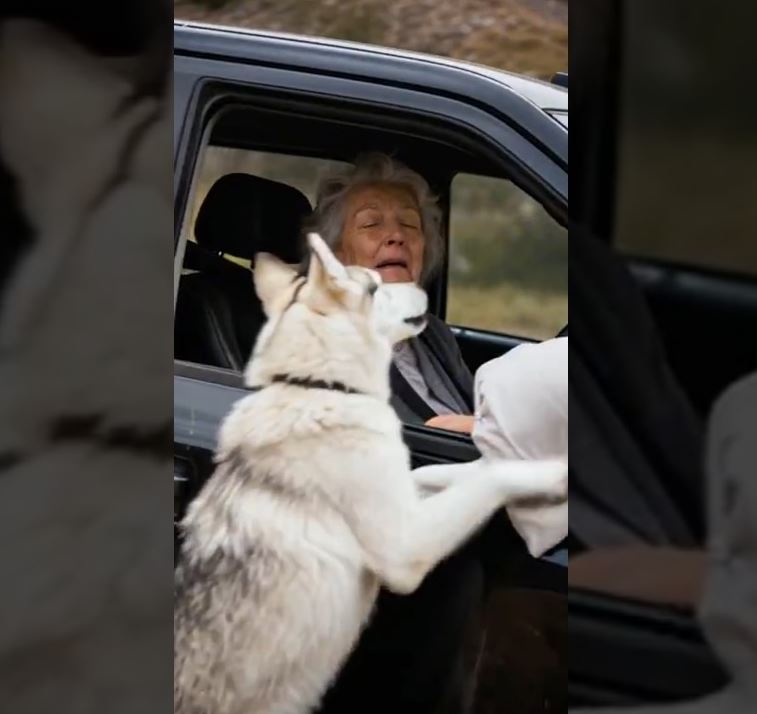
Dogs have been humanity’s companions for thousands of years. Loyal, perceptive, and often extraordinarily intuitive, they are more than pets—they are sentinels, friends, and sometimes our earliest warning systems.

While humans often overlook the subtle signs and behaviors dogs exhibit, these animals communicate constantly, alerting us to danger long before we can recognize it ourselves. This story is about understanding, respecting, and learning from their instincts—the ways in which dogs warn us, guide us, and sometimes even save our lives.
Take, for instance, the story of Max, a border collie living in a quiet suburban neighborhood. His owners, the Johnson family, were unaware that their home sat atop a faulty gas line.
Max, however, sensed something unusual long before the family did. He paced near the kitchen floor, sniffing the air relentlessly, whining softly, and scratching at the wall. When the Johnsons ignored him, Max grew more insistent, barking, pawing at doors, and refusing to leave the area.
Eventually, the family called the utility company, who discovered a dangerous gas leak. Max’s behavior had prevented a potential disaster.
This is not an isolated incident. Dogs possess senses far superior to humans: their sense of smell is thousands of times more acute than ours, allowing them to detect chemical imbalances, smoke, toxins, and even illnesses in humans.
They can hear frequencies far beyond human perception, alerting us to approaching storms, earthquakes, or intruders. Their instincts are honed through millennia of evolution, making them sensitive to subtle changes in the environment that we often overlook.
Many dogs demonstrate remarkable intuition about human emotions. Behavioral experts note that dogs can sense fear, anxiety, or illness in their owners. A dog might bark when a stranger approaches, not out of aggression, but as a protective measure. Some have even been known to wake families during fires, lead lost hikers back to safety, or alert children and adults experiencing medical emergencies like seizures or diabetic crises.
Consider the case of Daisy, a golden retriever trained as a medical alert dog. Her owner, a young man with epilepsy, had experienced unpredictable seizures for years. Daisy could sense the faint changes in her owner’s scent and body movements that occurred before a seizure began.
She would nudge him, lick his face, or bark to alert him to seek a safe place, preventing severe injury countless times. Her instincts were a literal lifeline.
Even outside of trained scenarios, dogs often act as guardians in subtle ways. A dog barking at a specific corner of a room, growling at a normally friendly visitor, or refusing to enter certain areas can be interpreted as warning signals.
Often, these behaviors have real causes—perhaps a human can’t hear or see, but the dog can sense it. People have reported cases of dogs alerting owners to fires, intruders, broken glass, or hidden animals. Some scientists believe dogs can even detect changes in electromagnetic fields, vibrations, or chemical markers that indicate danger.
Yet, despite their incredible sensitivity, humans frequently dismiss these warnings as trivial or irrational. We scold dogs for barking at nothing, pull them away from spaces we consider safe, and ignore their attempts to communicate. But animals, particularly dogs, are often giving us signals that can prevent accidents, injuries, or even death. Their loyalty is rooted not just in affection but in a deep-seated drive to protect the people they bond with.
It is crucial to pay attention to the subtle cues: a dog’s posture, the direction of their gaze, the tone of their bark, or the urgency of their movement. A sudden agitation may indicate something hidden, dangerous, or unexpected.
Dogs rarely act without reason; their instincts are fine-tuned to detect disturbances in the environment that our human senses cannot perceive.
This is why dogs have been used historically as early warning systems: herding dogs protecting livestock from predators, guard dogs alerting villagers to intruders, and sled dogs navigating treacherous Arctic terrain. Their abilities are extraordinary, often blending instinct, training, and intuition in ways that humans cannot replicate.
But there is a deeper lesson beyond mere survival. Dogs teach us patience, attentiveness, and respect for the natural world. They remind us that life is full of signals, many imperceptible to our limited senses, and that awareness and humility can be lifesaving.
They show that communication transcends words—that sometimes a nudge, a bark, or a look carries more meaning than pages of instructions or warnings.
In today’s modern world, where danger often hides in subtlety—poisoned food, gas leaks, approaching storms, or strangers with ill intent—dogs continue to serve as our vigilant guardians. Their loyalty, courage, and instinctual wisdom are gifts that demand recognition.