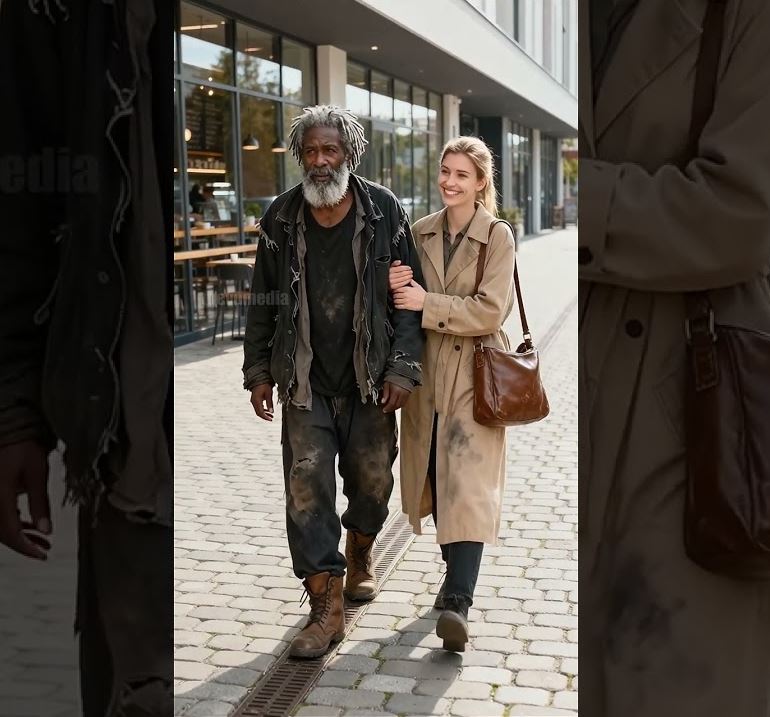
Everyone on Maple Avenue knew the man with the gray beard and the cardboard sign. He sat on the same patch of sidewalk every day, just outside the closed florist shop, rain or shine. Some people called him “the beggar,” others avoided looking at him at all. Very few knew his name.
His name was Samuel Carter.
Samuel had been homeless for nearly seven years, though he still remembered the exact date his life unraveled. A factory closure. A back injury. Prescription pills that slowly took control. A marriage that couldn’t survive the weight of disappointment and pain. One by one, the pieces fell away until all that remained was a backpack, a sleeping bag, and a street that never truly slept.
Yet despite everything he had lost, Samuel had kept one thing intact.
His kindness.
Every morning, he folded his blanket neatly, brushed the dust from his jacket, and whispered a quiet prayer before the city woke up. He didn’t ask for much. Most days, he barely asked at all. His sign didn’t mention hunger or tragedy. It simply read:
“If you can’t help, please smile.”
And Samuel smiled first.
One icy afternoon in late December, the wind slicing through coats and patience alike, Samuel noticed a woman standing across the street, holding a crying toddler. She looked frantic, rummaging through her purse, her face pale with panic. The child’s cries grew louder, raw and desperate, the kind that tightened Samuel’s chest.
People passed them without stopping.
Samuel pushed himself up, joints aching, and crossed the street slowly.
“Ma’am,” he said gently. “Is the little one okay?”
The woman looked at him, startled, instinctively pulling the child closer. “I… I think he’s sick,” she said, voice shaking. “He won’t stop crying, and I left my wallet at home. I don’t have money for a cab or the bus.”
Samuel glanced at the boy. His cheeks were flushed, his breathing uneven.
“Hospital’s three blocks that way,” Samuel said softly. “I’ll walk with you.”
The woman hesitated, then nodded, desperation overriding hesitation. Together, they walked through the cold, Samuel matching her pace, shielding the child from the wind with his own worn coat. When they reached the emergency entrance, Samuel didn’t go inside. He just waved gently and turned back toward Maple Avenue.
The woman never got his name.
Samuel returned to his spot, colder now, his hands numb. He checked his pockets. Earlier that day, a stranger had dropped a five-dollar bill into his cup. Samuel stared at it for a long moment, then stood again.
Across the street was a small bakery. He walked in, ignoring the looks, and bought a loaf of bread and two cups of soup. One he ate slowly, savoring the warmth. The other he carried down the block to an elderly man curled up beneath a bus stop bench.
That night, Samuel slept colder than usual, his blanket thin and the wind relentless. But he slept peacefully.
Three days later, something unusual happened.
A black SUV pulled up near the florist shop. The doors opened, and a well-dressed man stepped out, scanning the sidewalk. His eyes locked onto Samuel.
“You,” the man said, walking closer. “Are you the one who helped my sister?”
Samuel frowned. “I help a lot of people.”
The man swallowed hard. “My nephew. The little boy. Severe infection. Doctors said if they’d arrived even thirty minutes later…”
“My sister tried to find you,” Richard continued. “She went back to the hospital entrance. Asked around. Someone pointed her here.”
Samuel finally accepted the card, his hands rough against the smooth paper.
Richard exhaled slowly. “She hasn’t stopped crying since that day. She said you gave her your coat.”
Within a week, Samuel had a doctor’s appointment. His back injury was reassessed properly for the first time in years. Physical therapy was arranged. Then a small studio apartment—nothing fancy, but clean, warm, and his. A caseworker helped him replace lost documents. A barber trimmed his beard. New clothes replaced the ones worn thin by sidewalks and seasons.
But the moment that broke him came quietly.
Samuel stood alone in his apartment, holding a key that actually opened a door. He sat on the bed and wept, shoulders shaking, overwhelmed not by luxury—but by dignity.
Richard offered him a job too. Part-time maintenance. Flexible hours. “No pressure,” he said. “Just a place to start.”
Samuel showed up early every day.
Months passed. Samuel gained weight, strength, confidence. He still walked Maple Avenue often. Not because he had to—but because he remembered. He brought coffee. Socks. Warm words. He listened.