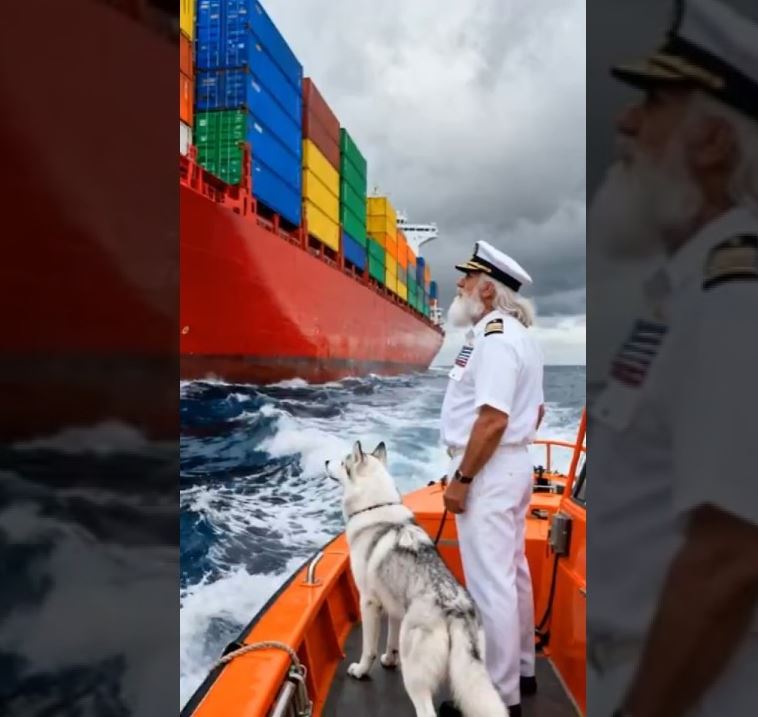
The ocean was calm in a way that felt almost deceptive, a vast sheet of dark blue stretching endlessly beneath a pale morning sky. The luxury cruise ship Aurora Crown cut through the water with effortless grace, its massive hull gliding forward as thousands of passengers slept, ate breakfast, or leaned against railings, enjoying the promise of a perfect day at sea. No one aboard suspected that danger was already awake—quiet, invisible, and growing by the minute.
On Deck C, near a restricted maintenance corridor, a medium-sized mixed-breed dog named Atlas lifted his head suddenly. Atlas was not a pet brought aboard for companionship. He was a trained safety and detection dog, assigned to the ship after a recent increase in onboard security measures. Most passengers barely noticed him, assuming he was simply another comforting presence for anxious travelers. Few understood that Atlas’s senses were sharper than any machine installed on the ship.
Atlas’s handler, Chief Security Officer Mark Ellison, had learned to trust that instinct without question. That morning, however, Mark was in the control room reviewing routine reports, unaware that Atlas—resting near a ventilation shaft—had begun to pace. The dog’s ears flattened, his tail stiffened, and his nose pressed close to the metal grating. Something was wrong.
The smell reached Atlas before anything else. Not smoke, not fire, but something far more dangerous—fuel vapors mixed with overheated wiring. It was faint, buried beneath layers of sea air, cleaning chemicals, and engine grease, but to Atlas it screamed urgency. He let out a low whine, then a sharp bark that echoed down the corridor.
A nearby crew member frowned. “Easy, boy,” he muttered, continuing on his way. But Atlas didn’t stop. He barked again, louder this time, scratching at the floor near the vent.
Minutes passed. The ship continued forward, oblivious. Beneath the lower decks, however, seawater had begun leaking into a mechanical compartment through a compromised seal. The water was creeping dangerously close to exposed electrical systems. A short circuit had already occurred, generating heat and releasing fumes that traveled silently through the ventilation system.
Atlas lunged toward the corridor door, barking furiously now. His urgency finally drew attention. A junior crew member stopped, unsettled by the dog’s behavior. “This isn’t normal,” she said, reaching for her radio. “Security, I think your dog’s trying to tell us something.”
Mark arrived moments later, his calm expression shifting as soon as he saw Atlas. The dog was no longer barking randomly—he was focused, insistent, pulling toward the vent and then back toward Mark, repeating the motion.
“What do you smell, buddy?” Mark murmured, crouching beside him.
Atlas responded by pressing his nose against the metal grating and releasing a sharp, urgent bark directly at it. Mark’s instincts kicked in. He ordered the area cleared and called engineering immediately.
Within minutes, engineers opened the access panel. The moment it came loose, a wave of hot, chemical-smelling air rushed out. One of the engineers cursed under his breath. “This shouldn’t be happening,” he said.
Alarms were triggered quietly at first—internal systems alerting command staff without panicking passengers. Thermal sensors revealed rising temperatures below Deck D. The situation was far worse than anyone expected. If the water reached the main electrical junction, it could cause a catastrophic fire or even an explosion.
The captain was notified. Calm, experienced, and precise, she initiated emergency protocols while keeping the ship’s public atmosphere steady. Passengers were politely asked to remain in their current areas. No sirens. No shouting. Panic would only make things worse.
Atlas, meanwhile, refused to leave Mark’s side. As crew members rushed past, the dog remained alert, eyes tracking every movement, ears flicking at distant sounds humans couldn’t hear. When the ship subtly changed course to reduce strain on the affected section, Atlas adjusted his stance instinctively, bracing himself.
Below deck, engineers worked frantically. Pumps were deployed to remove the water. Power was rerouted. But the heat continued to rise. One wrong move, one delayed decision, and thousands of lives could be at risk.
Then the worst happened.
A secondary system failed, sending a jolt through a cable line. Sparks flew inside the compartment. Smoke began to spread rapidly through the ventilation shafts. This time, humans could smell it too.
The captain made the call. Evacuation drills were initiated—not full abandonment, but strategic relocation of passengers away from the danger zone. Crew members moved swiftly, calmly guiding families and elderly passengers toward upper decks.