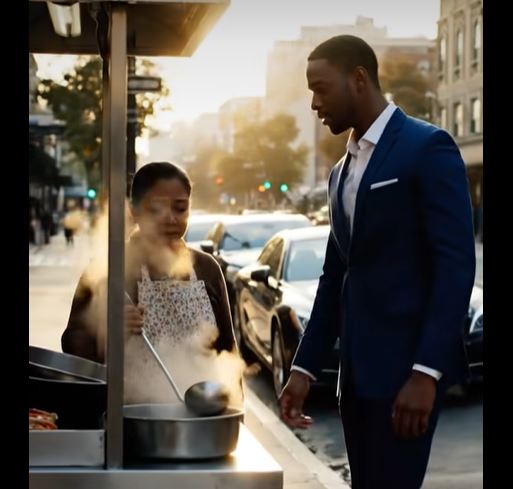
It was just past dawn when Maria unlocked the shutters of her small food stall at the corner of the city’s busiest street. The aroma of freshly fried pastries and simmering soups wafted into the chilly morning air, drawing in early commuters, street cleaners, and a few lingering night-shift workers.

Her stall was modest—nothing like the polished cafes downtown—but it was hers. Every corner, every utensil, every pot reflected the effort of someone who had poured not just labor but heart into a simple dream.
That morning, as she arranged the small baskets of bread, Maria noticed movement at the edge of the street. Three children appeared, ragged, hungry, and dirty. Their clothes were torn, and their faces carried the unmistakable look of those who had grown up on the streets—watchful, wary, and endlessly hungry.
But there was something else about them, something that made Maria stop for a heartbeat: they were triplets. Three tiny faces almost identical, moving together with an unspoken coordination that only siblings—or perhaps, twins and triplets—could have.
Maria didn’t hesitate. She called them over with a warm voice. “Come here, you three. You look like you could use some breakfast.”
The children approached cautiously, their eyes scanning for danger. Hunger outweighed fear, and they settled themselves near the edge of the stall. Maria handed each a steaming bowl of soup and a fresh piece of bread.
Their eyes lit up the moment they tasted it. Maria watched them, smiling softly, as they ate quickly but politely, trying not to seem desperate. She refilled their bowls without a word, only with care.
“Thank you,” the eldest whispered finally, his voice cracking slightly. “We… haven’t eaten like this in a long time.”
Maria shook her head. “No need to thank me. Just eat. You deserve it.”
For a few weeks, the routine continued. Every morning, the triplets appeared, and Maria fed them. Sometimes she gave them extra bread to take with them, and sometimes she offered blankets or jackets during the cold winter mornings. No one else at the market seemed to notice—or perhaps no one cared—but Maria never thought about recognition. She simply acted because it was the right thing to do.
Years passed. The triplets grew taller, stronger, and more confident, but they never forgot Maria’s kindness. They would occasionally wave from a distance or leave small tokens behind—a flower, a note, a drawing—but they respected her space and her pride. Maria continued her work at the stall, unaware of the mark she had left on their lives.
Then, one humid summer afternoon, the routine was broken in a way Maria could never have imagined. A low, powerful hum approached from the street, drawing her attention. Three Rolls-Royces rolled to a stop directly in front of her stall, their polished bodies gleaming in the sun.
The drivers remained in the cars for a moment before the rear doors opened, revealing three young men—well-dressed, confident, and unmistakably familiar.
Maria froze. There was something about their faces, the way they looked at her with a mixture of recognition and gratitude, that sent her heart racing. One of them stepped forward and spoke. “Do you remember us?”
She blinked, unsure if she heard correctly. “I… I’m sorry. I—”
“We’re the triplets,” another said, smiling. “The ones you fed years ago when we had nothing.”
Her hand flew to her mouth. The children she had fed, cared for, and quietly helped had grown into confident young men. And now, they were standing before her, successful in ways that seemed impossible to imagine back then.
“We haven’t forgotten what you did for us,” the eldest said, his voice steady. “Back then, you gave us hope. You gave us food, safety, and kindness when no one else did. And because of that, we’ve never forgotten you.”
Maria’s eyes filled with tears. She had never sought anything in return, never expected acknowledgment, and certainly never imagined the impact of her small acts of kindness. Yet here they were, standing before her with an offer that stunned her into silence.
“We want to invest in your stall,” the youngest said. “We want to help you expand, give you the success you deserve, and show our gratitude in a way that matches what you gave us.”
Maria shook her head, laughing through tears. “I… I can’t accept that. I was just… I was just trying to help.”
“No,” the middle one insisted. “You gave us a start when we had nothing. You believed in us when no one else did. Now it’s our turn to believe in you. You deserve everything this life can give.”