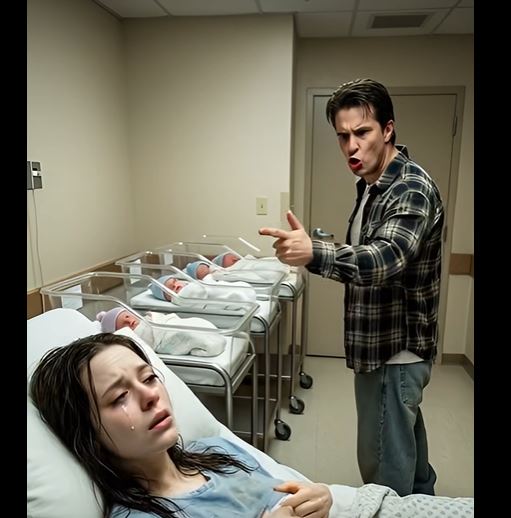
In the spring of 1995, the rain had not stopped for three days straight. The small maternity ward smelled of antiseptic and damp clothes, and the fluorescent lights flickered as if they, too, were exhausted. On a narrow hospital bed lay Elira, pale and shaking, her hair plastered to her forehead with sweat.

She had been in labor for nearly twenty hours. Doctors moved quickly around her, voices urgent but controlled, as one miracle after another entered the world.
Five babies.
Five tiny cries.
Five fragile lives fighting to breathe.
When the final baby was placed beside her, Elira broke down in tears—not from fear, but from overwhelming love. She whispered their names again and again, promising them silently that she would protect them, no matter what it took.
Her husband, Arben, stood frozen near the wall.
“This can’t be happening,” he muttered, his face drained of color. “Five? They said it was twins. Maybe triplets at most.”
A nurse corrected him gently. “They’re all stable. It’s rare, but it happens.”
Arben didn’t step closer. He didn’t touch the babies. He didn’t look at Elira.
Instead, he ran a hand through his hair and said the words that would scar her for life.
“This is a burden,” he said flatly. “I didn’t sign up for this.”
Elira stared at him, stunned. “They’re your children.”
He shook his head. “Five mouths to feed. Five futures to pay for. I won’t destroy my life for this mistake.”
The next morning, while Elira slept from exhaustion, Arben was gone.
No note.
No goodbye.
No explanation to the hospital staff.
Just absence.
For weeks, Elira waited, telling herself he would come back once the shock wore off. But days turned into months, and months into years. She left the hospital alone, pushing five incubators down a long hallway, her heart breaking with every step.
Life after that was survival.
She moved back into her parents’ tiny house. Money was always short. Some nights she skipped meals so the babies could have formula. She washed cloth diapers by hand in freezing water and rocked five cribs at once, humming lullabies until her voice disappeared.
People stared when she walked down the street with five toddlers holding onto a rope. Some admired her. Others pitied her. A few whispered cruel things.
But Elira never complained.
She worked three jobs over the years—cleaning offices at dawn, sewing clothes at home, and later working in a school kitchen. She celebrated birthdays with homemade cakes and secondhand gifts. She taught her children kindness, discipline, and gratitude.
They grew.
Five children, each different, each brilliant in their own way.
One became a doctor.
One an engineer.
One a teacher.
One a software developer.
One stayed close to home, managing the family business Elira eventually built from nothing—a modest but successful bakery that became famous in their town.
By the time Elira turned sixty, she was no longer poor. Not wealthy in luxury, but rich in something far more valuable—respect, stability, and a family that loved her fiercely.
And then, one autumn afternoon, thirty years later, the past knocked on her door.
Elira was in the bakery office reviewing invoices when her assistant hesitated at the doorway.
“There’s a man asking for you,” she said. “He says… he’s family.”
Elira’s hands went still.
When she stepped into the front of the bakery, she saw him immediately. Older, heavier, his hair gray and thinning—but unmistakable.
Arben.
He smiled awkwardly, as if no time had passed. “Elira. You look… well.”
Her heart didn’t race. It didn’t ache. It felt nothing.
“What do you want?” she asked calmly.
He cleared his throat. “I heard about the business. About the kids. I thought… maybe it’s time we talked.”
The children arrived one by one, drawn by the tension in the room. They recognized him instantly—from old photos, from stories their mother never told in anger, only in truth.
“I’m your father,” Arben said, spreading his arms slightly. “I deserve to know you.”
One of the sons stepped forward. “You left.”
Arben sighed. “I was young. I was scared. But I’m here now. And legally…” he hesitated, “this business, this property—it’s partly mine.”
The room went silent.
Elira looked at him for a long moment, then laughed softly—not with joy, but disbelief.
“You think you can walk back in after thirty years and take what I built?” she asked.
“I’m entitled,” he insisted. “I’m their father.”
Her daughter spoke up then, voice steady. “No. You’re just a stranger with our last name.”