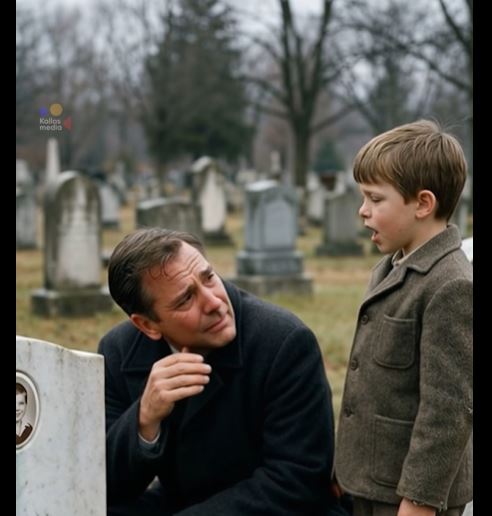
The cemetery was wrapped in a heavy silence, broken only by the soft rustling of leaves and the distant hum of passing cars. Gray clouds hung low over the city, casting a somber shadow across rows of polished headstones. Black umbrellas dotted the landscape as mourners gathered for the burial of a child whose life had ended far too soon.
Ethan Whitmore stood motionless beside the small white coffin.
He was one of the most accomplished CEOs in the country — a visionary leader who had built a global pharmaceutical empire from a modest laboratory. His name symbolized power, intelligence, and control. Yet none of those things mattered now. Standing at his son’s grave, Ethan was simply a father drowning in grief.
His eight-year-old son, Daniel, had been hospitalized for months after a sudden and aggressive illness. Doctors had done everything they could, or so Ethan had been told. Machines had surrounded the boy, tubes and monitors tracking every fragile breath. Ethan had spent countless nights in that sterile hospital room, holding his son’s hand, whispering promises that everything would be alright.
Four months later, Daniel was declared dead.
Or at least, that was what Ethan believed.
The funeral proceeded quietly. Colleagues, relatives, and business partners offered condolences, their words blending into meaningless echoes. Ethan barely heard them. His mind replayed the last moments he had seen his son — pale, motionless, surrounded by the cold glow of medical equipment.
A quiet sob escaped him as the coffin was slowly lowered into the ground.
Then, something unexpected happened.
A small boy standing nearby tugged gently at Ethan’s coat.
“Sir…” the child whispered, his voice uncertain. “That boy played soccer with me yesterday.”
Ethan froze.
He looked down at the child — a thin, nervous boy no older than seven, clutching a worn soccer ball against his chest. The boy pointed toward Daniel’s photograph displayed beside the grave.
The world seemed to tilt.
“What did you say?” Ethan asked, his voice barely audible.
The child swallowed. “I saw him. At the park near the hospital. We played together yesterday afternoon.”
Murmurs spread among the mourners. Some assumed the child was confused, others tried to guide him away, but Ethan’s heart pounded violently in his chest.
A fracture — small but devastating — formed within him.
At first, Ethan tried to dismiss the claim. Grief could distort reality, and children sometimes confused faces. But something about the boy’s sincerity unsettled him. The child described Daniel’s smile, the small scar above his eyebrow from a bicycle accident, and the way he laughed when he scored a goal.
Details no stranger could know.
That night, Ethan could not sleep. Questions consumed him. How could a child declared dead have been playing soccer just a day before his funeral?
Driven by a growing sense of unease, he returned to the hospital the next morning.
The hospital staff greeted him with professional sympathy, but Ethan’s demeanor had changed. His voice was calm, yet beneath it burned relentless determination.
He demanded to review Daniel’s medical records.
At first, administrators hesitated, citing confidentiality and procedural complexity. But Ethan was not merely a grieving parent — he was one of the hospital’s largest donors and a powerful figure whose influence could not be ignored.
Reluctantly, they complied.
Hours of review revealed something deeply troubling.
Inconsistencies appeared in Daniel’s charts. Several monitoring reports were missing. Signatures did not match. Time stamps showed unexplained gaps. The official death report had been authorized unusually quickly, without the full verification process typically required.
A cold realization spread through Ethan’s mind.
Something was wrong.
Determined to uncover the truth, Ethan began his own investigation. He reviewed surveillance footage from the hospital, interviewed nurses, and hired independent medical experts to analyze the records.
What he discovered was almost unthinkable.
A critical administrative error had occurred four months earlier. During a chaotic night in the pediatric ward, two patients with similar names had been mistakenly switched in documentation. One child had died. The other — Ethan’s son — had been transferred to a specialized recovery program under a different identity.
The hospital, fearing legal consequences, had concealed the mistake.
Daniel Whitmore had never died.
Ethan’s world shattered and reformed in the same moment.
Rage surged through him — at the deception, the negligence, the months of stolen time. But beneath the anger burned overwhelming hope.
If the records were correct, his son was alive.
The hospital eventually confirmed the truth under legal pressure. Daniel had been placed in a rehabilitation facility outside the city, slowly recovering after experimental treatment showed unexpected success.
The funeral had been arranged based on falsified documentation meant to cover the hospital’s catastrophic error.