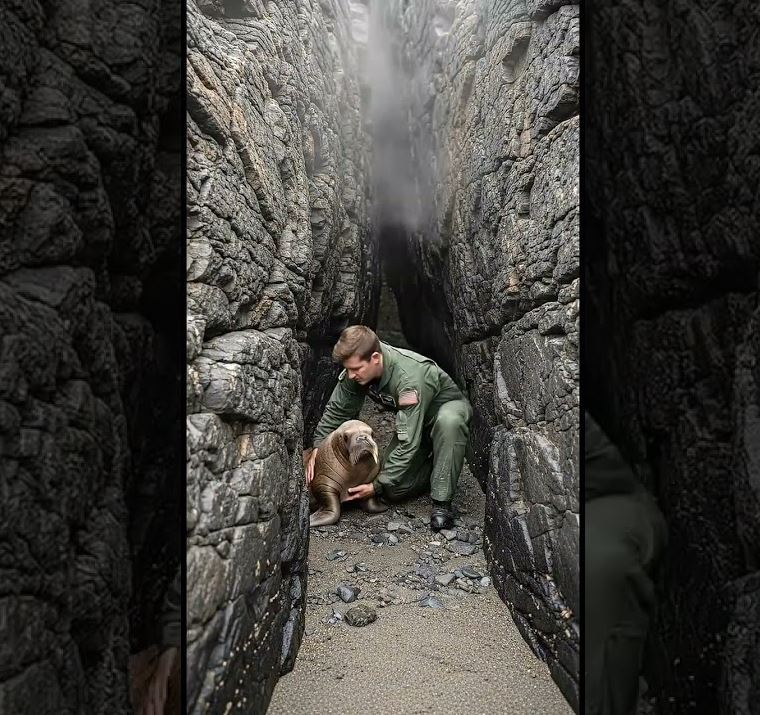
The discovery happened on a freezing morning along the remote shores of northern Alaska, where the vast ocean met endless stretches of ice and silence ruled the land.
The sky was a pale shade of gray, and the wind swept across the frozen coastline with a sharp, biting force. It was in this harsh and unforgiving environment that a team of marine researchers stumbled upon a sight none of them would ever forget—a tiny baby walrus, alone, shivering, and crying helplessly on a drifting slab of ice.
The research vessel Arctic Hope had been conducting routine observations of marine mammals in the region. Led by marine biologist Dr. Elena Markov, the team had spent weeks tracking walrus populations, studying migration patterns, and monitoring the effects of climate change on their natural habitat. They were accustomed to witnessing difficult scenes in the wild, but nothing had prepared them for what they were about to encounter.
Through her binoculars, Dr. Markov noticed a small movement in the distance. At first, she assumed it was a seal resting on the ice, but something about its behavior seemed unusual. The creature moved awkwardly, letting out weak, distressed cries that echoed faintly across the icy waters.
“Turn the vessel slightly to the left,” she instructed the captain, her voice tense with concern. As the ship drew closer, the team realized the truth—a baby walrus calf, no more than a few weeks old, stranded and completely alone.
Walrus calves rarely leave their mothers’ sides. They depend on them for warmth, nourishment, and protection against predators. The absence of the mother meant the calf’s chances of survival in such a brutal environment were dangerously low.
The tiny walrus struggled to lift its head, its whiskered face coated with frost. Its small flippers trembled as it attempted to crawl across the unstable ice. Each cry it released sounded weaker than the last, a heartbreaking call for a mother who would never come.
The team immediately faced a difficult decision. Intervening in nature is always complicated, but in this case, leaving the calf alone would almost certainly mean its death. After a brief but intense discussion, Dr. Markov made the call—they would attempt a rescue.
Carefully, the crew lowered a small inflatable boat into the freezing water. Two researchers, dressed in heavy protective gear, approached the fragile ice sheet with extreme caution. The calf, sensing movement, cried louder but lacked the strength to flee. Its dark, watery eyes seemed filled with fear and confusion.
As the rescuers drew near, they spoke softly, trying to calm the distressed animal. One of them gently wrapped the trembling calf in a thick thermal blanket while the other stabilized the shifting ice. The baby walrus offered little resistance, as if sensing that help had finally arrived.
When they lifted the small creature into the boat, the calf let out a faint sound and pressed its body against the rescuer’s chest, seeking warmth. It was a moment that silenced even the most experienced members of the team. In that instant, the raw vulnerability of the animal and the trust it showed left everyone deeply moved.
Back aboard the Arctic Hope, the crew quickly created a temporary care area. They warmed the calf gradually, careful not to shock its fragile system. A veterinarian on board examined the animal and confirmed that it was severely dehydrated and malnourished but otherwise free from serious injury.
They named the baby walrus “Nuka,” meaning “little brother” in the local Inuit language—a name that symbolized both his vulnerability and his place among those who now cared for him.
The following days became a race against time. Walrus calves rely heavily on their mothers’ milk, which is rich in nutrients essential for survival. The team worked tirelessly to develop a substitute formula, feeding Nuka every few hours. At first, he refused the bottle, crying desperately and searching for the comfort of his mother.
But gradually, with patience and gentle care, Nuka began to accept the nourishment. His strength slowly returned, and his weak cries turned into louder, more energetic calls. The once fragile calf started to explore his surroundings, using his tiny tusks to investigate anything within reach.
Despite the progress, the team knew that long-term survival in captivity was not the goal. Their mission was to rehabilitate Nuka and return him to the wild whenever possible.
For a walrus, social bonds and natural behaviors are essential for survival, and human care could never fully replace the guidance of a mother or the presence of a herd.