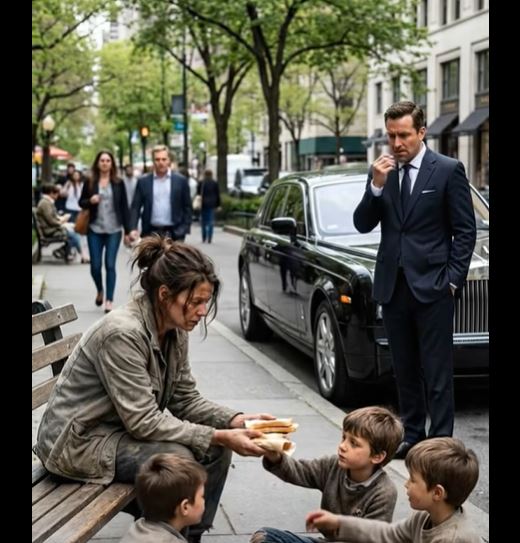
It was a cold, rainy evening in the outskirts of the city. Streetlights flickered, casting dim halos over puddles that reflected the soft glow of neon signs from the shops along the street.
Most people hurried past, eager to reach the warmth of their homes. But one man paused near a modest apartment building, a figure out of place in his tailored coat and polished shoes.
Leonard Matthews was a wealthy entrepreneur, a man whose life revolved around boardrooms, deals, and endless meetings. Yet tonight, he felt restless. Money, success, and power had never seemed enough.
Something inside him sought meaning beyond wealth—a reminder that life’s true value wasn’t measured in dollars or possessions.
As Leonard glanced into a small apartment window, he noticed a woman sitting on a worn rug, her children gathered closely around her. She had carefully divided a single plate of rice and beans among them, making sure each child received an equal portion.
Her hands were rough from years of work, yet there was a grace in the way she moved, a quiet dignity in her careful gestures. Her children, though hungry, accepted their portions with trust and gratitude, their eyes shining with love for their mother.
Leonard stood frozen, observing the scene in silence. Here was a family with almost nothing, yet they shared everything they had, and they did so without complaint, without despair.
He knocked lightly on the door, unsure of what he would say. The mother, Maria, opened it cautiously, her face lined with exhaustion and a wary distrust of strangers. “Yes?” she asked softly, her voice hesitant. Leonard could see the weariness in her eyes, the way life had already demanded more than her young shoulders should bear.
“I… I couldn’t help but notice,” Leonard began, struggling to find the words, “the way you care for your children. I want to help. Not with charity, not with pity—but in a way that could make a real difference.”
Maria’s brow furrowed. “I appreciate the thought,” she said cautiously, “but we’ve learned not to trust people who only give for recognition. We survive on what we have, and that’s enough for us.”
Leonard nodded, understanding. He had seen pride in many forms during his life, but there was something about this mother’s quiet strength that struck him. She wasn’t asking for help; she was doing everything she could to shield her children from the harsh realities of the world. Her resilience was inspiring.
Over the following weeks, Leonard found ways to support Maria and her family—not through handouts, but through opportunity. He connected her with a local organization that helped parents develop home-based businesses.
Maria, who had always dreamed of opening a small catering service, now had the guidance, resources, and training she needed to make it a reality. Leonard also ensured her children had access to quality education, enrolling them in programs that nurtured their talents and potential.
Maria’s eldest daughter, Sofia, had always loved science but had never had the means to explore her interest. With the scholarships Leonard arranged, she gained access to science kits, after-school programs, and mentors who encouraged her curiosity.
Mateo, the middle child, had a natural talent for painting and storytelling. With access to art classes and supplies, his imagination blossomed, giving him an outlet for expression and confidence he had never experienced before.
Even little Clara, the youngest, benefited from early childhood programs that nurtured her social and emotional growth.
Through it all, Maria never lost sight of what had mattered most—the lessons she had taught her children during countless nights of scarcity: patience, sharing, empathy, and gratitude.
She encouraged them to care for others, to value kindness over wealth, and to remember that even small acts of love could create ripples far greater than money ever could.
Leonard watched the family evolve with a mixture of pride and awe. He had entered their lives as a stranger, but he became a witness to the transformative power of compassion combined with opportunity.
He realized that no amount of money alone could have created the results he now saw; it had been Maria’s care, determination, and the foundation of trust she built with her children that allowed them to thrive.
Months passed, and the small apartment transformed. The meal that had once been a single plate shared among three hungry children now became a symbol of resilience and hope.
Maria’s catering business grew, providing not only for her family but also employing others in her neighborhood, creating a cycle of empowerment. Her children excelled in school, their talents nurtured and celebrated, their futures brightened by the combination of their mother’s perseverance and Leonard’s support.