The small chapel sat at the edge of the village, its weathered stone walls bathed in the soft golden light of dawn. The smell of incense drifted through the air, mingling with the faint chill of the early morning.
Villagers trickled in slowly, their faces solemn, some carrying baskets of food, others clutching prayer books worn by generations of devotion. It was a sacred time — a morning service meant for reflection, gratitude, and community.
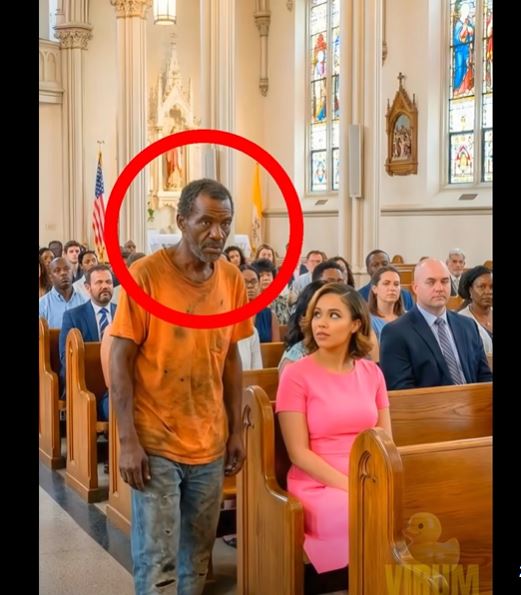
That morning, a man appeared at the chapel doors who immediately caught the attention of everyone present. His clothes were tattered, his hair matted, and his face carried the grime of a long life lived on the streets. His hands shook slightly as he held a small, empty satchel, and his eyes darted nervously from the chapel doors to the gathered congregation.
Whispers spread through the pews almost instantly.
“Who is that?” a woman murmured.
“Does he even belong here?” another whispered sharply.
Many shook their heads in disapproval, muttering about how someone so unkempt could even dare enter the sacred space. A few elders exchanged glances, clearly uncomfortable. Some assumed he was seeking charity, others judged him for what they perceived as laziness or misfortune brought upon himself.
The man didn’t speak. He simply moved toward a back pew, trying to make himself as small as possible, bowing his head as quietly as he could. Yet every step seemed to attract more eyes, more judgment, more murmurs.
The priest, Father Benedict, noticed immediately. He had seen judgment before — in the marketplace, in whispers along the streets, even here in the house of God. But he believed the chapel should be a sanctuary for everyone, no matter their appearance.
As the man knelt awkwardly in the back, Father Benedict approached him quietly.
“Good morning, my son,” he said gently. “Come with me.”
The congregation watched, some frowning, others murmuring, but the priest ignored the disapproval. He led the man to the vestry, a small room behind the altar where robes and ceremonial garments were kept.
“Here,” Father Benedict said, handing him clean clothing. “Change into these.”
The man’s eyes widened. “I… I can’t,” he stammered.
“Yes, you can,” the priest said kindly. “And you should. You deserve to feel clean and whole, even if only for today.”
The man nodded hesitantly. With trembling hands, he changed into the simple, modest clothes the priest had provided. For the first time that morning, his face looked lighter, his posture a little less slouched.
Father Benedict then brought out a bowl of warm water and a towel. “Wash yourself, my son,” he said. “It’s a blessing to begin anew.”
The man knelt before the water, and as he carefully cleaned himself, a sense of dignity returned with each motion. The grime of the streets, the judgment of strangers, even the shame of his own circumstances seemed to melt away with the simple act of washing.
Finally, Father Benedict led him back into the chapel. The congregation watched in silence, many avoiding his eyes, some still whispering under their breath. But the man walked tall now, his shoulders straightened, his head held high. He knelt in the front row, his hands clasped in genuine prayer.
The service began, and as the congregation recited hymns, a remarkable thing happened.
The man’s voice joined the others, soft at first, then stronger, filled with sincerity and devotion. Every word, every note, carried a purity that few could ignore. Some of the villagers shifted uncomfortably, suddenly aware of the contrast between their own quiet judgments and the unmistakable faith radiating from the man before them.
Father Benedict glanced around and smiled softly, knowing that faith is not measured by appearances, by wealth, or by social standing — but by the heart. He had given this man food, clean clothes, and the simple act of washing, and in return, he had witnessed the truest devotion of all.
When the service ended, the man lingered for a moment, quietly thanking the priest. He left with a small loaf of bread and a warm cup of stew, gifts from the chapel, and a heart renewed with dignity. Outside, the sun rose higher, casting its warm glow over the village streets.
The villagers returned to their routines, some still whispering, some still judging, but a seed had been planted. They had seen that true faith does not announce itself in riches or social standing. It manifests quietly, humbly, and sometimes in the people least expected to inspire it.
Father Benedict stood at the doorway, watching the man disappear down the cobblestone path. He whispered a prayer of gratitude, not just for the man, but for the reminder that kindness, compassion, and opportunity can reveal the deepest truths of the human spirit.