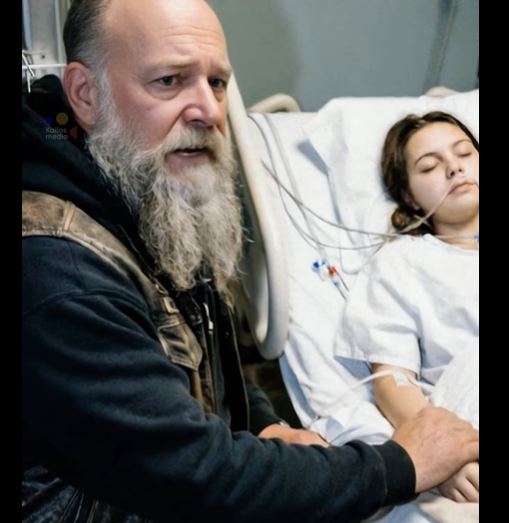
When my daughter fell into a coma, the world didn’t end all at once. It unraveled slowly — in quiet hospital hallways, in the steady rhythm of machines, in the unbearable silence where her laughter used to be.
Sofia had been my entire world since the day she was born. A bright, stubborn seventeen-year-old with dreams of becoming a musician, she filled every room with life. But one rainy evening, a devastating car accident stole that light in an instant. The doctors called it a severe traumatic brain injury. They said she might wake up.
They also said she might never.
Days turned into weeks. Weeks turned into months. Her hospital room became my second home. I memorized every sound — the steady beep of the heart monitor, the hiss of the oxygen machine, the distant footsteps of nurses in the corridor. I spoke to her constantly, telling her stories, playing her favorite songs, begging her to come back to me.
But she never responded.
Then, one morning, about three weeks after the accident, I noticed something strange.
A large man dressed in black leather stood quietly near her hospital bed.
He was impossible to miss — tall, broad-shouldered, covered in tattoos, wearing heavy boots and a worn biker jacket. His long gray-streaked beard and hardened expression made him look intimidating, almost dangerous. Yet his eyes, as he looked at my daughter, held something entirely different.
Gentleness.
I froze in the doorway, confused and immediately defensive.
“Can I help you?” I asked sharply.
He turned, clearly startled, and nodded respectfully.
“I’m sorry,” he said in a low voice. “I didn’t mean to intrude. I just wanted to check on her.”
“Do you know my daughter?” I demanded.
He hesitated, then simply said, “No… not really.”
The answer made no sense.
Before I could question him further, he quietly excused himself and left the room. Through the window, I watched him walk across the parking lot toward a powerful motorcycle and ride away.
I assumed it had been some kind of mistake.
But the next day, he returned.
And the day after that.
Every afternoon, at exactly the same time, the biker appeared. He never caused trouble, never spoke much, never overstayed his welcome. He would sit beside Sofia, speak softly to her, sometimes read aloud from a small book he carried, then leave.
The nurses said he always asked permission. He was respectful, calm, and never disruptive. Still, I couldn’t understand why a stranger would show such dedication.
Weeks passed, and his visits never stopped.
One day, curiosity finally overcame suspicion.
I arrived earlier than usual and stood outside the room before entering. Through the partially open door, I heard his voice — deep, gentle, filled with emotion.
“You’re stronger than you think, kid,” he was saying softly. “You fought harder than anyone I’ve ever known. You just need to keep fighting a little longer.”
I stepped inside quietly.
He turned and nodded politely.
“Why are you doing this?” I asked.
He looked at Sofia for a long moment before answering.
“Because she once saved my life.”
My breath caught.
He pulled a chair closer and began to explain.
Six months before the accident, he had been sitting alone on a bridge late at night, drowning in grief after losing his wife and son in a tragic fire. He had planned to end his life. No one had noticed him — no one except Sofia.
She had been walking home from music practice when she saw him. Instead of passing by, she had stopped. She sat beside him and spoke for hours — about music, about hope, about pain, about how even broken people could heal.
“She gave me a second chance,” he said, his eyes glistening. “When I heard about her accident on the news, I knew I had to be here for her the way she was there for me.”
Tears filled my eyes as I listened. My daughter had never mentioned this encounter. She had saved a life without ever telling anyone — not for praise, not for recognition, simply because she cared.
Over time, he became part of our strange hospital routine. He spoke to Sofia about the outside world — about sunsets, music playing on the radio, the changing seasons. He told her stories about his wife, his son, and how Sofia’s kindness had pulled him back from darkness.
Doctors began speaking cautiously about reducing hope. They explained that six months in a coma drastically reduced the chances of recovery. They suggested preparing for the possibility that Sofia might never wake.