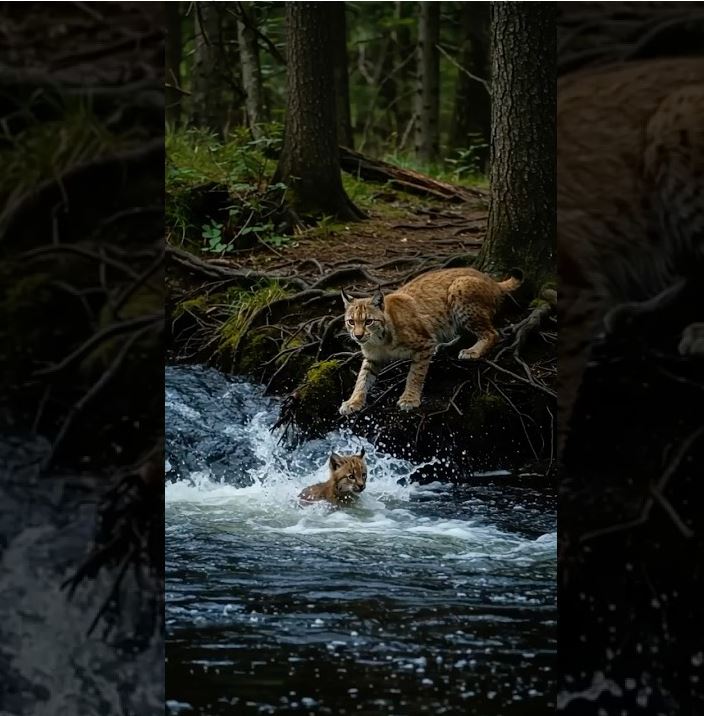
The river ran faster than usual that spring evening, swollen with the melting snow from the mountains above. Its waters churned and roared over jagged rocks, carrying branches and leaves along with it, as if the current itself were alive and restless.
The forest surrounding the river was quiet, the usual chorus of birds muted by the roar of rushing water. Most people would have avoided coming this far, but not Anton. He had grown up in these woods, knowing every hidden path, every tree, every whisper of the wind.
As he walked along the riverbank, scanning for firewood to bring back to his small cabin, a faint, desperate sound reached his ears—a high-pitched cry that cut through the noise of the river.
At first, he thought it was a bird, but the urgency in the sound told him otherwise. His instincts sharpened, and he began moving quickly along the bank, following the sound.
It wasn’t long before he saw the source. A small lynx cub, no older than a few months, was struggling in the river’s icy water. Its tiny paws flailed helplessly against the current, and each attempt to claw at the bank was met with failure.
The animal’s fur was soaked and matted, its eyes wide with terror. Anton’s heart tightened. He had seen animals drown before—fawns swept away by spring floods, birds trapped in ice—but to see a creature so young fighting so desperately was unbearable.
Without hesitation, Anton shed his jacket and rolled up his sleeves. He knew the river was dangerous; the current could easily drag a man off his feet, yet there was no time to hesitate. The cub’s life depended on immediate action.
He waded into the water, feeling the icy cold bite into his legs, the current tugging at him with every step. Each movement required careful calculation, but he could not afford caution. The cub was tiring, its small limbs flailing more weakly with every second. Anton extended his arm, reaching toward it, and the cub, in a mix of fear and instinct, lunged toward his hand.
With a surge of strength, he grabbed the tiny animal, holding it close to his chest. Its fur was slick and cold, and it trembled violently against him.
Anton felt the current push against his legs, threatening to unbalance him, but he pressed on, inch by agonizing inch, until he reached the safety of a shallow ledge. Once on firmer ground, he sank to his knees, exhausted but relieved. The cub had survived.
For a long moment, Anton simply held the lynx, stroking its wet fur and whispering soothing words. Its rapid breathing gradually slowed, and its wide, frightened eyes began to soften with trust. The forest, once drowned in the roar of the river, now seemed to hold its breath with him, as if acknowledging the fragile life that had been spared.
Knowing the cub could not survive on its own in this weakened state, Anton decided to take it back to his cabin. He wrapped it in his dry jacket, making a little nest for warmth, and carried it carefully through the forest.
Each step was a reminder of how fragile life could be—one misstep, one slip, and they both could have been claimed by the river.
Back at his cabin, Anton placed the cub near the fire he had lit earlier. He prepared a mixture of milk warmed slightly, knowing that the cub was likely hungry and cold.
The lynx hesitated at first, but hunger won over fear, and it began to drink, its small body trembling with relief. Anton watched quietly, his heart swelling with a mixture of pride, awe, and wonder.
Over the next few days, he nurtured the cub back to strength. He cleaned its fur, fed it carefully, and made sure it had a safe, dry place to rest. The bond between man and animal grew quickly—trust forged in the crucible of danger and survival.
The cub, which Anton named Luma, began to show signs of its natural curiosity and playful energy, pawing at sticks and exploring the cabin under his watchful eye.
But Anton knew the forest was Luma’s home. She was wild, a creature of the mountains and rivers, not a permanent resident of a human cabin. The challenge, he realized, was to prepare her to return to the wild safely.
Over the weeks, he allowed her supervised outings, teaching her to climb small trees and to recognize the calls of birds and other animals. Luma’s confidence grew, and Anton felt the bittersweet ache of knowing the day would come when she would leave.