The night my parents walked out on me in a Connecticut ER was etched into my memory with a clarity that time could never erase. It wasn’t a life-or-death emergency—it was something far more fragile: the excitement and anticipation surrounding my sister’s engagement party.
She had been glowing for weeks, caught up in the whirlwind of preparations, dresses, invitations, and family drama. I had been there to help, to support, to celebrate, but somehow my presence became inconvenient.
I remember the cold hospital hallway, its fluorescent lights buzzing faintly overhead, echoing my footsteps as I moved between rooms, trying to catch a glimpse of my sister before she left for the party.
My parents were with her, bustling around with that combination of pride and entitlement that had always defined them. But when I approached to ask a simple question—something trivial about the seating arrangements—they looked at me as though I were invisible. Then they walked out. Just like that.
No apology. No acknowledgment. Not even a glance back. It was as though I had never existed in that moment, and in their eyes, perhaps I hadn’t. The betrayal stung sharply, a kind of cold that seeped into the bones, leaving a hollow ache that would linger for years.
I watched them leave, the noise of the hospital around me blurring into a dull, indistinct hum. I was left standing alone, surrounded by strangers, abandoned by the people who were supposed to be my anchors.
Eight years passed. Eight years of piecing together a life that my parents could never see—or perhaps refused to see. I built walls, forged routines, and learned to rely on my own judgment.
I went to school, worked, made friends, traveled, and in quiet moments, I allowed myself the bitter satisfaction that their absence had forced me to grow stronger. Yet even as I moved forward, there was a shadow—an unspoken story that they had been telling everyone about me, a narrative they twisted and reshaped to suit their own version of the truth.
And then, one rainy afternoon, there was a knock at my door.
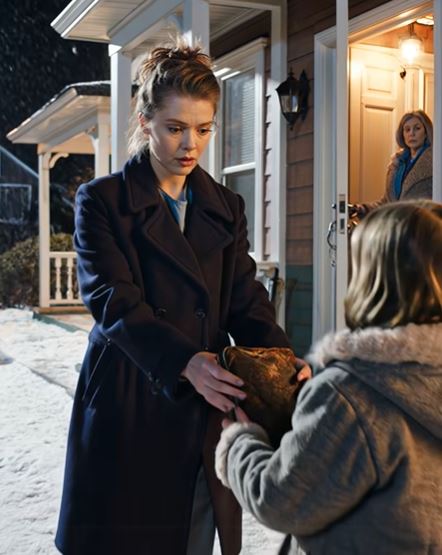
I opened it to find a little girl standing there, soaked from the sudden downpour, her dark hair plastered to her forehead. She clutched a small, worn book to her chest, her eyes wide and serious, carrying a weight far beyond her years.
“Hi,” she said softly. “I think this belongs to you.”
I took the book, confused. “Where did you get this?”
She shrugged. “It was my grandma’s. She told me it’s important. She said you should read it.”
The moment I flipped the cover, the air seemed to thicken. Inside were pages of letters, photographs, and scribbled notes—a chronicle of my life, as recorded not by strangers, but by someone who had been watching carefully, preserving truths my parents had tried to bury.
Every page revealed pieces of the story they had tried to distort: moments of courage I had quietly accomplished, kindnesses I had extended in secret, the very real person I had grown into while they had told everyone I was reckless, selfish, or incapable.
My heart pounded as I read. Each memory reconstructed, each photograph, each word chipped away at the narrative my parents had spun, a narrative designed to manipulate their friends, colleagues, and extended family.
For years, they had been telling stories about me, shaping perceptions to cast themselves as caring and generous while painting me as distant, flawed, or unworthy. The little girl, unknowingly perhaps, held the evidence that would unravel that illusion completely.
I looked up at her. “Do you know what this is?”
She nodded solemnly. “It’s the truth. My grandma said truth matters, even if people don’t always like it.”
In that moment, I realized that everything I had felt—the betrayal, the abandonment, the anger and sorrow—was no longer a solitary burden. The story my parents had been telling for years was about to be exposed.
Not with confrontation or rage, but with quiet proof: photographs, letters, moments captured faithfully and preserved against the distortions of time and pride.
As I closed the book that evening, I felt something shift. The anger remained, but it no longer had the power to define me. The shame, the sense of abandonment, the silent years of standing on the margins of my own family—all of it was still there, but now it coexisted with something far stronger: the certainty that the truth was mine to hold, to honor, and to share if I chose.