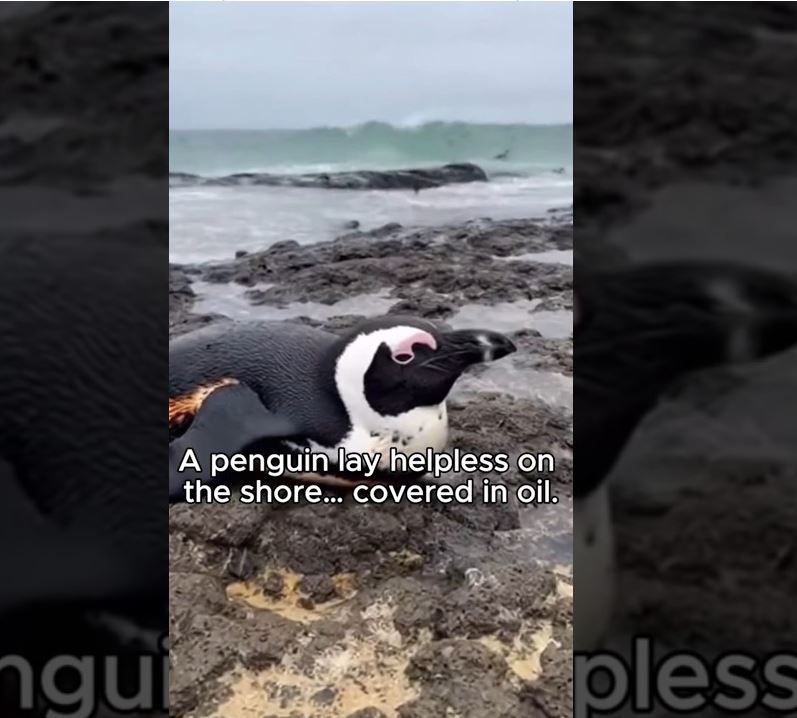
It all began on a frigid summer morning in Antarctica, where the wind bites with a relentless chill, and the ice stretches for miles in endless white sheets. The sun barely climbed above the horizon, casting pale light over the frozen landscape, yet even in such harsh conditions, life persisted—penguins waddling across the ice, seals sunbathing on distant floes, and skuas circling overhead.
I was part of a small research team stationed on the outskirts of the colony, studying penguin behavior and migration patterns. Most of the work was routine: counting nests, recording behaviors, monitoring chick survival rates.
But that morning, I encountered something extraordinary—a scene that would change my understanding of loyalty and gratitude in the animal world forever.
As I trudged across the snow, notebook in hand and camera slung over my shoulder, I noticed a lone penguin lying awkwardly in a shallow crevice. At first, I assumed it was simply resting, but something about its posture seemed wrong.
Its head drooped unnaturally, flippers splayed at odd angles, and a thin trail of blood marked the snow beneath it.
I knelt carefully beside the penguin, speaking softly to avoid startling it. It was a young gentoo, barely a year old, and it had clearly been injured—perhaps caught in a crack in the ice or struck by debris in the strong coastal winds.
Its breathing was labored, and its eyes, though bright, were filled with fear.
I knew immediate action was necessary. Gently, I wrapped the penguin in a thermal blanket I carried for emergencies, careful not to aggravate its injuries. The penguin squirmed, but I whispered reassurances, telling it, softly, “I’m here.
You’re safe now.” Somehow, it seemed to understand, its struggles gradually easing as it nestled against my chest for warmth.
I carried the penguin back to our base camp, where the team quickly prepared a makeshift enclosure with soft blankets, heated pads, and fresh fish. Over the next several days, I fed the young penguin carefully, monitoring its recovery and documenting the healing process. I named him Pippin, after the way he waddled with a curious, almost mischievous tilt to his head.
Weeks passed, and Pippin regained his strength. His limp disappeared, his feathers regained their glossy sheen, and his personality blossomed. Yet even as he became healthy, he displayed a behavior that astonished everyone: he never left my side.
Whether I walked to the research station, carried equipment, or even just sat down to eat, Pippin waddled alongside me, looking up with wide, trusting eyes.
One afternoon, I ventured down to the water’s edge to record feeding patterns among the colony. Pippin followed, but instead of joining the other penguins in the surf, he lingered near me, quacking softly as I waded into the shallow ice water.
He would nudge my leg, flap his flippers in excitement when I tossed small fish toward the group, but always returned immediately to my side.
The bond grew stronger with every passing day. Pippin recognized my voice instantly. When I called his name, he would sprint across the ice, sliding on his belly in a blur of black and white feathers. If another researcher approached, he often stayed rooted by me, as though saying, silently, “He saved me. He is mine to follow.”
Months later, when it was time for our team to leave the Antarctic for the season, I faced a difficult decision. Pippin was strong, healthy, and capable of returning to the wild, but the thought of leaving him behind, knowing he might wait for me and struggle without human help if necessary, weighed heavily on me.
The team prepared to release him near the colony’s core, where he would have the best chance of integrating back with his peers.
But Pippin had other plans. When the crate was opened, he didn’t waddle toward the other penguins. Instead, he hesitated, looking back at me with large, trusting eyes.
Then, in a moment that defied expectation, he leapt onto my boots, flippers wrapped around my ankles, as if insisting that I take him along. I froze, unsure what to do. Penguins are wild animals, and their survival instincts usually outweigh any attachment to humans.
The decision became obvious. I couldn’t ignore the bond, the loyalty that Pippin had shown, the life I had saved now choosing me in return.
We carried him gently back to the research station, and arrangements were made for him to travel with us, carefully monitored and accompanied by wildlife specialists to ensure his safety during transit.