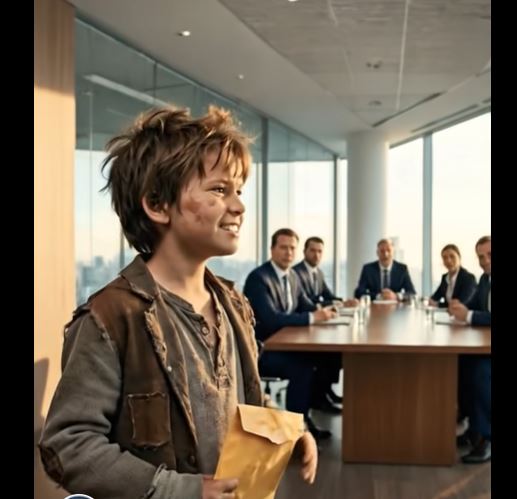
Aurelio Moncada’s laugh bounced against the glass walls of the boardroom as if the entire company was his private MRI box, amplifying every sound, every breath, every flicker of discomfort.
Six executives sat rigidly around the polished obsidian table, their reflections warped beneath the gleaming surface. At the far end, the CFO dabbed his trembling hand with a silk handkerchief, trying to mask the sheen of sweat gathering along his brow.
Outside, thirty floors below, the city moved with mechanical precision—cars threading through intersections, pedestrians swarming sidewalks, unaware that the fate of thousands of employees hung in the sterile air above them.
Aurelio leaned back in his chair, fingers steepled beneath his chin, eyes half-lidded with amusement.
“So,” he said, his voice smooth and deliberate, “you’re telling me the numbers are real.”
The CFO swallowed. “Yes, Mr. Moncada. The losses from the last quarter—combined with the acquisition—have created a… situation.”
“A situation,” Aurelio repeated, savoring the word like fine wine. His smile widened. “What a delicate way of saying we’re bleeding.”
No one spoke. The tension in the room thickened.
Aurelio rose slowly from his chair and walked toward the glass wall overlooking the city. His reflection merged with the skyline, a silhouette of power against steel and sky. For years, he had built Moncada Global into an empire—ruthless decisions, relentless expansion, and a reputation for crushing competition without hesitation.
Failure was not a language he spoke.
“Tell me,” he continued softly, still facing the city, “what would you have me do?”
The COO cleared his throat. “We recommend restructuring. Immediate layoffs. Division closures. A temporary freeze on operations in three regions.”
“And how many lives would that dismantle?” Aurelio asked, turning.
The COO hesitated. “Roughly eight thousand employees, sir.”
Aurelio’s eyes glittered—not with cruelty, but with something far more unsettling: curiosity.
“Eight thousand,” he repeated. “Fascinating.”
He returned to the table and rested his palms on its surface, leaning toward them. “And you believe survival requires sacrifice.”
“It’s the only logical solution,” the CFO said, voice barely steady.
Silence fell again.
Then Aurelio laughed.
It wasn’t loud, but it carried an unsettling resonance, like a sound echoing through hollow chambers.
“Logic,” he murmured. “You all worship logic as if it were divine.”
He pressed a button on the table. The glass wall behind him darkened instantly, sealing the room from the outside world. The executives exchanged uneasy glances.
Aurelio’s voice softened.
“I invited you here not to hear what you believe must be done,” he said, “but to discover what none of you considered.”
The door opened quietly.
A small boy stepped into the room.
He couldn’t have been older than ten. His clothes were simple, his posture uncertain, his wide eyes absorbing the sterile luxury around him. A security guard lingered outside, then shut the door, leaving the child alone among the most powerful people in the company.
Shock rippled across the table.
“Mr. Moncada,” the CFO whispered, “who is—”
“My son,” Aurelio said simply.
The word hung in the air.
Few even knew Aurelio had a child. His personal life was a fortress of secrecy, carefully sealed away from public view.
The boy approached slowly, clutching a small notebook to his chest. He looked at the executives, then at his father.
“You told me to come when the meeting started,” the boy said quietly.
Aurelio nodded. “Tell them what you told me this morning.”
The child hesitated, glancing at the intimidating faces surrounding him. Then he opened his notebook.
“You said the company was losing money,” he began, voice trembling slightly. “And that people might lose their jobs.”
The executives shifted uncomfortably.
“So I thought about it,” the boy continued. “And I wondered… if the company is like a body, and the workers are like cells, why would you cut off a part of the body instead of healing it?”
Aurelio watched silently.
The boy flipped a page. “I read that when the body is sick, sometimes the problem isn’t the cells—it’s the system around them. Maybe the company isn’t losing money because of the workers. Maybe something else is wrong.”
The CFO stiffened.
The boy’s voice grew steadier. “So I looked at the reports you left in your office. I didn’t understand everything, but I saw that the biggest losses were from one department buying things from another company at very high prices.”
The room went still.
The COO’s face drained of color.
“And that company,” the boy said innocently, “is owned by someone connected to the people sitting here.”