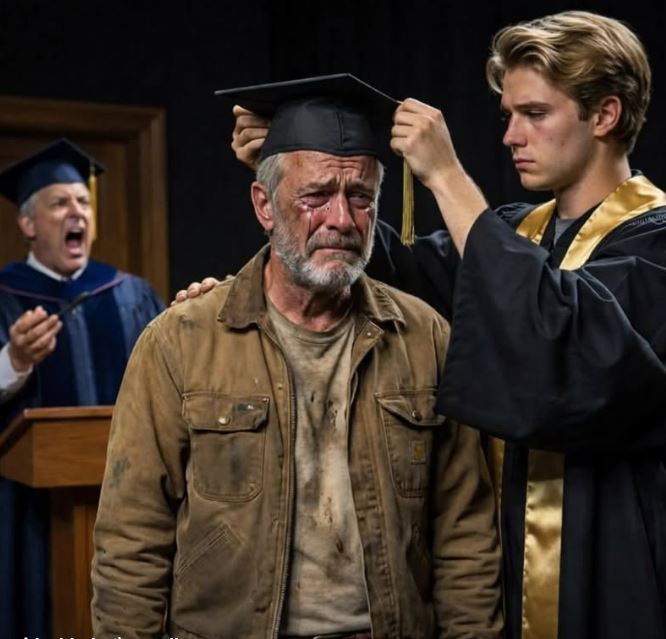
For twenty-five years, my stepfather woke up before sunrise, his body already aching from the day before. While the city still slept, he would quietly drink his bitter coffee, lace up his worn boots, and leave for construction sites where the air smelled of dust, sweat, and wet cement.
His hands were permanently rough, his back slightly bent, and his clothes always carried the gray marks of hard labor.
He did all of it for one reason — my education.
“I’m only a worker,” he would often say, handing me a small envelope filled with crumpled bills and coins he had saved. “But knowledge imposes respect. No one can take that from you.”
His name was Hector Alvarez, though to most people he was simply “the cement man,” a quiet laborer who mixed concrete, carried heavy loads, and rarely spoke more than necessary. To me, he was the foundation of everything I would ever become.
My biological father had left when I was still a child, and Hector entered our lives shortly afterward. He never tried to replace anyone, never demanded affection or gratitude. Instead, he showed love through sacrifice — working double shifts, skipping meals, and wearing the same jacket year after year so I could afford books, tuition, and school supplies.
When I received my acceptance letter to the university, I saw him cry for the first time. He held the paper in trembling hands, his eyes shining with pride.
“You will go further than I ever could,” he whispered.
The years that followed were not easy. While my classmates enjoyed comfortable lives, I studied knowing every page I read had been paid for by my stepfather’s physical pain. When I felt exhausted, I would picture him under the scorching sun, lifting bags of cement twice his weight. That image pushed me forward.
Eventually, after years of sacrifice — his and mine — I earned my doctorate.
The day of my graduation arrived on a bright spring morning. The university auditorium was filled with elegant families, professors in ceremonial robes, and distinguished guests. Proud parents sat in the front rows, dressed in fine suits and dresses, holding bouquets of flowers and expensive cameras.
Hector insisted on sitting in the back.
He wore a cheap suit he had borrowed from a neighbor, the sleeves slightly too short, the fabric stiff and outdated. His shoes were carefully polished but cracked with age. He kept his head lowered, trying not to attract attention, as if he believed he did not belong among scholars and intellectuals.
I noticed him immediately when I entered the hall. Even surrounded by hundreds of people, I could recognize the familiar curve of his shoulders, the quiet dignity in his posture. My heart tightened with emotion.
The ceremony proceeded with formal speeches about excellence, perseverance, and the pursuit of knowledge. Finally, the moment arrived for graduates to be recognized individually. My name was called, and I walked toward the stage, my heart pounding.
As I accepted my diploma, the audience applauded politely. But my eyes searched only for one person in the crowd. From the back row, Hector stood slowly and clapped with all his strength, pride shining in his tear-filled eyes.
Then something unexpected happened.
The university rector, an elderly and highly respected academic, had been scanning the audience when his gaze suddenly froze. His expression changed from calm authority to complete shock. He stepped away from the podium, staring intensely toward the back of the hall.
The room grew quiet.
The rector descended from the stage, walking slowly down the aisle, his eyes never leaving Hector. Murmurs spread among the guests as the distinguished man approached the humble worker in the worn suit.
When he reached him, the rector’s voice trembled.
“Hector Alvarez?” he asked, barely above a whisper.
Hector looked confused, rising hesitantly. “Yes… that’s my name.”
The rector staggered back slightly, visibly shaken. “Are you… the Hector Alvarez? The legend who disappeared?”
A wave of confusion swept through the audience. Professors exchanged bewildered glances. Students leaned forward, whispering among themselves.
Hector lowered his eyes. “I was once a teacher,” he said quietly.
The rector suddenly bowed deeply before him.
Gasps echoed throughout the hall.
“You are the man who revolutionized modern structural engineering,” the rector announced, his voice filled with reverence. “Your theories on reinforced composite materials changed the way we build today. You were considered one of the greatest minds of your generation… and then you vanished without explanation.”
The entire auditorium fell into stunned silence.
I stood frozen on the stage, unable to comprehend what I was hearing. The man who had spent decades mixing cement, who had sacrificed everything for my education, had once been a brilliant academic?