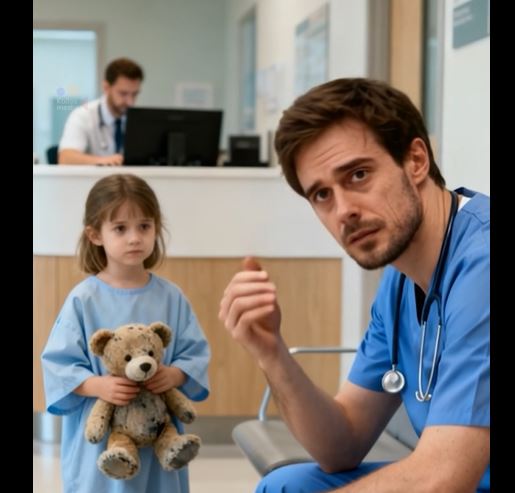
She sat on the edge of the examination table, her small legs swinging gently back and forth while her mother spoke quietly with the receptionist near the door. The clinic smelled of antiseptic and warm plastic, a scent Lily had come to associate with both fear and comfort.

Hospitals had been part of her life for as long as she could remember — endless tests, injections, and long nights beneath bright white lights.
But one thing always puzzled her.
Her mother never paid.
Lily had watched other families hand over cards, count money, or whisper anxiously about costs. She had seen worry in their faces, tension in their voices. Yet every time her mother approached the desk, the staff would smile gently and shake their heads.
“It’s already taken care of,” they would say.
Always the same words.
Always the same quiet mystery.
That afternoon, as they walked home through the busy streets, Lily finally asked.
“Mom,” she said softly, holding her mother’s hand, “why don’t we have to pay like everyone else?”
Her mother’s grip tightened slightly. For a moment, she seemed unsure how to respond.
“Some people just want to help,” she answered carefully.
Lily accepted the explanation at the time, but the question never truly left her mind.
Lily suffered from a rare chronic condition that required constant monitoring. Her childhood was filled with doctor visits, medications, and procedures that most children could not imagine. Yet despite the difficulty, she carried an unusual gentleness — always thanking nurses, always smiling even when she was afraid.
The hospital staff adored her.
She would bring drawings for the receptionists, fold paper cranes for the patients in the waiting room, and whisper encouragement to other children undergoing treatment. Her kindness seemed too large for someone so small.
And every time, her bills were quietly erased.
No explanations. No discussions. Just a discreet note in her file and a soft reassurance: covered.
As Lily grew older, her curiosity grew with her.
At ten, she began to notice the worried conversations her mother had late at night. She overheard words like rent, medication, and expenses. She saw the exhaustion in her mother’s eyes after working double shifts at a small bakery.
They were not wealthy.
They were barely surviving.
So why did the hospital never charge them?
The question lingered like a shadow.
Dr. Harris had treated Lily since her first diagnosis. He was a quiet man with silver-streaked hair and tired eyes that carried the weight of years in medicine. To most patients, he appeared reserved, professional, distant.
But with Lily, something in him softened.
He always made extra time for her appointments. He explained procedures carefully, never rushed her questions, and listened when she spoke about school, her drawings, or her dreams of becoming a teacher.
Yet there was also something else in his gaze — something deeper, heavier, like a silent memory he carried alone.
One afternoon, when Lily was twelve, she gathered the courage to ask him directly.
“Doctor,” she said gently, “why are my hospital bills always free?”
Dr. Harris froze.
The pen in his hand stopped moving. For a long moment, he simply stared at her, as if the question had reached a place in his heart he had carefully kept locked.
“That’s… not something you need to worry about,” he replied quietly.
But Lily noticed the sudden tremor in his voice.
And she noticed the tears he quickly turned away to hide.
Years passed.
Lily’s condition improved slowly but never disappeared. She became a familiar presence in the hospital halls — no longer a child, but a thoughtful teenager with quiet strength and endless compassion.
On her seventeenth birthday, she received a letter from the hospital administration requesting a meeting. Confused and slightly nervous, she arrived with her mother at Dr. Harris’s office.
The room felt different that day — heavy with unspoken emotion.
Dr. Harris stood by the window, his hands clasped tightly behind his back. When he turned, his eyes were already wet.
“There’s something you deserve to know,” he said.
He gestured for them to sit, then took a deep, trembling breath.
“Many years ago,” he began, “before you were born, I had a daughter.”
The room fell silent.
“She was seven years old,” he continued, his voice unsteady. “Bright, kind, and endlessly brave. But she was also very sick.”
Lily felt her chest tighten.
“She had the same condition you have,” he said softly.
Her mother gasped quietly beside her.
Dr. Harris continued, struggling to maintain composure. “At that time, I was a young doctor working long hours. I believed I could balance everything — my career, my family, my responsibilities. But I was wrong.”